CLAT 2026 AIR 2 Parv Jain: Preparation Strategy & Journey
Share this article:

CLAT 2026 Topper AIR 2 Parv Jain: How He Prepared, What He Did Differently, and How NLTI Supported His Journey
When the CLAT 2026 results were declared, Parv Jain securing AIR 2 with 111.75 marks stood out not only because of the rank, but because of how that rank was achieved in one of the most structurally unpredictable CLAT papers in recent years.
CLAT 2026 disrupted established preparation assumptions. Logical Reasoning became fully analytical, static GK appeared directly, Legal Reasoning tested constitutional facts, Quant caused early time pressure, and one LR question was withdrawn. In this environment, preparation quality mattered more than syllabus coverage.
Parv Jain was part of NLTI’s Super 30 mentorship program, and his preparation reflects a clear, methodical strategy rather than ad-hoc studying.
This blog breaks down what Parv actually did, section by section, and how NLTI’s mentorship, mocks, and study systems supported those decisions.
Best CLAT Coaching Online 2026–2027 by NLTI
Parv Jain’s Core Preparation Philosophy
Parv’s preparation was built around three principles:
1. Accuracy over attempts
2. Decision-making under time pressure
3. Preparation for uncertainty, not past patterns
Instead of chasing mock scores, his focus remained on:
Why questions were wrong
Where time leaked
Which sections needed restraint rather than aggression
This approach aligned closely with NLTI’s Super 30 structure, where evaluation prioritises error patterns and decision logic, not raw marks.
CLAT 2026 NLU Predictor & All India Rank Predictor
Logical Reasoning: Training for Analytical, Not Critical
CLAT 2026 removed Critical Reasoning entirely and shifted Logical to pure Analytical Reasoning. Many students were unprepared. Parv was not.
What Parv Did
Practised multi-condition analytical sets regularly
Focused on deduction clarity rather than speed chasing
Learned to abandon stuck puzzles early
How NLTI Supported This
NLTI Super 30 mocks already had analytical-heavy Logical sections
Mentors drilled skip-or-commit decisions during mock reviews
Analytical reasoning was treated as a primary skill, not a side topic
As a result, Parv did not panic when Logical turned fully analytical on exam day.
GK & Current Affairs: Static + Contextual Balance
CLAT 2026 GK was largely off-passage and static, a major deviation.
What Parv Did
Revised static GK alongside current affairs
Focused on institutional, treaty, and international basics
Avoided passage-only GK dependence
How NLTI Supported This
NLTI’s GK system integrates static + current from the start
Monthly consolidation ensured recall-based questions were covered
GK mistakes were categorised (static gap vs awareness gap) during analysis
This ensured Parv did not lose marks when GK questions demanded direct recall.
Read More: Top CLAT Coaching Packages for Every Budget
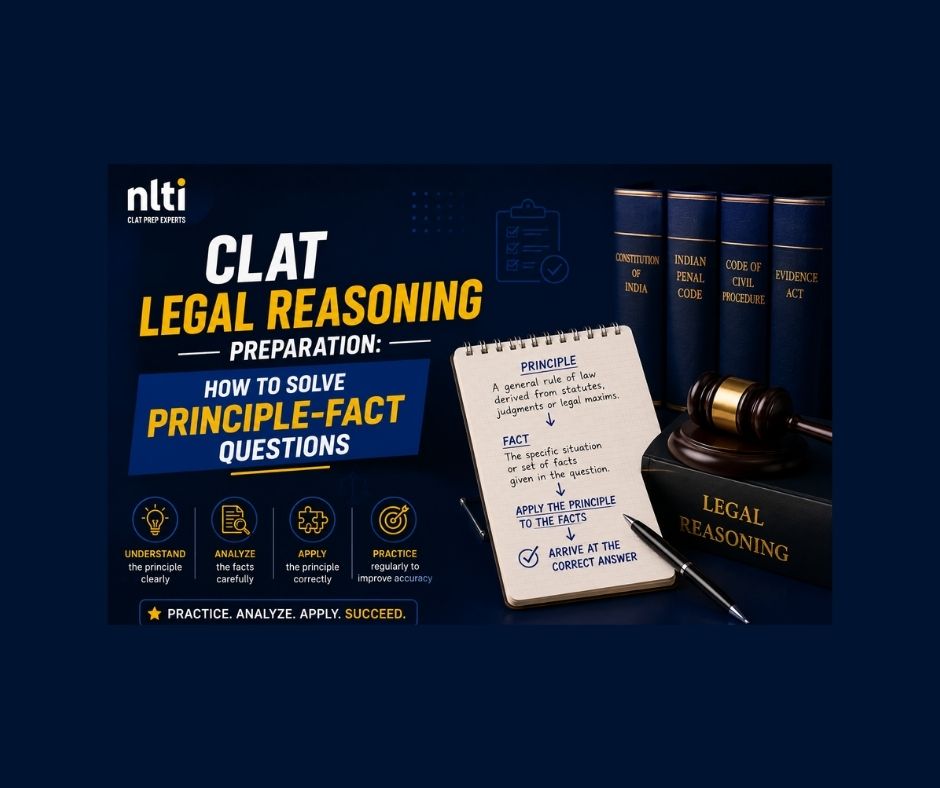
Legal Reasoning: Beyond Principle–Fact
Legal Reasoning in CLAT 2026 mixed:
Constitutional facts
Institutional roles
Governance-related static knowledge
What Parv Did
Revised constitutional basics alongside legal principles
Focused on application + factual awareness
Avoided over-assuming principle-only questions
How NLTI Supported This
Legal prep included constitutional frameworks, not just hypotheticals
Mentors flagged “static intrusion” risks in Legal sections
Mock discussions trained students to slow down when Legal felt unfamiliar
This prevented confusion when Legal deviated from standard patterns.
Read More: CLAT 2026 Cutoff: What to Expect vs Last Year
Quantitative Techniques: Time Discipline Over Solving Everything
Quant in CLAT 2026 was easy conceptually but time-heavy at the start.
What Parv Did
Used estimation wherever possible
Left time-consuming sets early
Protected time for later sections
How NLTI Supported This
Timed mocks simulated early-section time shocks
Mentors reinforced that QT is a time management test, not a math test
Post-mock reviews focused on time damage, not accuracy alone
Parv avoided the common mistake of letting Quant disrupt the rest of the paper.
Read More: CLAT 2026 Section-Wise Strategy for All Subjects
English: Stability, Not Aggression
English was traditional and scoring.
What Parv Did
Read calmly
Avoided overthinking
Treated English as a stabilising section
How NLTI Supported This
No unnecessary complexity added to English prep
Emphasis on consistency and accuracy
English used as a confidence anchor during mocks
Role of NLTI Super 30 in Parv Jain’s Journey
Parv’s preparation was not isolated. NLTI supported him through:
Weekly mentor-led mock analysis
Decision-focused feedback, not just score discussion
Study buddy accountability
Exam-day strategy sessions
Structured error tracking
This ecosystem ensured Parv was trained not just to solve questions, but to make correct choices under pressure.
Read More: Top CLAT Coaching Packages for Every Budget
Final Takeaway
Parv Jain’s AIR 2 in CLAT 2026 was built on analytical Logical dominance, static GK readiness, and strict accuracy control in a paper where pattern disruption decided ranks. His performance stood out because he lost minimal marks despite a withdrawn question and time-shifting sections.
With CLAT clearly moving toward analytical reasoning, static-heavy GK, and decision-based scoring, NLTI’s 2027 preparation is already structured around these exact stress points through analytical mocks, static–current GK integration, and mentorship focused on exam-day decision quality rather than pattern memorisation.
FAQ
1. Who secured AIR 2 in CLAT 2026?
Parv Jain secured All India Rank 2 in CLAT 2026 with 111.75 marks, placing him among the highest scorers in a highly unpredictable paper.
2. Which coaching institute did Parv Jain study from for CLAT 2026?
Parv Jain was a Super 30 student at NLTI, where he trained through analytical-heavy mocks, static GK integration, and mentorship-led preparation.
3. Why was CLAT 2026 considered unpredictable?
CLAT 2026 saw major pattern shifts including pure analytical Logical Reasoning, static GK outside passages, and mixed legal-static questions, disrupting conventional preparation models.
4. How did Parv Jain handle the analytical Logical Reasoning section?
He relied on structured analytical reasoning practice, focusing on deduction-based accuracy rather than speed-driven attempts.
5. What role did mentorship play in Parv Jain’s CLAT 2026 rank?
Mentorship helped him control accuracy under surprise, manage time shocks, and avoid panic during structurally unfamiliar sections.
6. What preparation approach is suitable for CLAT 2027 aspirants?
CLAT 2027 aspirants should prepare for both analytical and critical reasoning, strengthen static GK, and practice decision-based mock strategies.
Get In Touch
Have questions? We'd love to hear from you. Send us a message and we'll respond as soon as possible.