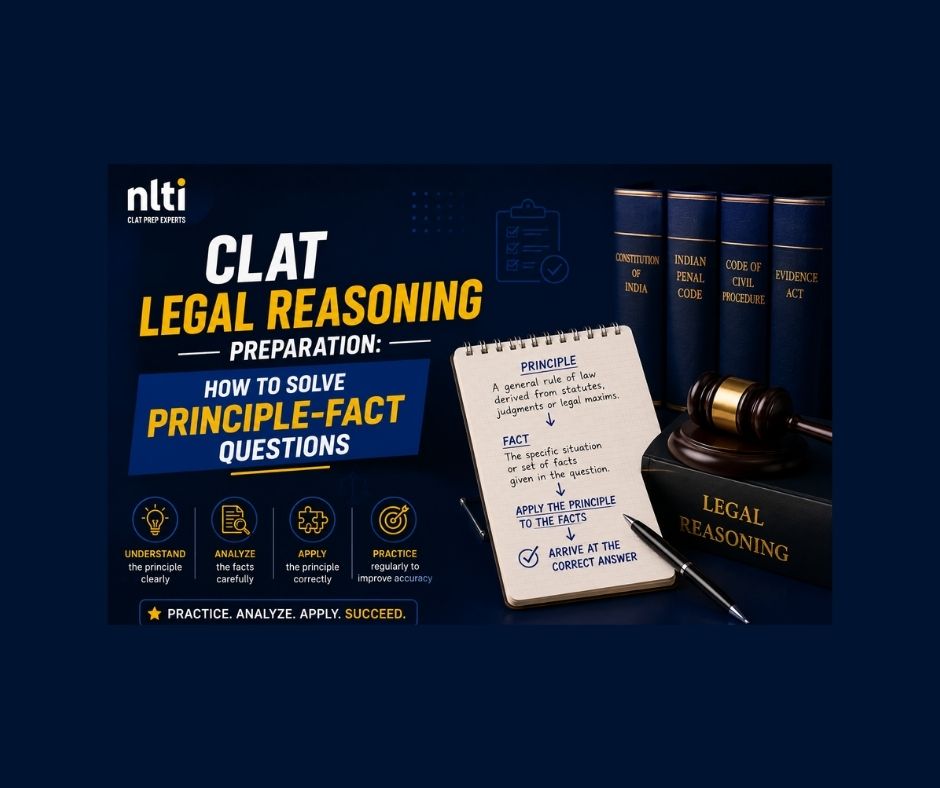
Legal Reasoning Strategy for CLAT 2027 Preparation
Share this article:

The CLAT legal section is no longer a test of whether you “know law.” It is a test of how accurately you can apply a given rule to unfamiliar facts under pressure. Over the last few years, and especially after CLAT 2026, legal reasoning for CLAT has moved decisively away from textbook-style preparation. Aspirants who relied on memorising IPC sections or constitutional articles found themselves struggling, while those who focused on structured thinking performed better.
Legal reasoning for CLAT now rewards precision, neutrality, and discipline of thought. The CLAT legal section does not test your opinions, moral instincts, or prior legal exposure. It tests whether you can think like the examiner wants you to think. CLAT 2026 made this shift explicit by blending factual awareness with application-based reasoning, forcing aspirants to re-evaluate their approach.
This blog breaks down a clear, practical CLAT legal reasoning strategy for CLAT 2027 aspirants, focusing on how to think, not what to memorise.
Best CLAT Coaching Online 2026–2027 by NLTI
Understanding the Role of Legal Reasoning in CLAT
The CLAT legal section consistently carries the highest weightage in the paper. This means that performance here has a disproportionate impact on overall rank movement.
Key realities of the CLAT legal section:
A strong legal score can compensate for weaker performance elsewhere.
Errors in legal reasoning are usually systematic, not accidental.
Negative marking in legal hurts more because passages are long and time-consuming.
Legal reasoning for CLAT is the most “thinking-heavy” section because:
Every question depends on understanding the same principle correctly.
One misinterpretation can lead to multiple wrong answers.
Options are designed to feel legally reasonable, even when they are logically incorrect.
Because of this structure, accuracy in legal reasoning for CLAT often separates top ranks from average ones.
Read More: Top CLAT Coaching Packages for Every Budget
How the CLAT Legal Section Has Evolved After CLAT 2026
CLAT 2026 marked a clear evolution in the CLAT legal section. The changes were subtle but significant.
Key shifts observed:
Mixing of static legal facts with principles
Some questions required awareness of constitutional bodies or institutional roles alongside application.
Reduced predictability of pure principle–fact patterns
Not all passages followed the clean, traditional structure students were used to.
Increased testing of constitutional awareness
Without requiring memorisation, the paper expected familiarity with legal frameworks.
Greater emphasis on careful reading over speed
Rushing through principles led to misapplication.
These changes directly inform the CLAT 2027 legal strategy. Legal reasoning for CLAT can no longer be treated as a mechanical exercise. It requires adaptability without abandoning structure.
Read More: CLAT 2026: Scoring, Negative Marking, Cutoffs & Tie-Breakers
Anatomy of a Legal Reasoning Question in CLAT
To master legal reasoning for CLAT, you must understand how a question is built.
What a principle really is
A principle is a self-contained rule for the passage.
It may be simplified, incomplete, or artificially framed.
It must be treated as absolute truth for that passage.
How facts are designed to mislead
Facts often contain emotionally charged or morally confusing details.
Some facts are irrelevant but feel important.
Timelines and exceptions are subtly embedded.
Why options look legally “correct” but logically wrong
Options often restate parts of the principle without applying them.
Some options apply the principle but ignore a key fact.
Others rely on real-world law, not the given rule.
This structure is why principle fact questions CLAT aspirants struggle with are rarely “tricky” but often misread.
Read More: CLAT 2026 Section-Wse Strategy for All Subjects
The Correct Thinking Process for Legal Reasoning for CLAT
A reliable CLAT legal reasoning strategy depends on discipline, not intuition.
Step 1: Read the principle neutrally
Do not judge whether the rule is fair or realistic.
Accept it exactly as written.
Step 2: Do not import outside legal knowledge
Your knowledge of IPC, Constitution, or case law is irrelevant.
Even if the principle contradicts real law, follow it.
Step 3: Apply the principle strictly to the facts
Match each condition in the principle to the facts.
Check whether all requirements are satisfied.
Step 4: Eliminate options that stretch logic
Eliminate options that assume facts not stated.
Eliminate options that ignore exceptions.
This disciplined process is the core of effective legal reasoning for CLAT.
Read More: CLAT 2026 Cutoff: What to Expect vs Last Year
Common Traps in the CLAT Legal Section
Even well-prepared students lose marks due to predictable errors.
Common traps include:
Overusing prior legal knowledge
This leads to rejecting correct options that don’t match real law.
Moral reasoning instead of legal logic
CLAT does not reward fairness-based thinking.
Ignoring exceptions in principles
Many principles contain hidden limitations.
Assuming facts not stated
If it’s not in the passage, it doesn’t exist.
Each of these traps directly reduces legal reasoning for CLAT accuracy, often across multiple questions in the same passage.
Read More: CLAT 2026 NLU Predictor & All India Rank Predictor
How to Prepare Legal Reasoning Without Memorising Law
A major misconception is that legal reasoning for CLAT requires memorising law.
Why bare acts are not required
CLAT does not test section numbers.
Passages contain all required rules.
What kind of legal awareness actually helps
Understanding how legal language is structured.
Familiarity with terms like “liability,” “authority,” “exception.”
Awareness of constitutional institutions at a basic level.
Balancing static concepts with application
Static awareness should support comprehension, not replace reasoning.
Application always takes priority.
This approach leads to smarter CLAT legal preparation, not heavier preparation.
Read More: CLAT 2026 Success Stories: Top Rankers’ Preparation
Practice Strategy for CLAT Legal Reasoning
Practice without structure is wasted effort.
An effective CLAT legal reasoning practice approach includes:
Practising limited passages daily, not bulk sets.
Writing down why an option was wrong, not just which one.
Categorising errors into:
Misread principle
Missed exception
Fact misinterpretation
Logical stretch
Quality of review matters more than quantity of questions.
Time Management in the CLAT Legal Section
Legal passages feel time-consuming because they demand sustained attention.
Key time strategies:
Do not spend more than a fixed time on one passage.
If a principle feels unclear, skip and return later.
Avoid re-reading the entire passage for every question.
A stable CLAT legal reasoning strategy balances speed with clarity, not aggression.
What Not to Do in Legal Reasoning for CLAT 2027
Avoid these mistakes completely:
Memorising IPC or constitutional articles.
Relying on “gut feeling.”
Reading explanations passively.
Practising without reviewing mistakes.
These habits give a false sense of preparation and collapse under exam pressure.
How Legal Reasoning Is Trained for CLAT 2027
In structured preparation environments like NLTI, legal reasoning is trained through principle-application focused drills rather than content-heavy law teaching. Students are exposed to mixed static and application-based legal questions early, reflecting the post-CLAT 2026 direction. Mentor-led discussions focus on identifying logical errors instead of simply checking answers. Legal mocks emphasise decision-making, when to trust application and when to reassess assumptions. This factual, process-driven approach mirrors how legal reasoning for CLAT is actually evaluated.
Final Word
Legal reasoning rewards discipline, neutrality, and consistency, not legal knowledge. The CLAT legal section has evolved to test how precisely you apply rules under uncertainty. A strong legal reasoning for CLAT approach stabilises ranks even when patterns shift. For CLAT 2027, success will belong to those who train their thinking, not their memory.
FAQs
1. Is legal reasoning the most important section in CLAT?
Yes. The CLAT legal section carries high weightage and strongly influences rank.
2. Do I need to study law subjects for legal reasoning for CLAT?
No. Application skill matters more than legal knowledge.
3. How many legal questions should I practice daily?
Quality matters more than quantity. A few passages with deep analysis are enough.
4. Can legal reasoning be mastered without coaching?
Yes, with disciplined practice and structured error analysis.
5. What is the biggest mistake in principle fact questions CLAT aspirants make?
Importing outside legal knowledge.
6. Should I read bare acts for CLAT legal preparation?
No. They are unnecessary for the exam.
7. How has CLAT 2026 affected CLAT 2027 legal strategy?
It increased emphasis on adaptability, reading precision, and mixed factual awareness.
Get In Touch
Have questions? We'd love to hear from you. Send us a message and we'll respond as soon as possible.