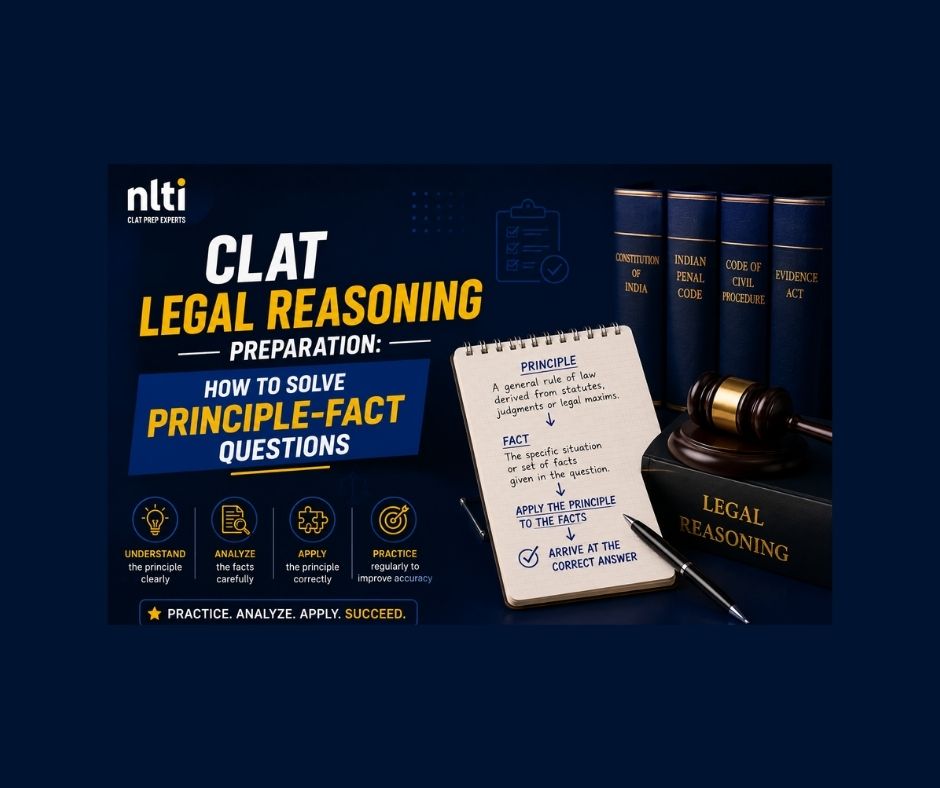
CLAT 2027 Legal Reasoning: New Pattern Strategy
Share this article:

Introduction
For years, students have misunderstood the CLAT legal section as a “law knowledge” test. Many believe that memorising IPC sections, constitutional articles, or legal definitions will help them score here. CLAT 2026 proved this assumption wrong.
The CLAT legal section is not about knowing law. It is about applying logic under pressure.
In CLAT 2026, legal reasoning passages became more analytical, mixed static and contemporary legal ideas, and contained trickier option sets designed to punish careless reading. Students who relied on rote learning struggled. Students who applied controlled reasoning succeeded.
This shift makes CLAT legal reasoning 2027 fundamentally different from older versions of the exam. Today, CLAT legal aptitude is about disciplined thinking, not legal memory.
Best CLAT Coaching Online 2026–2027 by NLTI
What Is Legal Reasoning in CLAT (Not Law)
CLAT legal reasoning is not a test of law. It is a test of reasoning using legal-sounding content.
Many students ruin their scores by assuming they must already “know law.” That assumption leads to the wrong preparation approach.
Here is what legal reasoning in CLAT actually is:
• A reading-based reasoning test
• A logic application exercise
• A discipline-of-thinking test
• A pattern-matching challenge
And here is what it is not:
• It is not a law school exam
• It is not about memorising acts
• It is not about prior legal knowledge
• It is not about real-world justice
This distinction is crucial.
In CLAT legal reasoning 2027, the examiners will give you all the legal rules you need inside the passage itself. Your job is not to recall law. Your job is to apply the given rule accurately.
This is why outside legal knowledge often hurts performance. Students try to “correct” the principle using what they think is the real law. That leads to wrong answers.
CLAT legal aptitude is about obedience to the given logic, not real-world correctness.
How the CLAT Legal Section Changed After 2026
CLAT 2026 marked a visible shift in how the legal section behaves.
Earlier, the section was more formulaic. Principles were simple. Facts were direct. Options were easier to eliminate.
That is no longer true.
The current CLAT legal reasoning pattern reflects:
• Increased analytical depth
• Longer, denser principles
• Mixed static + current legal ideas
• Less predictable question framing
• Trickier elimination logic
• More reasoning steps per question
Students now need to process more information before answering.
The legal section has become less about spotting obvious matches and more about carefully applying layered conditions.
In CLAT legal reasoning 2027, expect:
• Fewer obvious answers
• More subtle traps
• Options that look “legally correct” but are logically wrong
• Higher penalty for rushing
This shift means preparation methods must change too.
Read More: How Online CLAT Courses Transform Exam Preparation
Anatomy of a CLAT Legal Reasoning Question
Every CLAT legal question has four parts. Most students only notice two.
Let’s break them down properly.
1. The Principle
The principle is the rule the examiner wants you to use.
It may describe:
• A legal doctrine
• A hypothetical law
• A constitutional idea
• A moral-legal framework
Important: This principle may not reflect real law. That does not matter.
In principle fact questions CLAT, the principle is your only law.
You must:
• Read it slowly
• Understand every condition
• Identify exceptions
• Note keywords
Most mistakes happen because students skim the principle.
2. The Facts
The facts describe a situation that must be tested against the principle.
Facts often include:
• Names
• Actions
• Conditions
• Timelines
• Motives
Facts are designed to mislead.
They often contain:
• Emotionally charged content
• Irrelevant details
• Missing information
Students who assume facts that are not written usually fail.
3. The Options
Options are not random.
They are engineered to:
• Look legally sensible
• Trigger moral bias
• Reword parts of the principle
• Introduce small distortions
Many options will sound correct.
Only one will be logically correct.
4. The Traps
Traps are deliberate.
Common trap types:
• Over-generalisation
• Ignoring an exception
• Importing outside knowledge
• Moral reasoning
• Half-application
Understanding traps is central to mastering CLAT legal aptitude
Read More: How Online CLAT Courses Transform Exam Preparation
Why Most Students Fail Legal Reasoning
Legal reasoning looks easy. That is why it destroys scores.
Here are the most common failure points:
• Importing real-world law
• Using moral logic instead of legal logic
• Skimming the principle
• Assuming facts
• Rushing through options
• Overconfidence
Many students believe legal reasoning is “common sense.” It is not.
CLAT legal questions reward controlled thinking, not intuition.
This is why legal reasoning for CLAT punishes impulsive readers.
The examiners want you to:
• Obey the principle
• Ignore your opinions
• Apply logic mechanically
• Eliminate strictly
This discipline is hard. That is why this section separates ranks.
What CLAT Legal Reasoning Actually Tests
The CLAT legal section does not test law.
It tests five core abilities:
• Application skill
• Logical discipline
• Reading accuracy
• Option elimination logic
• Decision-making under uncertainty
This is why CLAT legal aptitude is one of the most misunderstood sections.
Students who memorise legal facts feel confident but perform poorly.
Students who practise disciplined reasoning perform better even without knowing any law.
In CLAT legal reasoning 2027, these five abilities will matter more than ever.
New Pattern Strategy for CLAT Legal Reasoning 2027
This is the most important part of this blog.
If you try to prepare legal reasoning like a knowledge subject, you will fail.
Here is how the new pattern must be approached.
Step 1: Read the Principle Like a Contract
Treat the principle as a binding contract.
Read it:
• Word by word
• Without assumptions
• Without emotions
• Without real-world logic
Underline:
• Conditions
• Exceptions
• Limitations
• Definitions
This step alone improves accuracy dramatically.
Step 2: Neutralise Your Bias
Before reading the facts, remind yourself:
“I do not care what I think is right. I only care what the principle allows.”
This mental reset is crucial.
Students who skip this step often answer emotionally.
Step 3: Apply the Principle Mechanically
Do not reason like a human.
Reason like a machine.
Match each fact with each condition.
Check every clause.
Look for violations.
Do not guess.
Step 4: Eliminate Before You Select
Never jump to the first good-looking option.
In CLAT legal reasoning 2027, traps are common.
Eliminate:
• Overstated options
• Options that add facts
• Options that ignore exceptions
• Options that soften or exaggerate
Only then select.
Step 5: Learn When to Skip
Some passages are time sinks.
If:
• Principle is too long
• Facts are confusing
• Options are dense
Mark it and move on.
Read More: Online vs Offline CLAT 2026 Coaching: Which Is Better?
Static Legal Knowledge: How Much Is Needed?
One of the most confusing areas for aspirants is static legal knowledge.
Students often ask: Should I study IPC? Do I need to memorise constitutional articles? Is bare act knowledge necessary?
The honest answer: very little static law is needed for CLAT.
In the CLAT context, “static” does not mean memorising sections. It means understanding:
• Basic legal concepts (rights, duties, liability, negligence, etc.)
• Broad constitutional ideas (equality, freedom, federalism, etc.)
• Institutional roles (courts, parliament, executive, etc.)
This knowledge helps only in understanding passages faster. It does not replace reasoning.
In CLAT legal reasoning 2027, static knowledge may appear:
• As background context in passages
• As framing for principles
• As real-world anchors
But the exam will still give you the rule to apply.
If you spend months memorising bare acts, you are wasting time.
Your goal is not legal memory. Your goal is logical application.
This is what the CLAT legal syllabus actually demands.
Legal Reasoning vs Legal Knowledge (Critical Difference)
This distinction decides ranks.
Legal knowledge is about knowing law. Legal reasoning is about applying a given rule.
CLAT tests the second.
Students with strong legal knowledge often perform worse because:
• They argue with the principle
• They override the passage
• They apply real law
• They “correct” the question
CLAT punishes this behaviour.
In the CLAT law section, you must suspend reality.
The only law that matters is the one written in the passage.
This is why over-smartness fails here.
CLAT does not reward brilliance. It rewards obedience to logic.
Read More: CLAT 2026 Guide: Exam Structure, Syllabus & Eligibility
How to Practise Legal Reasoning the Right Way
Most students practise legal reasoning incorrectly.
They:
• Solve many questions
• Check answers
• Move on
This builds speed, not accuracy.
Correct practice involves:
1. Passage-Based Drills
Never practise single questions in isolation.
CLAT always tests legal reasoning in passages.
Train your brain to:
• Maintain context
• Track principles
• Handle multiple facts
2. Error-Based Revision
After each practice set, classify mistakes:
• Misread principle
• Misread facts
• Logic mismatch
• Trap fall
This is more valuable than solving more questions.
3. Pattern Tracking
Maintain a notebook of:
• Common traps
• Repeated mistake types
• Time sinks
This is how legal reasoning for CLAT improves sustainably.
4. Timed Solving
Legal reasoning feels slow.
But rushing kills accuracy.
Train in:
• Controlled speed
• Calm reading
• Steady elimination
This builds exam temperament.
Section-Wise Time Management for Legal Reasoning
Legal reasoning often feels time-consuming.
This happens because:
• Principles are long
• Facts are layered
• Options are tricky
You must avoid over-investment.
Practical rules:
• Do not exceed 1.5 minutes per question
• Skip dense passages initially
• Return later if time permits
• Avoid emotional attachment
In CLAT legal reasoning 2027, speed without accuracy is useless.
CLAT 2027 Exam Pattern & Marking Scheme Explained
Common Myths About CLAT Legal Reasoning
Let’s clear them.
Myth 1: Legal is about law
No. It is about reasoning.
Myth 2: Legal is the easiest section
It only looks easy.
Myth 3: Static law is compulsory
No. Understanding > memorisation.
Myth 4: More attempts = more marks
Negative marking kills this logic.
How Legal Reasoning Fits Into CLAT 2027 Strategy
Legal reasoning is a rank stabiliser.
Why?
Because:
• It is high-weightage
• It punishes careless mistakes
• It affects confidence
• It sets the tone
A bad legal section often ruins the entire paper.
This is why CLAT legal aptitude must be trained with discipline.
In CLAT 2027 preparation, legal reasoning should be:
• Accuracy-first
• Calm-paced
• Pattern-aware
NLTI Note
NLTI publishes pattern-based CLAT content that focuses on application-driven legal reasoning and post-2026 section behaviour analysis.
Final Word
CLAT legal reasoning is not about law. It is about disciplined thinking.
The new pattern rewards:
• Calm readers
• Logical thinkers
• Careful eliminators
• Strategic skippers
In CLAT legal reasoning 2027, memorisation will not save you.
Only structured reasoning will.
FAQs
1. What is legal reasoning in CLAT?
Legal reasoning in CLAT tests your ability to apply a given principle to facts using logic, not law knowledge.
2. Is legal reasoning hard in CLAT?
It feels easy but is deceptively tricky due to layered principles and close options.
3. How many questions are asked from legal?
Typically 28–32 questions, making it one of the highest weightage sections.
4. Do I need to study IPC for CLAT?
No. CLAT does not require IPC memorisation.
5. How to improve legal reasoning accuracy?
Focus on slow principle reading, elimination logic, and error analysis.
6. Is static law important for CLAT?
Only conceptually, not memorisation-wise.
7. How long does legal reasoning take in the exam?
Around 35–40 minutes ideally.
8. What is the best way to practise legal reasoning?
Passage-based timed practice with detailed post-analysis.
Get In Touch
Have questions? We'd love to hear from you. Send us a message and we'll respond as soon as possible.