Score 90+ in CLAT Legal Reasoning: 3-Tier Strategy
Share this article:
Ask any serious CLAT aspirant which section makes or breaks their final rank, and you will hear a unanimous answer: Legal Reasoning. Accounting for a massive chunk of the paper, this section isn't just about reading words; it is the ultimate test of your analytical stamina.
The old days of simple principle-fact problems are long gone. Today, the Consortium throws multi-paragraph editorial passages at you, packed with conflicting arguments, dense legal jargon, and subtle nuances designed to drain your clock.
If you are struggling to move past the average 60-mark plateau in your mock tests, the problem isn't your intelligence, it is your strategy. In this guide, we reveal the exact three-tier approach needed to break the 90+ barrier in Legal Reasoning, dismantle complex passages on the first read, and eliminate silly errors under pressure.
We will also highlight how we at the National Law Training Institute (NLTI) use personalized analysis matrices, real-time diagnostic drills, and live mentorship to turn your weakest sections into your highest-scoring assets.
Best CLAT Coaching Online 2027–2028 by NLTI
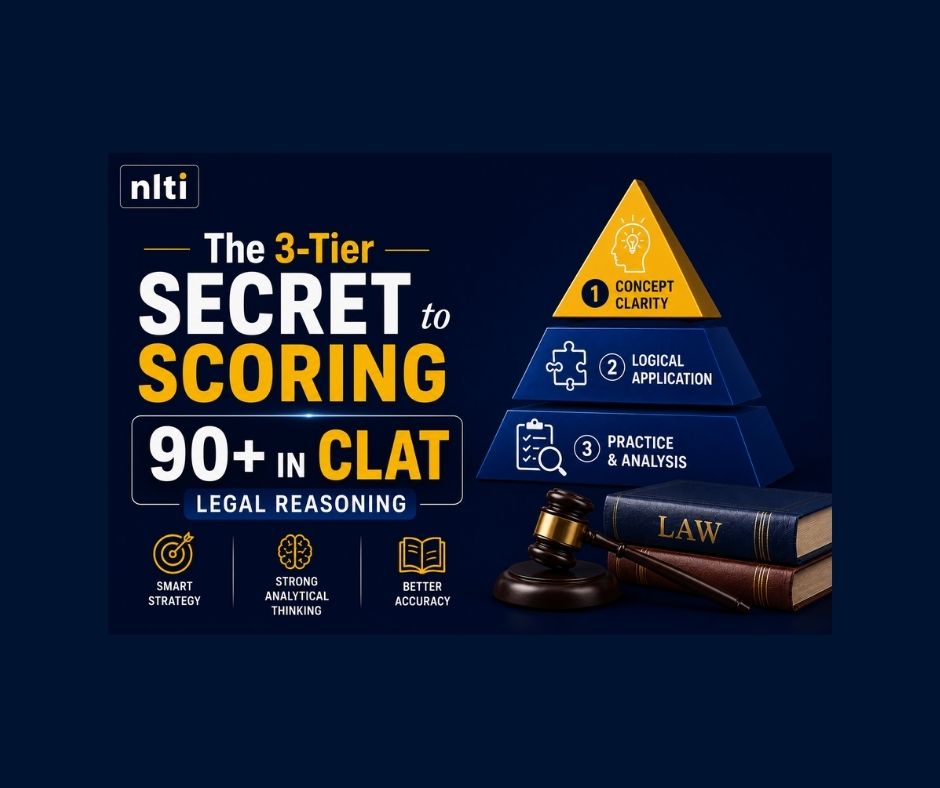
Quick Overview: The 3-Tier Strategy Matrix
Cracking the legal section requires shifting away from passive reading to active, structured analysis. Here is a brief look at the three tiers we will explore:
Tier 1: Premise Mapping (The Art of Filtration): Learning how to separate the core legal principles from filler background text and historical commentary.
Tier 2: The Objectivity Rule (Zero Extrapolations): Training your brain to apply the passage's rules strictly as written, completely ignoring your personal biases or outside legal knowledge.
Tier 3: Structural Eliminating (The Trap Identifier): Spotting and eliminating deceptive distractor options like 'too broad', 'partially correct', or 'altered premise' variables.
Tier 1: Premise Mapping and the Art of Filtration
The biggest trap in modern CLAT legal passages is the introduction of emotional, socio-political narratives or heavy historical background. When you read a text on data privacy or freedom of speech, you are often buried under paragraphs explaining why the issue matters before you ever reach the operational legal rule.
Average students waste valuable minutes digesting this fluff. High scorers use a technique we call Premise Mapping. As you scan the passage, your eyes must search exclusively for conditional markers like 'provided that', 'except when', 'unless', or 'holds liable if'.
These words signal the birth of a mandatory legal test. By underlining just the conditional rules, you strip a 450-word passage down to its bare structural skeleton, saving you over thirty seconds per question block.
CLAT 2027 Complete Guide: Exam Date, Eligibility & Syllabus
Tier 2: The Objectivity Rule (Leaving Your Brain at the Door)
This is where most smart students lose critical marks. Because you are preparing for a law exam, you naturally study landmark judgments, constitutional amendments, and basic tort laws. But when you step into the CLAT exam hall, your external knowledge can become a dangerous liability if the passage deliberately alters a real-world law.
The Consortium loves testing your ability to follow instructions blindly. If a passage explicitly states that 'stealing an apple to feed a starving child is completely legal', then for those five questions, that is the supreme law of the land. You must never extrapolate, assume, or bring in outside legal logic.
At NLTI, we constantly emphasize this mental boundary. We design our proprietary sectionals with counter-intuitive principles to ensure you learn to treat the passage as an absolute source of truth, completely insulating your score from subjective assumptions.
CLAT 2027 Preparation Tips: Subject-Wise Strategy for 90+ Marks
Tier 3: Master Option Elimination (Spotting the Distractors)
In a high-stakes exam like CLAT, choosing the right answer is often about confidently eliminating the three wrong ones. The test creators rely on highly specific psychological patterns to draft their distractor options.
CLAT 2027 Complete Guide: Exam Date, Eligibility & Syllabus
How We Engine-Boost Your Scores at NLTI
Knowing a strategy is one thing; executing it flawlessly when the timer is ticking down is a completely different challenge. That is exactly why our entire pedagogy at the National Law Training Institute is built around execution metrics.
We don't just tell you what you did wrong after a mock exam. Our advanced analytics dashboard tracks how many seconds you spent on each option, where you wavered, and whether you fell for a specific trap pattern.
Through our daily intensive practice modules, we provide targeted legal passages curated by top NLU alumni who have mastered this section themselves. We show you how to read with purpose, balance speed with precision, and build the deep cognitive stamina required to maintain a peak 90+ accuracy rate from the first question to the very last page of the booklet.
Scoring high in CLAT Legal Reasoning requires the right strategy, consistent practice, and expert guidance. NLTI helps aspirants strengthen their analytical skills through structured preparation, regular mock tests, personalised mentoring, and exam-focused study resources designed to maximise performance in every section of the CLAT exam.
Frequently Asked Questions
1. Do I need to read heavy legal textbooks or memorize bare acts for CLAT Legal Reasoning?
Absolutely not. CLAT does not expect you to have a pre-existing law degree or deep institutional knowledge of statutes. The section is strictly an aptitude test designed to evaluate how you comprehend and apply rules under pressure. While familiarity with basic terms like contracts, torts, or constitutional concepts helps boost your reading speed, your primary focus should be on practicing passage-based deduction drills rather than rote memorization.
2. My score drops drastically when I try to read legal passages faster. How do I fix this?
This happens because you are likely trying to speed up your actual reading of complex words, which breaks your comprehension. The fix is to change *what* you read, not how fast you read. By practicing our Premise Mapping framework at NLTI, you learn to skim past the narrative fluff and slow down only when you hit operational legal criteria. This structural adjustment keeps your accuracy pristine while instantly lowering your overall section timing.
3. Why is the Objectivity Rule important in CLAT Legal Reasoning?
The Objectivity Rule teaches students to rely only on the legal principles provided in the passage. Personal opinions, prior legal knowledge, or assumptions should never influence answers, as CLAT tests your ability to apply the given information objectively.
4. How can I improve my accuracy in CLAT Legal Reasoning?
Improve your accuracy by practicing passage-based questions regularly, identifying legal principles before reading the options, eliminating incorrect choices systematically, and reviewing your mistakes after every mock test.
5. What are the most common trap options in CLAT Legal Reasoning?
Common trap options include partially correct statements, extreme words such as "always" or "never," and morally appealing answers that are not supported by the passage. Learning to identify these traps helps improve accuracy.
6. Do I need to memorize legal concepts to score well in CLAT Legal Reasoning?
No. CLAT Legal Reasoning is designed to test analytical thinking rather than legal knowledge. Understanding basic legal terminology is useful, but success depends primarily on applying the legal principles provided in each passage.
7. How can I solve Legal Reasoning passages faster in CLAT?
Instead of trying to read every word quickly, focus on identifying operational legal rules, highlighting important conditions, and ignoring background information that does not affect the questions.
Get In Touch
Have questions? We'd love to hear from you. Send us a message and we'll respond as soon as possible.