CLAT 2024–2026 Paper Analysis & Exam Trends
Share this article:
Introduction
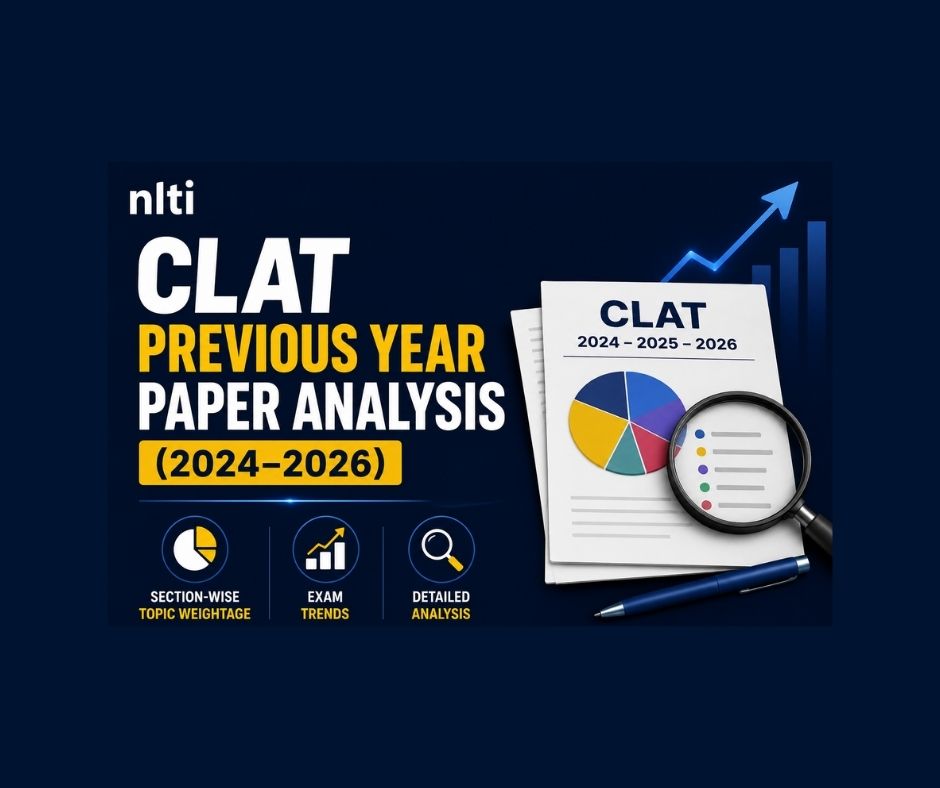
The CLAT previous year paper analysis helps aspirants understand the changing exam pattern, important topics, and section-wise trends before starting their preparation.
The CLAT last 3 years analysis (2024–2026) shows that the exam has gradually shifted from direct knowledge-based questions to a more comprehension-driven and application-oriented format.
The latest CLAT exam trend analysis highlights increasing importance of:
Passage-based comprehension
Application of concepts
Current affairs linked with static knowledge
Logical interpretation and analytical ability
Understanding the CLAT section-wise weightage and trends allows students to identify high-priority areas, analyse the Consortium of NLUs exam pattern, and create an effective strategy for CLAT 2027 preparation.
This article covers the detailed CLAT topic-wise analysis (2024–2026) of all five sections: English Language, Current Affairs & GK, Legal Reasoning, Logical Reasoning, and Quantitative Techniques.
Best CLAT Coaching Online 2027–2028 by NLTI
English Language Topic-wise Weightage (CLAT 2024–2026)
The CLAT English Language section has remained completely passage-based over the last three years. The focus has moved away from grammar-based preparation towards reading comprehension, inference, interpretation, and vocabulary in context.
CLAT English Language Topic-wise Analysis
Note: Some questions involve overlapping skills; classification is based on the dominant skill tested.
Key Trends
Reading comprehension remains the most important skill for CLAT English.
Questions increasingly test understanding of the passage rather than memorised concepts.
Vocabulary is mostly tested through contextual meaning.
Literature, philosophy, and opinion-based passages have become common.
Important Areas for CLAT 2027 Preparation
Reading comprehension
Inference-based questions
Author’s viewpoint and tone
Vocabulary in context
CLAT General Knowledge Syllabus & Current Affairs Topic-wise Weightage (2024–2026)
The CLAT General Knowledge syllabus has evolved significantly. Recent papers test current affairs along with their historical, political, legal, and international background.
CLAT GK Topic-wise Analysis
Key Trends
Indian polity and international relations remain high-weightage areas.
International relations questions in CLAT GK have gained importance.
Current affairs are tested with connected static knowledge.
Students need conceptual understanding rather than isolated memorisation.
Important Areas for CLAT 2027 Preparation
Indian Constitution and governance
International relations
Government schemes
International organisations
Major national and global events
CLAT 2028: Exam Date, Eligibility, Syllabus & Strategy
CLAT Legal Reasoning Important Topics & Constitutional Law Weightage in CLAT (2024–2026)
Legal Reasoning has become one of the most dynamic sections of CLAT. Recent papers show increasing importance of constitutional law, Supreme Court judgments, new legislation, and contemporary legal issues.
CLAT Legal Reasoning Topic-wise Analysis
Note: Cyber Law and Data Protection have been grouped together as technology-related legal developments.
Key Trends
Constitutional Law has become the dominant area in recent CLAT papers.
Recent judgments and new laws are increasingly tested.
Legal Reasoning focuses more on application than memorisation.
Students need awareness of current legal developments along with legal fundamentals.
Important Areas for CLAT 2027 Preparation
Constitutional Law
Fundamental Rights
Supreme Court judgments
New legislation
Contemporary legal issues
Master CLAT Legal Reasoning with a Pattern-Based Approach
With Constitutional Law, recent judgments, and contemporary legal developments becoming increasingly important, the right preparation strategy can significantly improve performance.
Get expert guidance, updated study material, and exam-focused practice designed according to the latest CLAT pattern.
Start your CLAT 2027 preparation with NLTI today.
[Explore NLTI CLAT Preparation Programs →]
Analytical Reasoning vs Critical Reasoning in CLAT: Logical Reasoning Topic-wise Weightage (2024–2026)
Logical Reasoning has witnessed one of the biggest pattern changes in recent CLAT papers.
While earlier papers were dominated by passage-based critical reasoning, recent papers have introduced more analytical reasoning, puzzles, and deduction-based questions.
CLAT Logical Reasoning Topic-wise Analysis
Key Trends
CLAT 2024 was completely passage-based.
CLAT 2025 introduced analytical reasoning sets.
CLAT 2026 showed a stronger shift towards traditional reasoning topics.
Students should prepare both critical reasoning and analytical reasoning.
Important Areas for CLAT 2027 Preparation
Arguments and conclusions
Assumptions and inference
Strengthen and weaken questions
Seating arrangements
Blood relations
Scheduling puzzles
CLAT 2027 Complete Guide: Exam Date, Syllabus, Eligibility & Prep
CLAT Quantitative Techniques Weightage & Data Interpretation Analysis (2024–2026)
Quantitative Techniques remains the most predictable section of CLAT.
The section mainly tests CLAT data interpretation questions, percentages, ratios, and basic arithmetic calculations.
CLAT Quantitative Techniques Topic-wise Analysis
Key Trends
Data Interpretation dominates the section every year.
Percentage and ratio-based calculations are repeatedly tested.
Advanced mathematics has limited importance.
Accuracy and calculation speed matter more than formulas.
Important Areas for CLAT 2027 Preparation
Data interpretation
Percentage
Ratio and proportion
Income-expenditure calculations
Basic arithmetic
Key Trends Across CLAT 2024–2026
The CLAT previous year paper analysis (2024–2026) shows that the exam is becoming more comprehension-based, analytical, and application-focused.
Major trends include:
Comprehension is the core skill: English, Legal Reasoning, and Logical Reasoning increasingly test understanding and application.
Constitutional Law is gaining importance: Recent Legal Reasoning papers show strong focus on governance and judgments.
Current Affairs requires context: CLAT GK tests events along with their background and significance.
Logical Reasoning is evolving: Both critical reasoning and analytical reasoning are now important.
Quant remains predictable: Data Interpretation, percentages, and ratios continue to dominate.
CLAT 2027 Quantitative Techniques Guide
Most Important Topics for CLAT 2027 Based on PYQ Analysis
Based on the CLAT last 3 years analysis, aspirants should prioritise these high-weightage areas:
Final Preparation Strategy Based on CLAT Topic-wise Weightage
The CLAT topic-wise weightage analysis helps students focus on areas that matter most instead of preparing every topic equally.
Analyse previous year papers to understand repeated patterns and question types.
Develop daily reading habits to improve comprehension and accuracy.
Focus on high-weightage areas like Constitutional Law, Current Affairs, Critical Reasoning, and Data Interpretation.
Practise mocks regularly and analyse mistakes to improve speed, accuracy, and question selection.
A strategy aligned with the latest CLAT exam trend analysis can help aspirants prepare smarter for CLAT 2027.
CLAT Previous Year Papers (2023–2026) with Analysis
Conclusion
The CLAT 2024–2026 topic-wise analysis shows that the exam increasingly rewards comprehension, conceptual clarity, and application skills.
For CLAT 2027, aspirants should focus on high-weightage topics, practise previous year papers, and develop strong reading and analytical abilities.
A preparation strategy based on:
Strong reading ability
Updated current affairs knowledge
Constitutional understanding
Logical reasoning practice
Data interpretation skills
can help students adapt to the evolving CLAT pattern and improve their chances of securing a top rank.
Prepare smarter with a strategy aligned to the latest CLAT trends.
[Start Your CLAT 2027 Preparation with NLTI →]
Frequently Asked Questions (FAQs)
1. Why is CLAT previous year paper analysis important?
CLAT previous year analysis helps aspirants understand the changing exam pattern, identify important topics, and prioritise preparation according to actual trends.
2. Which topics are most repeated in CLAT UG?
The most repeated areas across recent CLAT papers include:
Reading comprehension
Constitutional Law
International relations
Critical reasoning
Data interpretation
3. Has the CLAT difficulty level changed from 2024 to 2026?
The difficulty level has remained moderate, but the nature of questions has changed. Recent papers have become more:
Passage-based
Application-oriented
Analytical
4. What are the most important CLAT Legal Reasoning topics?
The most important Legal Reasoning areas are:
Constitutional Law
Fundamental Rights
Supreme Court judgments
New laws and amendments
Contemporary legal issues
5. How should students prepare for CLAT comprehension-based sections?
Students should:
Read regularly
Practise passage-based questions
Improve reading speed
Analyse mistakes from mocks
6. Is Quantitative Techniques difficult in CLAT?
No. Recent CLAT papers mainly test:
Data interpretation
Percentages
Ratios
Basic arithmetic
Advanced mathematics has very limited importance.
7. How many years of CLAT papers should students analyse?
Students should analyse at least the last 3–5 years of CLAT papers to understand changing trends, recurring topics, difficulty levels, and question patterns.
Get In Touch
Have questions? We'd love to hear from you. Send us a message and we'll respond as soon as possible.