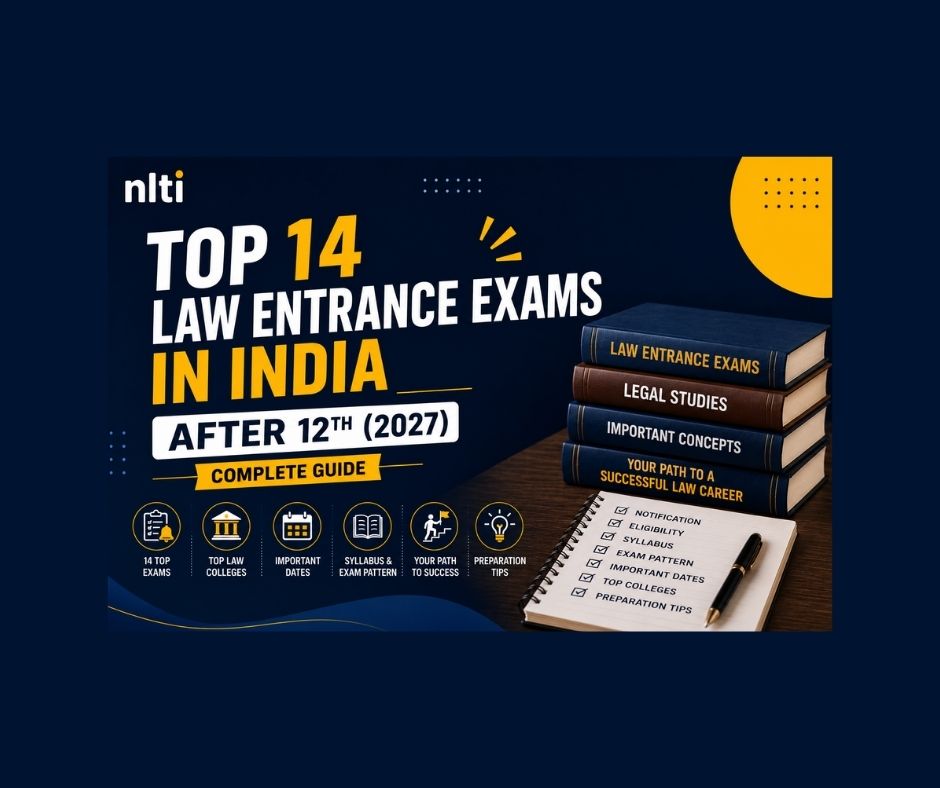
Top 14 Law Entrance Exams in India After 12th (2027)
Share this article:
Introduction
Law entrance exams serve as the primary gateway for admission into India's premier law colleges and universities. While the Common Law Admission Test (CLAT) remains the most widely recognized exam for National Law Universities (NLUs), numerous alternative exams open doors to prestigious central, state, and private law schools.
This guide outlines the top law entrance exams in India after the 12th grade, including key dates, eligibility requirements, exam patterns, and participating institutions to help you map out your legal career.
Crack CLAT 2027 with Chandigarh's Best Crash Course
Law Entrance Exam Calendar 2027
Preparing effectively requires a clear timeline of important dates. The table below lists the tentative schedule for major undergraduate law entrance exams for the 2027 admission cycle based on official updates and historical patterns.
Note: Dates are subject to change based on official notifications. Candidates should regularly check official university websites for updates.
1. CLAT (Common Law Admission Test)
The Common Law Admission Test (CLAT) is India's preeminent national-level law entrance test for undergraduate admissions. Administered by the Consortium of NLUs, it facilitates entry into elite National Law Universities and numerous affiliated institutions.
Key Highlights
Conducting Body: Consortium of National Law Universities (NLUs)
Exam Level: National
Courses Offered: 5-Year Integrated LLB & LLM
Mode of Examination: Offline (Pen & Paper)
Duration: 2 Hours
Total Questions: 120 MCQs
Marking Scheme: +1 for correct answers, -0.25 for incorrect answers
Exam Date: 6 December 2026
Official Website: consortiumofnlus.ac.in
Eligibility & Pattern
Eligibility: Passed or appearing in Class 12 (10+2) with a minimum of 45% marks (40% for SC/ST/PwD candidates). No upper age limit.
Exam Sections: English Language, Current Affairs & General Knowledge, Legal Reasoning, Logical Reasoning, and Quantitative Techniques.
Participating Institutes: 26 NLUs and over 60 affiliated law schools.
3 Hours a Day for NLSAT 2027: Is It Enough?
2. AILET (All India Law Entrance Test)
Conducted exclusively by National Law University, Delhi, the AILET is widely regarded as one of the toughest and most competitive law entrance examinations in the country.
Key Highlights
Conducting Body: National Law University (NLU), Delhi
Exam Level: University Level
Courses Offered: BA LLB (Hons.), LLM, and PhD
Mode of Examination: Offline (Pen & Paper)
Duration: 2 Hours
Total Questions: 150 MCQs (150 Marks)
Marking Scheme: +1 for correct answers, -0.25 for incorrect answers
Exam Date: 13 December 2026
Official Website: nationallawuniversitydelhi.in
Exam Pattern
English Language: 50 Questions
Current Affairs & General Knowledge: 30 Questions
Logical Reasoning: 70 Questions
3. SLAT (Symbiosis Law Admission Test)
The Symbiosis Law Admission Test (SLAT) is a national entrance test managed by Symbiosis International (Deemed University) for aspirants targeting its premier law schools.
Key Highlights
Conducting Body: Symbiosis International (Deemed University)
Exam Level: National
Courses Offered: BA LLB (Hons.) & BBA LLB (Hons.)
Mode of Examination: Computer-Based Test (CBT)
Duration: 60 Minutes
Total Questions / Marks: 60 MCQs / 60 Marks
Marking Scheme: +1 for correct answers; No Negative Marking
Exam Date: December 2026
Official Website: slat-test.org
Admission Process & Colleges
Process: SLAT Score followed by a Personal Interaction (PI) round.
Participating Colleges: Symbiosis Law Schools in Pune, Noida, Hyderabad, and Nagpur.
4. MH CET Law (Maharashtra Common Entrance Test for Law)
Conducted by the State CET Cell, Maharashtra, MH CET Law is a major state-level gateway for securing admissions into top-tier public and private law colleges across Maharashtra.
Key Highlights
Conducting Body: State Common Entrance Test Cell, Maharashtra
Exam Level: State Level
Courses Offered: 5-Year Integrated LLB & 3-Year LLB
Mode of Examination: Computer-Based Test (CBT)
Duration: 120 Minutes
Total Questions / Marks: 120 MCQs / 120 Marks
Marking Scheme: +1 for correct answers; No Negative Marking
Exam Date: April 2027 (Tentative)
Official Website: cetcell.mahacet.org
Top Participating Colleges
Government Law College (GLC), Mumbai
ILS Law College, Pune
Dr. Ambedkar College of Law, Mumbai
Over 120+ approved state colleges.
Best 3-Year Law Colleges in Maharashtra Through MHCET
5. LNAT (Law National Aptitude Test)
The Law National Aptitude Test (LNAT) measures critical thinking and reasoning capabilities rather than rote legal knowledge. In India, it is primarily used by private institutions like Jindal Global Law School.
Key Highlights
Conducting Body: LNAT Consortium (Administered via Pearson VUE)
Exam Level: International
Courses Offered: Undergraduate Law Programmes (LLB)
Mode of Examination: Computer-Based Test (CBT)
Duration: 2 Hours 15 Minutes
Exam Window: September 2026 – July 2027
Official Website: lnat.ac.uk
Exam Pattern
Section A: 42 Multiple Choice Questions based on passages and logical deduction.
Section B: One argumentative essay evaluated directly by participating universities.
6. NMIMS LAT (NMIMS Law Aptitude Test)
Conducted by SVKM's NMIMS, the NMIMS LAT serves as the gateway for its multidisciplinary law schools spread across multiple major Indian cities.
Key Highlights
Conducting Body: SVKM's NMIMS
Exam Level: University Level
Courses Offered: BA LLB (Hons.) & BBA LLB (Hons.)
Mode of Examination: Computer-Based Test (CBT)
Duration: 120 Minutes
Total Questions: 150 MCQs
Marking Scheme: +1 for correct answers; No Negative Marking
Exam Window: January – May 2027 (Multiple Phases)
Official Website: nmims.edu
Top NLUs in India: Rankings, Fees & Admission Guide
7. CULEE (Christ University Law Entrance Examination)
Christ (Deemed to be University) administers CULEE for undergraduate legal education across its primary campuses, incorporating a multi-tier selection model.
Key Highlights
Conducting Body: Christ (Deemed to be University)
Exam Level: University Level
Courses Offered: BA LLB (Hons.), BBA LLB (Hons.) & BCom LLB (Hons.)
Mode of Examination: Computer-Based Test (CBT)
Duration: 120 Minutes
Total Questions: 120 MCQs
Marking Scheme: +1 for correct answers, -0.25 for incorrect answers
Exam Date: December 2026 (Tentative)
Official Website: christuniversity.in
8. AIL LET (Army Institute of Law Entrance Test)
The Army Institute of Law Entrance Test is designed specifically to shortlist candidates for the Army Institute of Law in Mohali, with specialized category quotas.
Key Highlights
Conducting Body: Army Institute of Law (AIL), Mohali
Exam Level: University Level
Course Offered: BA LLB (Hons.)
Mode of Examination: Offline (Pen and Paper)
Duration / Questions: 2 Hours / 200 MCQs
Marking Scheme: +1 for correct answers; No negative marking
Exam Window: May – June 2027 (Tentative)
Official Website: ail.ac.in
9. RULET (Rajasthan University Law Entrance Test)
Managed by the University of Rajasthan, RULET opens admissions to the esteemed Faculty of Law in Jaipur.
Key Highlights
Conducting Body: University of Rajasthan
Exam Level: University Level
Course Offered: BA LLB (Hons.)
Mode of Examination: Offline (Pen and Paper)
Duration: 2 Hours
Total Questions: 150 MCQs (Tentative)
Exam Window: May – June 2027 (Tentative)
Official Website: uniraj.ac.in
10. JMI BA LLB Entrance Test
Jamia Millia Islamia conducts its independent entrance exam for its prominent Faculty of Law, known for its academic rigor and accessibility.
Key Highlights
Conducting Body: Jamia Millia Islamia (JMI)
Exam Level: University Level
Course Offered: BA LLB (Hons.)
Mode of Examination: Offline (Pen and Paper)
Duration / Questions: 2 Hours / 150 MCQs
Marking Scheme: +1 for correct answers; negative marking applies as per official guidelines
Exam Window: April – May 2027 (Tentative)
Official Website: jmi.ac.in
11. Panjab University BA/B.Com LLB Entrance Test (PU Law Entrance Test)
The Panjab University BA/B.Com LLB Entrance Test is a university-level entrance examination conducted by Panjab University, Chandigarh for admission to its five-year integrated undergraduate law programmes.
It is one of the most popular law entrance exams in North India, especially for students targeting the prestigious University Institute of Legal Studies (UILS).
Key Highlights
Conducting Body: Panjab University, Chandigarh
Exam Level: University Level
Courses Offered: BA LLB (Hons.) & B.Com LLB (Hons.)
Mode of Examination: Offline (Pen and Paper)
Duration: 90 Minutes
Total Questions: 100 MCQs
Marking Scheme: +1 for correct answers; negative marking as per official notification
Exam Window: January 2027 (Tentative)
Official Website: pglaw.puchd.ac.in
Exam Pattern
The PU Law Entrance Test generally covers:
English Language
Current Affairs & General Knowledge
Legal Aptitude
Logical Reasoning
Basic Numerical Ability
Colleges Accepting PU Law Entrance Scores
University Institute of Legal Studies (UILS), Panjab University, Chandigarh
UILS Regional Centres (as per university notifications)
Best AI Tool for CUET PG LLB GK Preparation
12. AP LAWCET (Andhra Pradesh Law Common Entrance Test)
The AP LAWCET is a state-level entrance examination conducted for admission into undergraduate and postgraduate law programmes offered by law colleges across Andhra Pradesh.
The exam provides admission opportunities to students seeking 3-year LLB and 5-year integrated LLB programmes in various affiliated colleges.
Key Highlights
Conducting Body: Andhra Pradesh State Council of Higher Education (APSCHE)
Exam Level: State Level
Courses Offered: 5-Year LLB & 3-Year LLB
Mode of Examination: Computer-Based Test (CBT)
Duration: 150 Minutes
Total Questions: 120 MCQs
Marking Scheme: +1 for each correct answer; No negative marking
Exam Window: May 2027 (Tentative)
Official Website: cets.apsche.ap.gov.in
Exam Pattern
The AP LAWCET question paper consists of:
General Knowledge & Current Affairs
Mental Ability & Logical Reasoning
Legal Aptitude
Basic Legal Principles
Colleges Accepting AP LAWCET Scores
Andhra Pradesh law colleges affiliated with participating universities
Top Career Options After Delhi University 3-Year LL.B.
13. TS LAWCET (Telangana State Law Common Entrance Test)
The TS LAWCET is a state-level law entrance examination conducted for admission to undergraduate law programmes offered by universities and affiliated law colleges in Telangana. It is an important option for candidates looking for affordable legal education opportunities in Telangana.
Key Highlights
Conducting Body: Telangana State Council of Higher Education (TSCHE)
Exam Level: State Level
Courses Offered: 5-Year LLB & 3-Year LLB
Mode of Examination: Computer-Based Test (CBT)
Duration: 150 Minutes
Total Questions: 120 MCQs
Marking Scheme: +1 for each correct answer; No negative marking
Exam Window: June 2027 (Tentative)
Official Website: lawcet.tsche.ac.in
Exam Pattern
The TS LAWCET syllabus includes:
General Knowledge & Current Affairs
Mental Ability & Reasoning
Legal Aptitude
Basic Legal Concepts
Colleges Accepting TS LAWCET Scores
Osmania University affiliated law colleges
Telangana state law colleges participating in counselling
14. KLEE (Kerala Law Entrance Examination)
The Kerala Law Entrance Examination (KLEE) is conducted by the Commissioner for Entrance Examinations (CEE), Kerala for admission to five-year integrated law programmes offered by government and private law colleges in Kerala.
Key Highlights
Conducting Body: Commissioner for Entrance Examinations (CEE), Kerala
Exam Level: State Level
Course Offered: 5-Year Integrated LLB
Mode of Examination: Computer-Based Test (CBT)
Duration: 2 Hours
Total Questions: 200 MCQs
Marking Scheme: +1 for correct answers; negative marking applicable
Exam Window: July 2027 (Tentative)
Official Website: cee.kerala.gov.in
Exam Pattern
The KLEE question paper includes:
General English
General Knowledge
Arithmetic & Mental Ability
Legal Studies
Logical Reasoning
Colleges Accepting KLEE Scores
Government Law Colleges in Kerala
Private law colleges affiliated with Kerala universities
Best Law Coaching Institute in Chandigarh for CLAT
How to Choose the Right Law Entrance Exam After 12th?
With multiple law entrance exams available, students should select options based on target institutions, specific career pathways, and preparation alignment:
Target NLUs: Focus primarily on CLAT and AILET.
Target Private Law Universities: Consider exams like SLAT, NMIMS LAT, CULEE, and LNAT.
Target State/Central Universities: Explore regional options such as MH CET Law, PU Law Entrance, JMI BA LLB, KLEE, AP LAWCET, and TS LAWCET.
While most undergraduate law exams share overlapping core sections such as English Language, Logical Reasoning, Current Affairs, and Legal Reasoning their formats, pacing, and difficulty levels can vary considerably.
Strategy Note: Because law entrance testing involves varying competition levels and pattern shifts, candidates are strongly advised not to rely on a single test. Targeting 4 to 6 complementary entrance exams maximizes admission security and opens up a broader range of top-tier college choices.
Frequently Asked Questions (FAQs) About Law Entrance Exams After 12th
1. Which is the best law entrance exam after 12th?
CLAT is widely regarded as the most popular and prestigious law entrance exam for securing admission to National Law Universities (NLUs). However, exams like AILET, SLAT, NMIMS LAT, CULEE, and the JMI BA LLB Entrance Test also provide exceptional opportunities for top-tier legal education.
2. Is CLAT the only law entrance exam after 12th?
No. CLAT is just one among many options. Students can choose from a robust selection of national, university, and state-level exams, including AILET, SLAT, NMIMS LAT, CULEE, MH CET Law, PU Law Entrance, and various state CETs.
3. Can I prepare for multiple law entrance exams together?
Yes. Because most law entrance tests feature overlapping core sections such as English Language, Current Affairs, Logical Reasoning, and Legal Reasoning a unified and synchronized preparation strategy allows aspirants to target multiple exams simultaneously.
4. How many law entrance exams should I target?
Due to high competition levels and occasional pattern variations, students are strongly encouraged to target 4 to 6 law entrance exams. Diversifying your applications significantly safeguards your admission prospects and opens up a wider range of college choices.
5. When should I start preparing for law entrance exams?
Beginning your preparation 8 to 12 months in advance is ideal. This timeframe helps you build strong reading speed, critical reasoning skills, a solid command over current affairs, and the stamina needed for competitive testing.
6. What subjects are tested in law entrance exams?
While specific weightages vary by exam, the most common sections tested across undergraduate law entrances include:
English Language
Current Affairs & General Knowledge
Legal Reasoning & Aptitude
Logical & Analytical Reasoning
Quantitative Techniques / Basic Numerical Ability
Begin Your Law Entrance Preparation with NLTI
Success in competitive law entrance exams requires more than hard work it demands the right strategy, expert mentorship, and consistent practice. NLTI helps aspirants prepare for CLAT, AILET, SLAT, and other leading law entrance exams through a comprehensive learning framework designed to build conceptual clarity and optimize performance.
Why Choose NLTI?
Experienced faculty and structured classroom modules
Comprehensive study material tailored to latest exam trends
Regular mock tests equipped with in-depth performance analysis
Specialized current affairs and legal reasoning training
Personalized mentorship and dedicated doubt-resolution sessions
Start your preparation with expert guidance and take a decisive step toward securing admission to your dream law college.
Admissions Open | Join NLTI’s Law Entrance Preparation Program Today
Get In Touch
Have questions? We'd love to hear from you. Send us a message and we'll respond as soon as possible.