100 Important Vocabulary Words for CLAT 2027 PDF
Share this article:
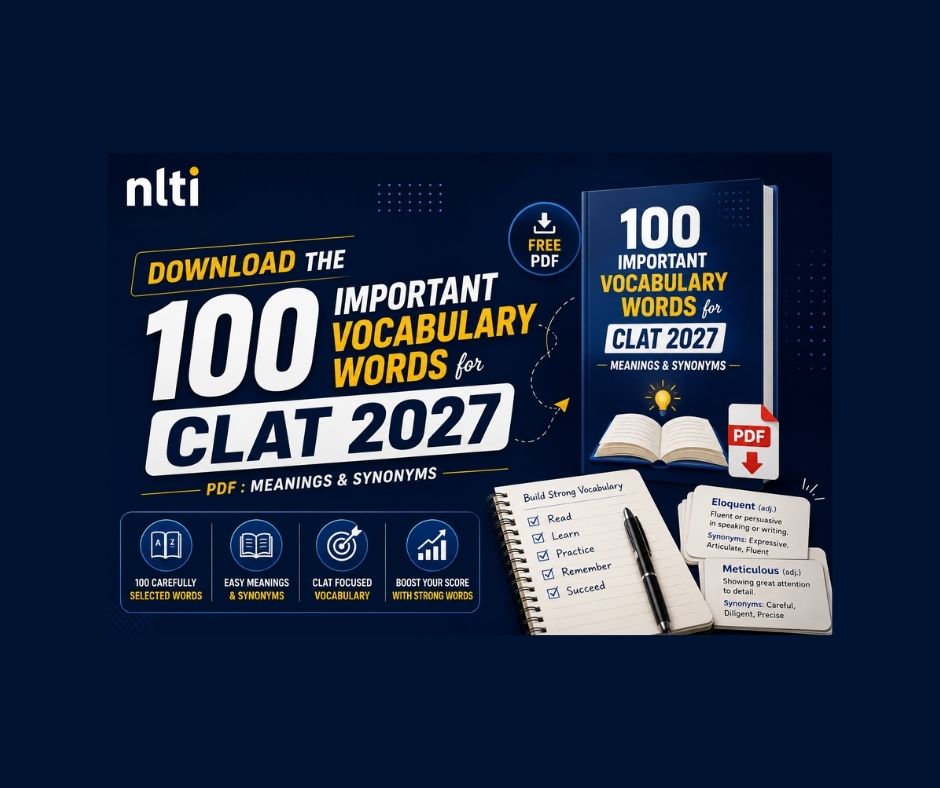
Vocabulary plays an important role in CLAT preparation. Although CLAT does not have a separate vocabulary section, a strong command of English can help you understand passages faster, identify arguments, interpret unfamiliar terms and eliminate incorrect options more confidently.
Students preparing for CLAT 2027 do not need to memorise thousands of difficult words. Instead, focus on important vocabulary words for CLAT that commonly appear in newspapers, editorials, legal discussions, current affairs and analytical passages.
This CLAT vocabulary list covers 100 useful words with their meanings and synonyms to help you build your vocabulary systematically.
Best CLAT Coaching Online 2027–2028 by NLTI
100 Important Vocabulary Words for CLAT
Download 100 vocabulary words
How to Prepare Vocabulary for CLAT
Memorising a CLAT vocabulary list once is not enough. The goal is to recognise and understand words when they appear in unfamiliar passages.
1. Learn Words in Context
Instead of memorising only a definition, see how a word is used.
Mitigate – to make something less severe.
Example: The government introduced measures to mitigate the effects of inflation.
Context makes it easier to remember the word and understand how it is used in a passage.
2. Read Editorials Regularly
Reading newspapers and quality editorials is one of the most effective ways to improve your English vocabulary for CLAT. Editorials expose you to words related to law, politics, economics, governance and social issues.
When you encounter an unfamiliar word, first try to understand its meaning from the surrounding sentences. Then check a reliable dictionary and add it to your notes if it is useful.
3. Maintain a Vocabulary Notebook
Create four columns:
Word | Meaning | Synonym/Antonym | Example
Avoid adding every unfamiliar word you encounter. Prioritise words that appear repeatedly or are useful for understanding arguments and reading comprehension passages.
4. Revise Regularly
Vocabulary improves through repetition. Instead of continuously adding new words, revise the words you have already learned. Try recalling their meanings before looking at your notes.
CLAT 2027: Complete 4-Month Preparation Strategy
7-Day CLAT Vocabulary Revision Plan
After completing the list, repeat the process with new words collected from your reading material.
CLAT 2027 Syllabus: Section-wise Guide for Beginners
Test Your CLAT Vocabulary
Test yourself on some of the words from the list before checking the answers.
1. Choose the word closest in meaning to “mitigate”:
A. Increase
B. Reduce
C. Ignore
D. Predict
2. The meaning of “ambiguous” is:
A. Clearly expressed
B. Extremely difficult
C. Open to more than one interpretation
D. Completely false
3. Which word means “to spread information widely”?
A. Disseminate
B. Reconcile
C. Inhibit
D. Ratify
4. The committee's decision was criticised as ______ because it appeared to be based on personal preference rather than reason.
A. Equitable
B. Arbitrary
C. Pragmatic
D. Impartial
5. Which word is closest in meaning to “plausible”?
A. Believable
B. Impossible
C. Unrelated
D. Unclear
6. The court's decision was based on an earlier judgment that served as a ______.
A. Mandate
B. Prejudice
C. Precedent
D. Disparity
Answers
B — Reduce
C — Open to more than one interpretation
A — Disseminate
B — Arbitrary
A — Believable
C — Precedent
CLAT 2027 Complete Guide: Exam Date, Syllabus, Eligibility & Prep
Does CLAT Require Vocabulary Preparation?
There is no fixed vocabulary syllabus for CLAT. The examination focuses on comprehension and reasoning rather than simply testing whether students can memorise word meanings.
However, a strong vocabulary can make passages easier to understand and reduce the time spent figuring out unfamiliar words. This is why vocabulary should be treated as part of your overall CLAT English preparation, alongside reading comprehension and regular practice.
Frequently Asked Questions
1. How can I improve my vocabulary for CLAT?
Read editorials regularly, learn words in context, maintain a vocabulary notebook and revise frequently. Reading comprehension practice will also help you understand how vocabulary is used in passages.
2. How many words should I learn for CLAT?
There is no fixed number. Learning and revising useful words consistently is more effective than trying to memorise an arbitrary number of difficult words.
3. Is vocabulary directly tested in CLAT?
CLAT does not have a separate vocabulary section. However, vocabulary is important for understanding passages and answering comprehension-based questions accurately.
4. Should I learn difficult English words for CLAT?
Focus on useful and frequently encountered words rather than extremely obscure vocabulary. Words appearing in editorials, current affairs, legal discussions and analytical writing are generally more valuable.
5. How much time should I spend on vocabulary?
Even 15–20 minutes a day can be effective if you combine vocabulary learning with regular reading and revision.
Build a Stronger CLAT Preparation Strategy with NLTI
Vocabulary is only one part of effective CLAT preparation. Consistent reading, mock-test practice, analysis, conceptual clarity and personalised guidance are equally important.
With live classes, personalised mentorship, regular mocks and structured study resources, NLTI helps aspirants build a focused preparation strategy for law entrance examinations.
Start your CLAT preparation with the right resources, consistent practice and a strategy designed around your strengths and areas for improvement.
Get In Touch
Have questions? We'd love to hear from you. Send us a message and we'll respond as soon as possible.