Indian Court System Explained: A Beginner's Guide
Share this article:
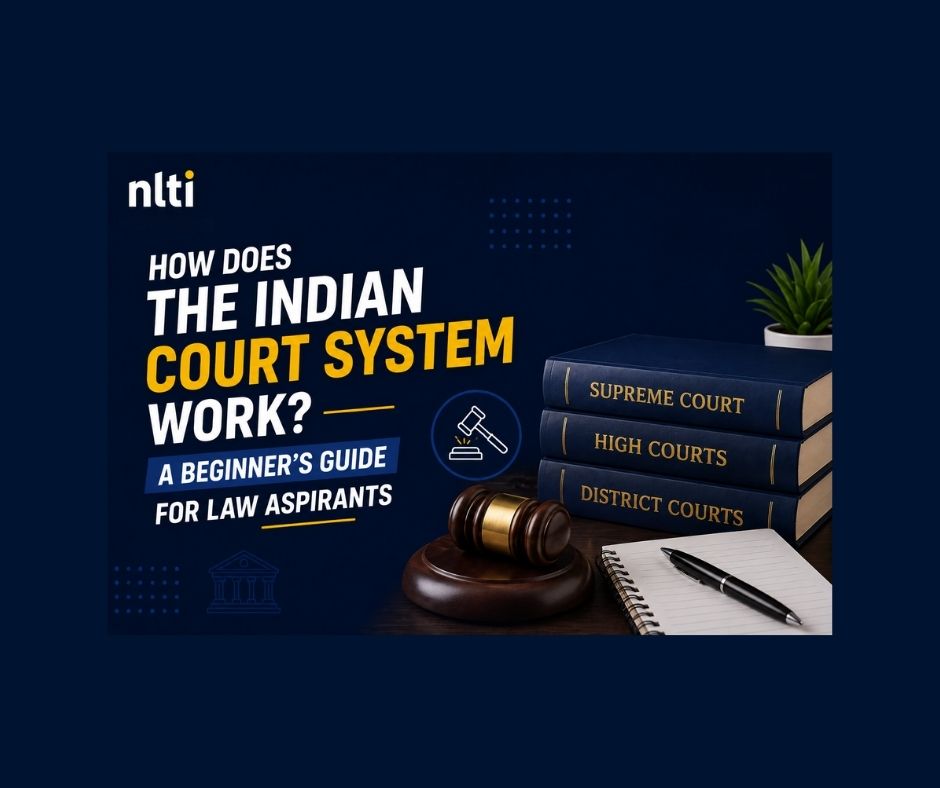
If you are planning to study law or preparing for exams like CLAT, you will often hear terms like Supreme Court, High Court, District Court, jurisdiction, appeals, civil cases and criminal cases.
But what do these terms actually mean? And how does a case move through the Indian court system?
The Indian judiciary has different levels of courts, each with its own role. Understanding this basic structure can make it much easier to follow legal news, read judgments, and understand what you will eventually study in law school.
Let's break it down.
Best CLAT Coaching Online 2027–2028 by NLTI
How Is the Indian Court System Structured?
At the simplest level, you can think of the Indian judiciary like this:
This doesn't mean every case automatically travels through all three levels.
Where a case begins and whether it can move to a higher court depends on the type of case, the court's jurisdiction, and the relevant law.
1. Supreme Court of India
The Supreme Court of India is the highest court in the country.
It deals with important constitutional matters and can hear certain appeals from High Courts and other courts and tribunals.
The Supreme Court has different types of jurisdiction, including:
Original jurisdiction
In certain matters, a case can come directly to the Supreme Court. For example, the Constitution gives the Supreme Court original jurisdiction in certain disputes between the Union and States or between States.Appellate jurisdiction
The Supreme Court can hear certain appeals against decisions of High Courts and other courts and tribunals. It can also grant special leave to appeal under Article 136 in appropriate cases.Fundamental Rights
Under Article 32, a person can approach the Supreme Court for enforcement of Fundamental Rights. The Supreme Court can issue constitutional writs for this purpose.
The important thing to remember is:
The Supreme Court is not simply the next stop for every case. A matter must fall within its jurisdiction or have a legally available route of appeal.
How to Read a Court Judgment in India
2. What Does a High Court Do?
A High Court is generally the highest court within a State or a group of States and Union Territories.
India has 25 High Courts.
High Courts hear appeals from lower courts and also have other important powers.
For example, High Courts can exercise writ jurisdiction under Article 226 and supervise courts and tribunals within their jurisdiction in accordance with the Constitution and law.
So, if a person wants to challenge certain actions of a public authority or seeks to challenge a lower court's decision, the High Court may become relevant depending on the circumstances.
For a law student, an easy way to remember it is:
District Courts deal with a large number of cases at the local level, while High Courts operate at the State or specified territorial level.
3. What Happens in District Courts?
Most people are more likely to encounter the judicial system at the District and subordinate court level than directly at the Supreme Court.
These courts deal with a large number of civil and criminal matters.
Depending on the case, you may come across courts and judicial officers such as:
District Judges
Additional District Judges
Sessions Judges
Civil Judges
Other subordinate judicial officers
For example, a dispute involving property, money or a contract may be heard by an appropriate civil court.
Similarly, criminal proceedings relating to offences are dealt with by the appropriate criminal court according to the applicable law.
The exact court depends on the nature of the case and its jurisdiction.
Is AI Replacing Lawyers? What CLAT Aspirants Should Know
What Does “Jurisdiction” Mean?
You will come across the word jurisdiction again and again in law.
In simple terms:
Jurisdiction means the legal authority of a court to hear and decide a particular matter.
For example, a court may have jurisdiction based on:
Location
Where did the incident happen? Where do the parties live? Where is the property involved?Type of case
Is it a civil dispute, criminal matter or another type of legal issue?Original or appellate jurisdiction
Is the court hearing the matter for the first time, or is it reviewing a decision made by a lower court?
This is why you cannot simply choose any court you want and file a case there.
The relevant law determines which court has the authority to hear the matter.
Civil vs Criminal Cases
Another basic distinction you will encounter throughout your legal education is the difference between civil and criminal cases.
Civil Cases
Civil cases generally involve disputes between individuals, organisations or other parties.
Examples include disputes relating to:
Property
Contracts
Money
Ownership
Certain family matters
Compensation
The purpose is generally to resolve the dispute and provide an appropriate legal remedy.
Criminal Cases
Criminal cases involve alleged offences under criminal law.
Examples can include:
Theft
Assault
Cheating
Fraud
Other offences recognised under criminal law
Here, the prosecution seeks to establish the accused's guilt according to the applicable law and procedure.
The procedures, courts and possible outcomes can differ between civil and criminal matters.
Civil Law vs Criminal Law: Key Differences in India
How Do Appeals Work?
Suppose a case is decided by a lower court.
What happens if one party believes the decision is wrong?
Depending on the applicable law, that party may have a right to appeal to a higher court.
A simplified example is:
District Court $\rightarrow$ High Court $\rightarrow$ Supreme Court
But remember: this is only a simplified picture.
Not every case can automatically go through all three levels.
The availability of an appeal depends on the relevant law and the circumstances of the case.
For certain matters, there may be specific requirements before a higher court can hear an appeal.
The Supreme Court can also exercise its power under Article 136 to grant special leave to appeal in appropriate cases.
So, don't think of an appeal as simply “taking the same case to the next court.”
The higher court examines the matter within the scope allowed by law.
A Simple Example
Imagine two people have a dispute over a piece of property.
This is why the actual route of a case can vary.
Litigation vs Corporate Law: Best Career After LLB
Are All Disputes Heard by Regular Courts?
No.
India also has tribunals and other specialised mechanisms that deal with particular types of disputes.
There are also alternatives such as Lok Adalats, where eligible disputes can be settled through a process focused on compromise and settlement.
For someone studying law, this is important because the legal profession is much broader than traditional courtroom litigation.
Why Should Law Students Understand the Court System?
You don't need to memorise every technical detail before entering law school.
But understanding the basic structure will help you make sense of subjects such as:
Constitutional Law
Criminal Law
Civil Procedure
Criminal Procedure
Evidence
Jurisprudence
It will also make legal news and judgments easier to understand.
If you see a headline saying that a matter has been “appealed before the High Court”, for example, you'll already have an idea of what that means.
CLAT 2027 Question Selection Strategy: Attempt or Skip
The Indian Court System in One Minute
If you remember only five things, remember these:
Supreme Court: India's highest court.
High Courts: Highest courts within their respective jurisdictions.
District & Subordinate Courts: Deal with a large number of cases at the local and trial levels.
Jurisdiction: The legal authority of a court to hear a particular matter.
Appeal: A legally available way of challenging a decision before a higher court; it isn't automatically available in every case.
Once you understand these basics, the Indian court system becomes much easier to follow.
Thinking About a Career in Law? Curious about law as a career or unsure which legal path could suit you? Talk to NLTI counsellors for guidance on law courses, entrance exams and career options.
Talk to an NLTI student counsellor
Preparing for a Law Entrance Exam?
Get structured preparation, mock analysis and personalised mentorship to build a stronger foundation for your law entrance journey.
Explore NLTI Programs
FAQs
1. How many levels of courts are there in India?
Broadly, the Indian judiciary can be understood through the Supreme Court, High Courts and District and subordinate courts. India also has tribunals and other specialised mechanisms.
2. What is jurisdiction in law?
Jurisdiction means the legal authority of a court to hear and decide a particular matter.
3. What is the difference between civil and criminal cases?
Civil cases generally involve disputes such as property, contracts or money, while criminal cases involve alleged offences under criminal law.
4. Can every case go to the Supreme Court?
No. A case can reach the Supreme Court only when there is a legal basis for its jurisdiction or appeal.
5. What is an appeal?
An appeal is a legally permitted way of challenging a lower court's decision before a higher court. Not every decision can automatically be appealed.
Get In Touch
Have questions? We'd love to hear from you. Send us a message and we'll respond as soon as possible.