CLAT Legal Reasoning: Solve Principle-Fact Questions
Share this article:
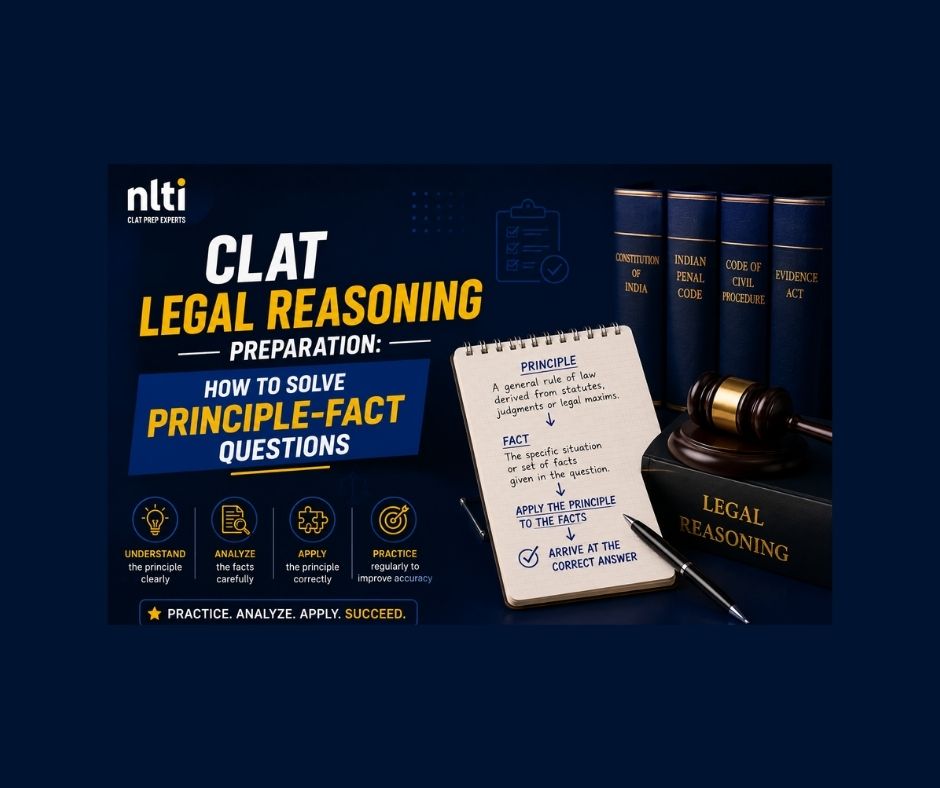
Legal Reasoning is one of the sections where the right preparation strategy can make a big difference to your CLAT score. But there is a common misconception that you need to know a lot of law before you can attempt it well.
You don't need to study law like a law student.
What you do need is the ability to understand a legal principle, identify the conditions attached to it and apply it to a new set of facts. Your basic legal knowledge helps, but the passage itself usually gives you the information needed to solve the question.
This is especially important for principle-fact questions, where students often lose marks not because they don't know the concept, but because they apply the principle incorrectly.
Best CLAT Coaching Online 2027–2028 by NLTI
What Does CLAT Legal Reasoning Actually Test?
CLAT Legal Reasoning is largely about comprehension and application.
A passage may discuss a constitutional issue, criminal law, contracts, torts or a contemporary legal development. You may then be given a hypothetical situation and asked what follows from the principle discussed in the passage.
Think of the process as:
Read → Understand the principle → Identify the relevant facts → Apply → Eliminate → Answer
The difficulty usually comes from the last three steps. You may understand what the principle says but still choose the wrong option because you overlooked one condition, missed an exception or assumed a fact that wasn't given.
How to Prepare for CLAT Legal Reasoning
A good preparation strategy has three parts:
1. Build basic legal awareness
You should be familiar with broad areas such as:
Constitutional Law & Fundamental Rights
Criminal Law (framed under the Bharatiya Nyaya Sanhita / BNS framework)
Contract Law & Law of Torts
Family Law & Important legal developments
You don't need to memorise every section of every statute. The objective is to understand common legal terms and concepts so that an unfamiliar passage doesn't feel completely foreign.
2. Practise passage-based questions
Legal Reasoning is not a section you can master by reading theory alone. Once you understand the basic concepts, start solving passages. Initially, focus on getting the questions right rather than finishing them quickly. Once your accuracy improves, introduce time limits.
3. Analyse your mistakes
This is where a lot of improvement happens. Don't simply write Legal Reasoning: 21/30. Instead, ask:
Did I misunderstand the principle?
Did I miss an important word?
Did I apply the principle incorrectly?
Did I fall for an option that added information?
Did I run out of time?
Your mistakes tell you what you actually need to work on.
CLAT 2027: How to Complete the Paper in 2 Hours
How to Solve Principle-Fact Questions
The most useful habit you can develop is to break the principle into conditions.
Principle: A person is liable for negligence if they owe a duty of care, breach that duty and cause damage to another person.
Instead of remembering the principle as one sentence, break it down:
Duty → Breach → Causation → Damage
Now consider the facts: A is driving carelessly and hits B's car. B's car is damaged.
The answer becomes much easier. Don't simply read the facts and decide who seems right. Check whether each condition of the principle has actually been satisfied.
Step 1: Identify the Principle
Before looking at the answer options, ask: What exactly is the rule given in the passage? If the principle is complicated, read it again. You don't have to memorise the wording; you need to understand what the rule requires.
Step 2: Break the Principle Into Conditions
Look for words that place conditions on the rule, such as: if, only if, unless, provided that, knowingly, intentionally, voluntarily, reasonably.
Principle: A person is liable only if they knowingly caused the damage.
Now there are two separate questions: Did the person cause the damage? and Did the person know they were causing it? If the second condition isn't satisfied, the conclusion changes.
Step 3: Match the Facts to the Principle
Now move to the factual situation. Don't treat every detail as equally important. Ask: Which facts actually affect the conditions in the principle? If the principle is about whether someone acted intentionally, information about what they knew matters much more than background details.
Step 4: Look for Exceptions
Exceptions are a favourite place for questions to become tricky.
Principle: A person is liable for an act unless it was done in self-defence.
You may understand the general rule perfectly but still get the question wrong if you miss the exception. Whenever you see words such as unless, except, provided that or subject to, slow down and check what follows them.
Step 5: Don't Add Your Own Facts
Suppose the passage says: A caused damage to B's property. You cannot assume that A did it intentionally just because circumstances make it seem likely. If intention is a condition of the principle, it needs to be established from the information given. Don't complete the story yourself.
Step 6: Eliminate the Options
Once you've applied the principle, look at the options. Be particularly careful with options that:
introduce a fact not mentioned in the passage
ignore one of the conditions or overlook an exception
apply a different legal principle or make a broader claim than supported
A useful question is: Can I justify this option using only the information given? If you need to add your own assumption, it is likely wrong.
Improve Reading Speed for CLAT 2027
What If Two Options Look Correct?
When two options seem plausible, don't choose the one that sounds more logical or detailed. Go back to the principle. Check which option follows from all the conditions given in the passage.
The safest approach is:
Principle → Conditions → Facts → Conclusion
If an option doesn't fit somewhere in that chain, eliminate it.
Should You Use Your Legal Knowledge?
Yes but carefully. You should know enough law to understand the language of the passage. Basic familiarity with concepts such as negligence, liability, fundamental rights, offer and acceptance, or criminal intention can make reading much easier.
However, don't let outside knowledge override the principle given in the question.
Remember: Use legal knowledge to understand the passage. Use the passage to answer the question.
Important Topics for CLAT Legal Reasoning
Instead of trying to memorise every legal provision, build familiarity with these core areas:
Constitutional Law: Fundamental Rights (Articles 14, 19, 21), equality, reasonable restrictions, personal liberty, and constitutional remedies.
Criminal Law (BNS): Intention and knowledge, negligence, criminal liability, general exceptions, and self-defence.
Contract Law: Offer, acceptance, consideration, capacity, and breach of contract.
Law of Torts: Negligence, defamation, nuisance, strict liability, and liability for harm.
The goal is familiarity, not exhaustive memorisation.
CLAT 2027 Question Selection Strategy: Attempt or Skip
Analyse Your Mistakes, Not Just Your Score
Suppose you score 18/30 in one test and 22/30 in the next. That's useful, but it doesn't tell you everything. Maintain a simple error log:
After a few practice sessions, patterns will emerge, making your preparation much more targeted.
How to Start CLAT Preparation: Beginner's Complete Guide
CLAT Legal Reasoning: Quick Checklist
Before marking an answer, ask yourself:
[ ] What is the principle?
[ ] What conditions does it contain?
[ ] Which facts satisfy those conditions?
[ ] Is there an exception?
[ ] Am I assuming something that isn't stated?
[ ] Am I relying on outside legal knowledge?
[ ] Does the option actually follow from the principle?
If you can make this process habitual, principle-fact questions become much easier to handle.
Frequently Asked Questions (FAQs)
1. Do I need prior law school knowledge to attempt CLAT Legal Reasoning?
No. The section tests reading comprehension and application, not rote memorization. The passage provides all necessary rules.
2. How much time should I spend on a single legal reasoning passage?
Aim for 10 to 12 minutes per passage including questions during practice, reducing time as your accuracy improves.
3. What should I do if two answer options seem correct?
Return to the principle and check which option fits every condition without adding outside assumptions.
4. Should I use my own real-world legal knowledge to answer?
Use it only to understand terms, never to override or alter the specific rule provided in the passage text.
5. How do I spot trick questions in principle-fact sets?
Watch out for qualifiers like unless, only if, or except, which often hide critical exceptions or strict conditions.
6. How many practice passages should I solve weekly?
Focus on quality over quantity. Aim for 4 to 6 passages a week, followed by a thorough error analysis of every mistake.
Final Takeaway
You don't need to know everything about law to perform well in CLAT Legal Reasoning. You need to become good at reading a rule carefully and applying it without making assumptions. Look for the rule, break it into conditions, match those conditions with the facts, check for exceptions, and choose the answer supported by the passage.
Knowing the strategy is one thing. Having the right guidance and staying consistent with your preparation is another.
Learn with NLTI
At NLTI, students get structured CLAT preparation along with personalised mentorship, regular performance tracking, mock analysis and academic guidance to help them identify where they are losing marks and improve systematically.
For students looking for classroom learning, NLTI also offers CLAT classroom programs in Chandigarh, with face-to-face teaching, regular practice and mentorship under one roof.
Looking for structured CLAT preparation with dedicated mentorship?
Start your CLAT preparation with NLTI.
Explore CLAT Programs →
Get In Touch
Have questions? We'd love to hear from you. Send us a message and we'll respond as soon as possible.