CLAT 2028 Exam Pattern: 3 Sections & Preparation Guide
Share this article:
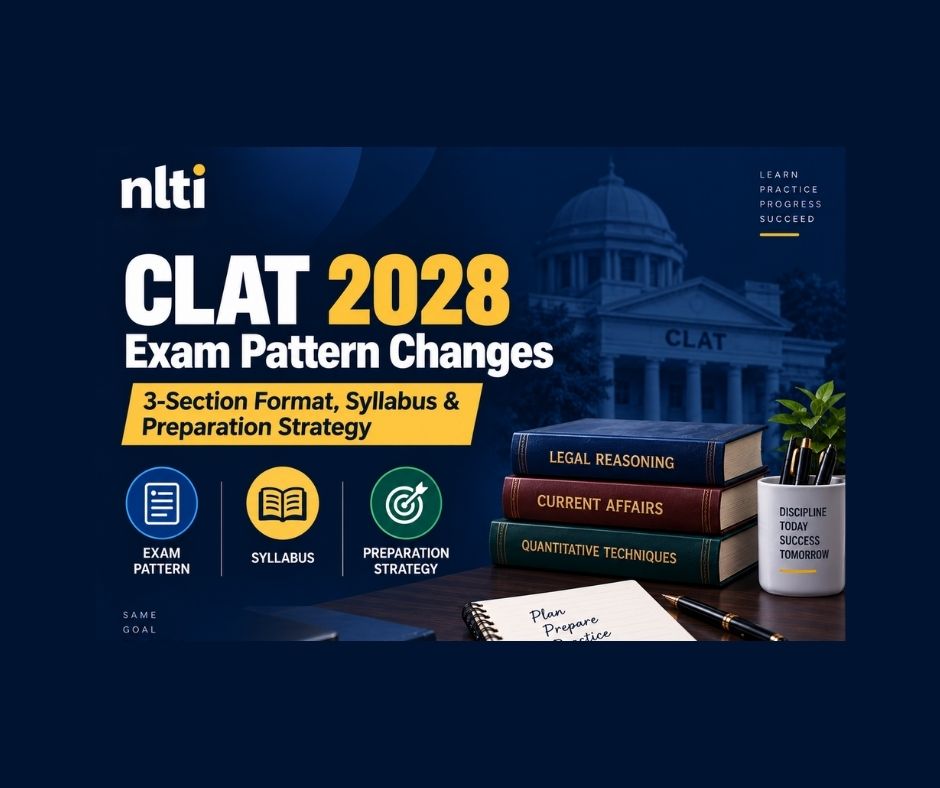
The CLAT 2028 exam pattern could look very different from the current five-section format. The CLAT Expert Committee has proposed a new three-section structure, changes to the role of Current Affairs and General Knowledge, fewer questions and a stronger focus on reasoning, comprehension and aptitude.
If you are preparing for CLAT 2028, these proposed changes are important to understand but there is no need to change your preparation strategy overnight. The recommendations are not the final CLAT 2028 exam pattern yet, and the Consortium is still considering the reforms and stakeholder feedback.
So, what exactly has been proposed? Which sections could change? Will GK be removed? And most importantly, how should CLAT 2028 aspirants prepare right now? Here is everything you need to know.
Best CLAT Coaching Online 2027–2028 by NLTI
What Are the Proposed CLAT 2028 Changes?
The CLAT Expert Committee Report 2026 has recommended several changes to the existing undergraduate CLAT examination.
The recommendations aim to make CLAT more focused on aptitude, comprehension, reasoning and application, rather than relying heavily on speed, memorisation and a large number of questions.
Currently, CLAT UG consists of five sections:
English Language
Current Affairs including General Knowledge
Legal Reasoning
Logical Reasoning
Quantitative Techniques
The Expert Committee has proposed restructuring these into three broader sections.
Who Is on the CLAT Expert Committee?
The recommendations have been prepared by a five-member panel of academic experts, including professors associated with leading universities across the world:
Prof. Dev Saif Gangjee - University of Oxford - Co-Chair
Prof. Tarunabh Khaitan - London School of Economics (LSE) - Co-Chair
Prof. Shyamkrishna Balganesh - Columbia Law School - Member
Prof. Pritam Baruah - BML Munjal University - Member
Prof. Surabhi Ranganathan - University of Cambridge - Member
The committee was constituted to review the existing CLAT examination and recommend medium- and long-term reforms.
Public Feedback on the Report
The CLAT Expert Committee Report has also been opened for public feedback and suggestions from students, experts and other stakeholders. The feedback will be considered before further decisions are taken on the proposed reforms.
CLAT 2027: How to Complete the Paper in 2 Hours
Key Takeaways at a Glance
3 sections proposed: Language & Comprehension, Logical Reasoning & Legal Aptitude, and Quantitative Techniques.
GK & Current Affairs: Proposed to be removed as a separate section.
Fewer questions: Around 10–15 questions have been proposed per section.
Major focus: Greater emphasis on comprehension, reasoning, critical thinking and application.
Status: These are recommendations, not the final CLAT 2028 pattern.
CLAT 2027: No change the existing five-section pattern continues.
Proposed CLAT 2028 Exam Pattern
1. Language & Comprehension
The proposed section would focus on a student's ability to read, understand and interpret written material.
It could test skills such as:
Reading comprehension
Interpretation
Inference
Understanding arguments
Analysis of written material
This makes strong reading ability particularly important for CLAT 2028 preparation.
2. Logical Reasoning & Legal Aptitude
The proposed structure brings Logical Reasoning and Legal Aptitude together into a broader aptitude-based section.
Students may need to demonstrate:
Critical thinking
Logical reasoning
Analysis of arguments
Application of principles
Drawing conclusions
Problem-solving ability
The emphasis would be on how students apply information and reason through a problem, rather than simply recalling information.
3. Quantitative Techniques
Quantitative Techniques would remain a separate component.
Students would still need to develop mathematical and data interpretation skills, including areas such as percentages, ratios, averages, arithmetic and data interpretation.
Improve Reading Speed for CLAT 2027
Will GK and Current Affairs Be Removed From CLAT 2028?
One of the most discussed recommendations is the removal of Current Affairs and General Knowledge as a separate section.
However, this should not be interpreted as a confirmed change yet.
The removal of GK and Current Affairs is part of the Expert Committee's recommendations. The final CLAT 2028 syllabus and exam pattern are yet to be announced.
Therefore, aspirants should not completely stop following current affairs based only on the proposed reforms.
Fewer Questions, Greater Focus on Aptitude
The Expert Committee has also proposed a substantial reduction in the number of questions.
Under the proposed structure, each of the three sections could contain approximately 10–15 questions.
The broader objective is to move away from excessive emphasis on speed and towards depth of reasoning, comprehension and application.
For students, this could mean that simply solving a large number of questions may not be enough. Understanding why an answer is correct and analysing a passage carefully could become even more important.
What Do the Reforms Mean for CLAT 2028 Aspirants?
The proposed changes point towards a broader shift in the skills that CLAT may prioritise.
Students should focus on developing:
Strong reading comprehension
Logical reasoning
Legal aptitude
Critical thinking
Quantitative ability
Inference and analysis
Application-based problem-solving
These skills will remain useful even if the final CLAT 2028 pattern differs slightly from the current recommendations.
CLAT 2027 Question Selection Strategy: Attempt or Skip
CLAT 2028 Preparation Strategy
Since the final CLAT 2028 pattern is not confirmed yet, aspirants should focus on building strong fundamentals rather than preparing for a hypothetical paper.
1. Build a Daily Reading Habit
Make reading a part of your daily routine.
Read editorials, newspapers, opinion pieces and long-form articles to improve:
Comprehension
Vocabulary
Reading speed
Critical thinking
Ability to understand arguments
The goal is not simply to read more but to understand what you read.
2. Strengthen Logical and Legal Reasoning
Practise identifying arguments, assumptions, conclusions and inferences.
For Legal Reasoning, focus on understanding a principle and applying it to a new situation.
A useful approach is:
Principle → Facts → Application → Conclusion
This is more effective than trying to memorise large amounts of legal information.
3. Don't Ignore Quantitative Techniques
Even if the proposed structure contains fewer Quantitative Techniques questions, the section will continue to require preparation.
Build strong fundamentals in:
Percentages
Ratios
Averages
Profit and loss
Time, speed and distance
Time and work
Basic algebra
Data interpretation
4. Practise Passage-Based Questions
CLAT is a reading-heavy examination. Develop the ability to identify:
The central argument
The author's viewpoint
Important facts
Inferences
Assumptions
Relationships between ideas
After solving a passage, analyse why your answer was correct and why the other options were wrong.
5. Take Mocks Strategically
Class 11 students do not need to begin with multiple full-length mocks every week.
A better progression is:
Topic Tests → Sectional Tests → Mixed Practice → Full-Length Mocks
Mock analysis is equally important. Identify your mistakes, time-consuming questions and recurring weaknesses after every test.
6. Keep Track of Official Updates
The CLAT 2028 pattern may evolve as the reform process continues.
Follow updates from the Consortium of National Law Universities rather than changing your preparation every time an unverified CLAT 2028 pattern update appears online.
How to Start CLAT Preparation: Beginner's Complete Guide
What About CLAT 2027 Aspirants?
For CLAT 2027 aspirants, there is no need to change your preparation strategy because of these proposed reforms.
The Consortium has confirmed that the CLAT 2027 syllabus and examination pattern will remain unchanged.
CLAT 2027 aspirants should therefore continue preparing for all five existing sections:
English Language
Current Affairs & General Knowledge
Legal Reasoning
Logical Reasoning
Quantitative Techniques
The proposed reforms are primarily relevant to students looking ahead to future examination cycles.
Final Takeaway
The proposed CLAT 2028 exam pattern changes could significantly change how students approach the examination.
The proposed three-section structure, fewer questions and greater emphasis on reasoning, comprehension and aptitude indicate a shift towards assessing how students think and apply information.
However, the final CLAT 2028 pattern is still to be confirmed.
For now, the smartest approach is to focus on skills that will remain valuable regardless of the final format:
Read better. Reason better. Apply better.
Students who build strong fundamentals now will be in a much better position to adapt when the final CLAT 2028 pattern is announced.
CLAT Legal Reasoning: Solve Principle-Fact Questions
Start Your CLAT Preparation With NLTI
Preparing for CLAT 2028 early gives you time to build strong fundamentals, improve your reading and reasoning skills, and prepare with a clear strategy.
Whether you are looking for CLAT online coaching or classroom CLAT coaching in Chandigarh, NLTI offers structured programmes with expert guidance, regular practice and personalised mentorship.
Want to know which programme is right for you? Connect with NLTI for counselling and take the first step towards your CLAT preparation.
Frequently Asked Questions
1. What are the proposed CLAT 2028 exam pattern changes?
The Expert Committee has proposed restructuring the CLAT UG examination into three broader sections: Language & Comprehension, Logical Reasoning & Legal Aptitude, and Quantitative Techniques.
2. Will CLAT 2028 have three sections?
A three-section structure has been proposed by the Expert Committee. However, aspirants should wait for the official CLAT 2028 notification before treating this as the final exam pattern.
3. Will GK be removed from CLAT 2028?
The Expert Committee has proposed removing Current Affairs and General Knowledge as a separate section. The final decision has not yet been confirmed.
4. How many questions will CLAT 2028 have?
The proposed structure suggests approximately 10–15 questions per section. The final number of questions will depend on the officially notified examination pattern.
5. Should I stop studying Current Affairs for CLAT 2028?
No. Until the final CLAT 2028 pattern is officially announced, students should continue developing general awareness and reading habits while strengthening comprehension and reasoning skills.
6. Is the CLAT 2027 pattern changing?
No. The CLAT 2027 syllabus and examination pattern will remain unchanged. Aspirants should continue preparing for the existing five sections.
7. How should I prepare for CLAT 2028?
Focus on reading comprehension, logical reasoning, legal aptitude, quantitative techniques, critical thinking and passage-based practice. Build fundamentals first and gradually move towards sectional tests and full-length mocks.
8. When should I start preparing for CLAT 2028?
Starting in Class 11 gives students enough time to build strong fundamentals, develop reading habits and gradually increase their practice without unnecessary pressure.
Get In Touch
Have questions? We'd love to hear from you. Send us a message and we'll respond as soon as possible.