NLSAT 2027 Critical Reasoning Questions & Strategy
Share this article:
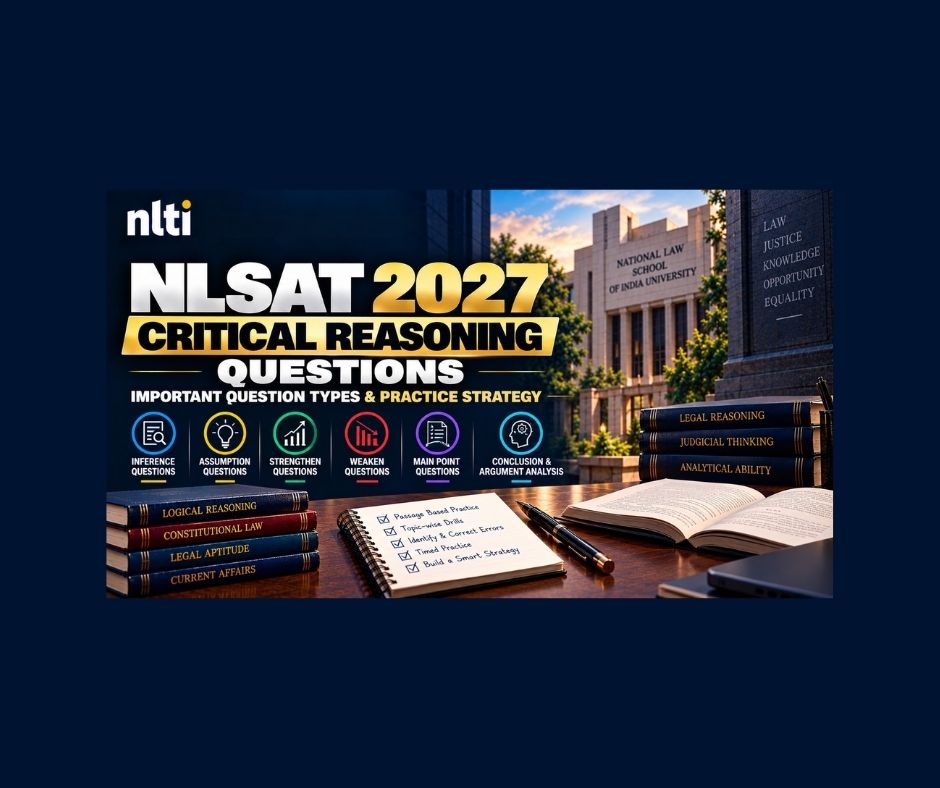
NLSAT 2027 critical reasoning is a part of NLSAT preparation because it checks a candidate's ability to understand arguments, find logical connections and look at information carefully. By just using memory students should build the habit of reading carefully and looking at how an argument is put together.
Knowing the NLSAT 2027 critical reasoning question types can help students study in a better way, get better at answering correctly and stay away from usual errors.
Check Out NLSAT Coaching and Mentorship by NLTI
What Does Critical Reasoning Test?
NLSAT 2027 critical reasoning questions ask candidates to analyse arguments not simply recall facts.
You may need to identify:
• The conclusion
• Supporting premises
• Assumptions
• Evidence
• Logical gaps
• Contradictions
• Cause‑and‑effect relationships
• Inferences
• Alternative explanations
For effective NLSAT preparation candidates should focus on why an argument works and whether the evidence truly supports its NLSAT conclusion.
NLSAT 2027 Important Topics: What Should You Study First?
Important NLSAT 2027 Critical Reasoning Question Types
Understanding common question patterns is an important first step.
1. Main Conclusion Questions
A conclusion is the main point an author is trying to establish.
When solving these questions, ask:
• What is the author trying to prove?
• Which statement depends on the other information?
• What is the central claim?
Do not confuse an example or supporting fact with the conclusion.
2. Assumption Questions
An assumption is an idea that an argument relies upon without necessarily stating it directly.
For NLSAT 2027 critical reasoning questions, identify the connection between the evidence and the conclusion.
Ask yourself:
What must be true for this argument to work?
If removing an idea seriously damages the argument, that idea may be an important assumption.
NLSAT 2027 Current Affairs: Legal & National Issues
3. Strengthen the Argument
These questions ask you to find information that makes an argument stronger.
Look for an option that:
• Adds support to the conclusion
• Gives evidence that matters
• Makes the link between the reasons and the conclusion clearer
• Eliminates a weak spot or doubt in the argument
Stay away, from choices that just talk about the same subject but do not actually back up the argument.
4. Weaken the Argument
A weakening question asks you to find information that creates doubt about the conclusion.
Possible approaches include:
• Finding contradictory evidence
• Identifying an alternative explanation
• Showing that an assumption may not hold
• Demonstrating that the evidence is insufficient
During NLSAT 2027 critical reasoning practice, pay close attention to the exact conclusion before evaluating the answer choices.
NLSAT 2027 Free Mock Tests & Practice Papers Guide
5. Inference Questions
Inference questions ask what can be reasonably concluded from the information that is provided.
The biggest mistake is to bring in information that's, outside the given facts.
Follow these steps:
Read all the information carefully. Look at each detail.
Identify what is directly supported by the information.
Eliminate options that need assumptions that are not supported by the information.
Select the conclusion that logically follows from the information that is given.
6. Identify the Flaw
Some arguments contain weaknesses in their reasoning.
Common flaws include:
• Assuming correlation proves causation
• Generalising from insufficient evidence
• Ignoring an alternative explanation
• Making an unsupported comparison
• Treating an assumption as a fact
Recognising these patterns can make NLSAT 2027 critical reasoning questions easier to analyse.
NLSAT 2027 Critical Reasoning Practice Strategy
Effective practice should gradually move from understanding concepts to solving timed questions.
NLSAT 2027 Exam Pattern & Marking Scheme Explained
How to Analyse Your Mistakes
After completing NLSAT 2027 critical reasoning questions, do not simply check the correct answers.
Create an error log.
Daily NLSAT 2027 Critical Reasoning Practice
A simple daily routine can include:
• 20 to 30 minutes of argument reading
• 10 to 15 critical reasoning questions
• Review of incorrect answers
• One short reasoning exercise
• Weekly timed practice
Candidates should focus on the quality of analysis rather than simply increasing the number of questions attempted.
NLSAT Admit Card 2026: Download & Exam Guide
Common Mistakes to Avoid
Reading Too Quickly
Missing a key word can change the meaning of an argument. Read carefully before examining the answer choices.
Choosing an Answer Based on Personal Opinion
Critical reasoning questions depend on the information given. It does not matter if you personally agree with an argument. It does not affect the answer.
Using Outside Knowledge
Unless the question asks for awareness choose your answer based only on the information and reasoning provided.
Ignoring the Conclusion
Always find the conclusion, before looking at the answer choices.
Practising Without Reviewing
Solving questions without going back to check your work is not helpful.
How to Improve Accuracy and Speed
Follow this sequence:
Read → Identify the argument → Find the conclusion → Analyse the evidence → Evaluate options → Select the supported answer
Once your accuracy becomes consistent, introduce time limits and practise mixed question sets.
During practice, classify every question according to its type. This can help you identify whether you are consistently struggling with assumptions, inferences, strengthen or weaken questions, or another area.
NLSAT Current Affairs & GK Prep 2027 Guide
NLSAT 2027 Critical Reasoning Final Checklist
Before the examination make sure you can confidently work with:
• conclusions
• Premises
• Assumptions
• Inferences
• Strengthen questions
• Weaken questions
• flaws
• Cause‑and‑effect arguments
• Contradictions
• Alternative explanations
• Evidence‑based reasoning
I recommend keeping your preparation aligned with the latest official exam information when the NLSAT 2027 details are released.
Conclusion
The NLSAT 2027 critical reasoning study should focus on learning how arguments are built of just remembering the way questions are asked. Begin with practice without time limits take the time to find the points and the hidden ideas and then slowly start working on different types of questions and ones that have time limits.
Nlsat 2027 critical reasoning practice, along, with looking carefully at the mistakes made can help people get better at solving problems and build better thinking skills.
Start Your NLSAT 2027 Preparation With NLTI
Build your preparation with structured study material, regular practice and expert guidance.
Start your NLSAT 2027 preparation with NLTI today.
FAQs
1. What is critical reasoning in NLSAT?
Critical reasoning in NLSAT is about how you can evaluate arguments. It tests your ability to look at evidence find assumptions and see how ideas connect.
2. What types of questions should I practise?
You should practise conclusion questions, assumption questions, inference questions, strengthen and weaken questions flaw questions, evidence questions and cause-and-effect questions.
3. How can I improve my reasoning skills?
Read arguments often. Do practice questions. After each one go over the answers carefully. Understand where you made mistakes. This helps you grow.
4. Should I use knowledge while solving reasoning questions?
No. Stick to what's given in the question. Only use knowledge if the question specifically asks for it.
5. How critical reasoning questions should I practise daily?
There is no number. It's better to do a questions carefully and learn from each one than to rush through many without understanding.
6. How do I identify the conclusion?
Think about what the author's trying to prove. The conclusion is usually the point. The other parts of the argument support that point.
7. Why do I make mistakes in assumption questions?
A common mistake is treating an assumption, like a fact. Remember assumptions are not said directly. They are the missing pieces that make the argument work.
8. Should I practise reasoning under time limits?
Yes,. Only after you can get most answers right without time pressure. Practice first then slowly add time limits.
9. How should I analyse answers?
First know the question type. Then figure out where your reasoning went wrong. Write down the mistake in a log so you don’t make it again.
10. Is reasoning important for NLSAT preparation?
Yes. Critical reasoning is very important. It tests your ability to analyse arguments use evidence properly and understand relationships.
Get In Touch
Have questions? We'd love to hear from you. Send us a message and we'll respond as soon as possible.