CLAT 2027 Previous Year Paper Analysis: Key Insights
Share this article:
CLAT 2027 Previous Year Paper Analysis: What CLAT PYQs Actually Reveal
CLAT previous year questions are often misunderstood. Many aspirants treat CLAT PYQs as revision tools or repetition banks, assuming similar questions will reappear. This assumption is precisely why strong aspirants still underperform.
CLAT PYQs are not about repetition. They are about exam behaviour.
A serious analysis of CLAT previous year papers, especially CLAT 2024–2026, shows that the exam has undergone a structural shift. The Consortium now tests reasoning discipline, accuracy control, and decision-making under pressure rather than content familiarity.
This blog presents a detailed CLAT 2027 previous year paper analysis, decoding how CLAT PYQs should be studied, what patterns actually repeat, and how aspirants should convert PYQ insights into rank improvement.
Best CLAT Coaching Online 2027–2028 by NLTI
Why CLAT Previous Year Questions Matter More Than Syllabus Completion
Most aspirants focus on finishing the CLAT syllabus. Toppers focus on understanding how questions are framed.
CLAT previous year questions reveal:
How the Consortium sets traps
How close answer choices are framed
How accuracy gaps create massive rank swings
How section difficulty shifts year to year
How decision-making is tested more than knowledge
Between CLAT 2021 and CLAT 2026, the exam moved decisively away from predictability. PYQs are the only reliable evidence of this change.
Macro Trends Observed from CLAT PYQs (2019–2026)
A longitudinal review of CLAT PYQs reveals five dominant trends:
1. Analytical reasoning has replaced direct reasoning
2. Accuracy now outweighs attempt volume
3. GK is no longer passage-dependent
4. Quant is logic-heavy, not calculation-heavy
5. English tests interpretation, not grammar
These trends explain why aspirants relying on older preparation templates struggle.
Read More: Reading Comprehension Strategy for CLAT 2027
Section-Wise Evolution Based on CLAT Previous Year Papers
English & Reading Comprehension: From Easy Marks to Rank Separator
Earlier CLAT English sections rewarded surface-level reading. That is no longer the case.
What PYQs Show
Passage length has increased
Topics are abstract (philosophy, sociology, public policy)
Questions test tone, intent, and implication
Options are closely worded to test precision
Common PYQ Traps
Extreme language options
Emotionally appealing distractors
Options that are factually correct but contextually wrong
How to Use English PYQs
Identify passage structure, not facts
Track how tone-based questions are framed
Practise elimination rather than answer-hunting
CLAT English now rewards controlled interpretation, not fluency.
Logical Reasoning: The Biggest Structural Shift
Logical Reasoning shows the clearest transformation in CLAT.
Earlier Pattern
Short passages
Dominance of critical reasoning
Standalone assumption or inference questions
Post-2026 PYQ Pattern
Analytical reasoning dominance
Multi-condition passages
Deduction-heavy logic sets
Reduced standalone CR questions
Why Aspirants Fail Here
They read without mapping conditions
They assume instead of deducing
They over-invest time in sinkhole questions
How to Use Logical PYQs
Break passages into logical constraints
Practise eliminating options via contradictions
Track time spent per logical set
Logical Reasoning now determines rank volatility.
Read More: How to Analyze CLAT Mock Tests Like a Topper
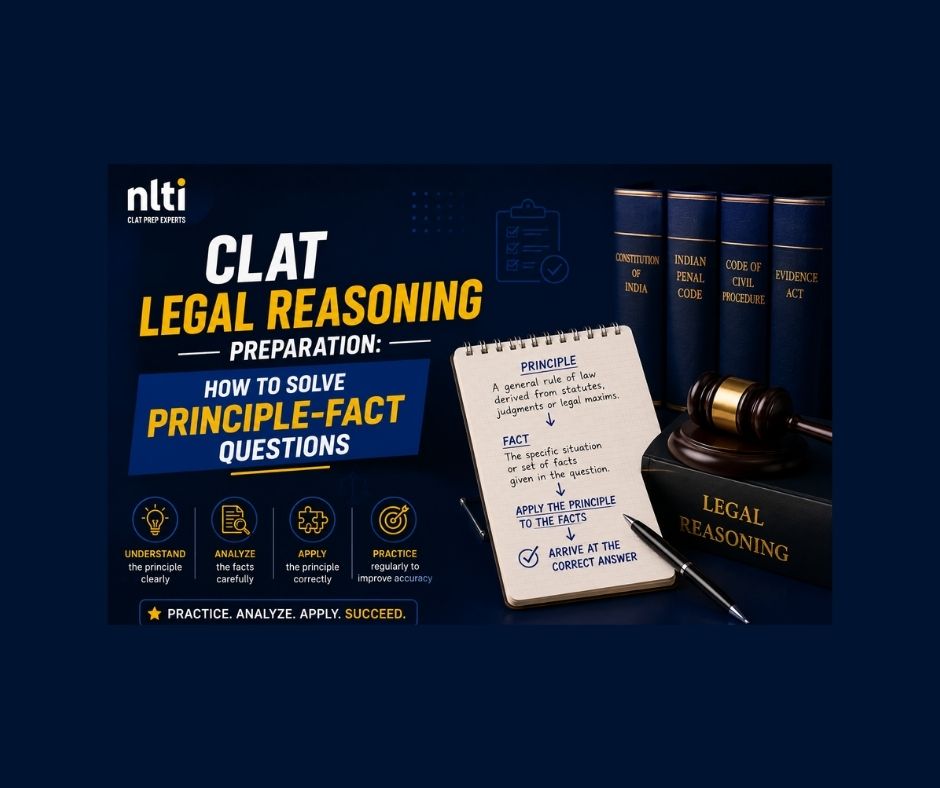
Legal Reasoning: Application Over Legal Knowledge
CLAT legal reasoning is often misprepared as a law subject. PYQs show otherwise.
What PYQs Reveal
Principles are increasingly abstract
Static legal awareness appears subtly
Options are designed to tempt real-world law application
Common Legal PYQ Mistakes
Importing IPC or constitutional knowledge
Moral reasoning instead of legal logic
Skimming principles
Correct PYQ-Based Strategy
Reduce principles to logical rules
Apply facts strictly, without assumptions
Eliminate options that add extra conditions
Legal reasoning tests discipline, not legal literacy.
GK & Current Affairs: Integrated and Unpredictable
GK is the most misjudged section.
PYQ Pattern Shift
Movement away from purely passage-based GK
Increased off-passage static questions
Integration of static concepts with current events
Why Aspirants Struggle
Excessive note-making without revision
Over-reliance on newspapers
Lack of issue-based consolidation
How to Use GK PYQs
Identify depth level (factual vs analytical)
Link current events to static themes
Analyse why wrong options are tempting
GK now tests retention and linkage, not volume.
Quantitative Techniques: DI Over Arithmetic
CLAT maths has been simplified structurally but made trickier behaviourally.
PYQ Observations
Data interpretation dominates
Arithmetic is basic but deceptive
Calculation-heavy approaches fail
Time displacement affects later sections
Common Quant PYQ Errors
Over-calculation
Ignoring estimation
Blindly attempting all DI questions
Correct PYQ Strategy
Practise selection logic
Build estimation comfort
Learn to skip low-return questions
Quant rewards decision clarity, not solving ability.
Read More: Current Affairs Strategy for CLAT 2027 Preparation
How CLAT PYQs Have Changed the Exam
How to Analyse CLAT Previous Year Questions Correctly
Solving PYQs without analysis is ineffective.
Step 1: Reverse Engineer Every Question
Ask:
Why is the correct option correct?
Why is each wrong option wrong?
Step 2: Classify Errors
Label mistakes as:
Reading error
Logic error
Calculation error
Panic error
Overthinking error
Step 3: Extract Patterns
Convert multiple PYQs into:
Logical templates
GK issue clusters
Recurrent RC traps
Step 4: Simulate Exam Behaviour
Solve PYQs in CLAT-like section order to practise time displacement.
Read More: Best Books for CLAT 2027 – Section-Wise Preparation
What CLAT PYQs Cannot Do
CLAT PYQs do not:
Predict exact difficulty
Guarantee repetition
Replace mock testing
Simulate exam pressure
They teach structure, not certainty.
How Many Years of CLAT PYQs Are Enough?
Last 6–7 years for pattern understanding
Last 3 years for behavioural alignment
Earlier years only for sectional familiarity
More PYQs do not equal better preparation.
Weekly PYQ-Based Study Framework
Day 1: Logical PYQs (timed)
Day 2: Deep analysis + error logging
Day 3: Legal + GK PYQs
Day 4: Quant DI PYQs
Day 5: Reattempt weak questions
This builds stability, not panic.
Why Serious Aspirants Use PYQs Differently
They:
Analyse more than they solve
Track behavioural mistakes
Focus on accuracy patterns
Use PYQs to calibrate strategy
NLTI analyses post-2026 CLAT PYQs to identify accuracy traps, decision-making errors, and section-wise behaviour shifts for aspirants.
Final Takeaways for CLAT 2027 Aspirants
CLAT PYQs are diagnostic tools, not revision sheets
Accuracy matters more than attempts
Decision-making is the hidden skill
Exam behaviour repeats, not questions
Final Word
CLAT previous year questions are the most honest mirror of the exam. They expose preparation gaps that books and videos cannot.
Used casually, PYQs waste time.
Used analytically, they transform preparation into performance.
For CLAT 2027, PYQs are not optional. They are essential — but only if studied the right way.
FAQs
1. How many years of CLAT previous year questions should I solve for CLAT 2027?
Ideally, solve the last 6–7 years of CLAT PYQs for pattern understanding, with deeper analysis of the most recent 3 years.
2. Are CLAT previous year questions enough to crack CLAT 2027?
No. CLAT PYQs help understand exam behaviour, but they must be combined with mock tests and section-wise practice for complete preparation.
3. Do questions repeat in CLAT from previous years?
Exact questions do not repeat. However, question structures, traps, and reasoning patterns often reappear in modified forms.
4. Should I solve CLAT PYQs in a timed manner or section-wise?
Both are useful. Start section-wise for understanding, then solve PYQs in full-length timed format to simulate exam conditions.
5. Are older CLAT PYQs (before 2018) still relevant for CLAT 2027?
They are less relevant for strategy. CLAT papers before 2019 follow a different pattern and should be used only for basic familiarity.
6. How are CLAT PYQs different from mock test questions?
CLAT PYQs reflect the actual Consortium exam philosophy, while mock tests are predictive. PYQs show what has happened; mocks test readiness.
Get In Touch
Have questions? We'd love to hear from you. Send us a message and we'll respond as soon as possible.