CLAT 2027: Complete Exam Overview for Law Aspirants
Share this article:

CLAT is one of the most misunderstood entrance exams in India, especially among beginners. Many aspirants treat it like a memory-based test, similar to school exams or competitive GK papers. That misunderstanding leads to months of inefficient preparation. CLAT 2027 is not about how much information you can memorise. It is a skill-based, decision-driven law entrance exam that rewards reading ability, logical application, and accuracy under pressure.
A large number of CLAT 2027 aspirants begin preparation without first understanding the exam itself. They jump straight into books, mock tests, or coaching schedules without clarity on the CLAT exam details, exam structure, or marking logic. This confusion often results in burnout, panic, and wasted effort.
This blog provides a complete, clear, and updated overview of CLAT 2027 so law aspirants know exactly what the exam is, how it works, and what to expect before starting preparation.
Best CLAT Coaching Online 2027–2028 by NLTI
What Is CLAT? (Explained Clearly for Aspirants)
CLAT stands for Common Law Admission Test. It is a national-level law entrance exam conducted by the Consortium of National Law Universities (NLUs). CLAT 2027 is primarily meant for admission to undergraduate and postgraduate law programmes offered by NLUs across India.
CLAT 2027 is a skill-based exam, not a knowledge-heavy one. It tests how well aspirants can read complex material, apply logic, understand arguments, and make accurate decisions under time pressure.
What CLAT actually tests:
Reading comprehension and interpretation
Logical and analytical reasoning
Application-based legal aptitude
Data interpretation and numerical reasoning
What CLAT does not test:
Mugged-up GK facts
School-level grammar rules
Legal theory or bare acts
Mathematical formulas beyond basic arithmetic
Understanding these CLAT exam details early prevents aspirants from treating CLAT 2027 like a traditional exam.
Which Colleges Accept CLAT 2027 Scores?
CLAT 2027 scores are accepted by National Law Universities (NLUs) across India. NLUs are autonomous public institutions established specifically for legal education.
Key points:
Around 24 NLUs currently participate in CLAT UG admission
Most NLUs offer 5-year integrated law degrees such as BA LLB, BBA LLB, BCom LLB, and BSc LLB
Some private universities and institutions also use CLAT scores as a reference
CLAT is different from other law entrance exams because it acts as a centralised admission test for multiple premier institutions, making it highly competitive. This is why law entrance exam CLAT preparation requires clarity and discipline.
Read More: How to Analyze CLAT Mock Tests Like a Topper
CLAT 2027 Exam Details at a Glance
These CLAT exam details form the foundation for understanding how the paper behaves.
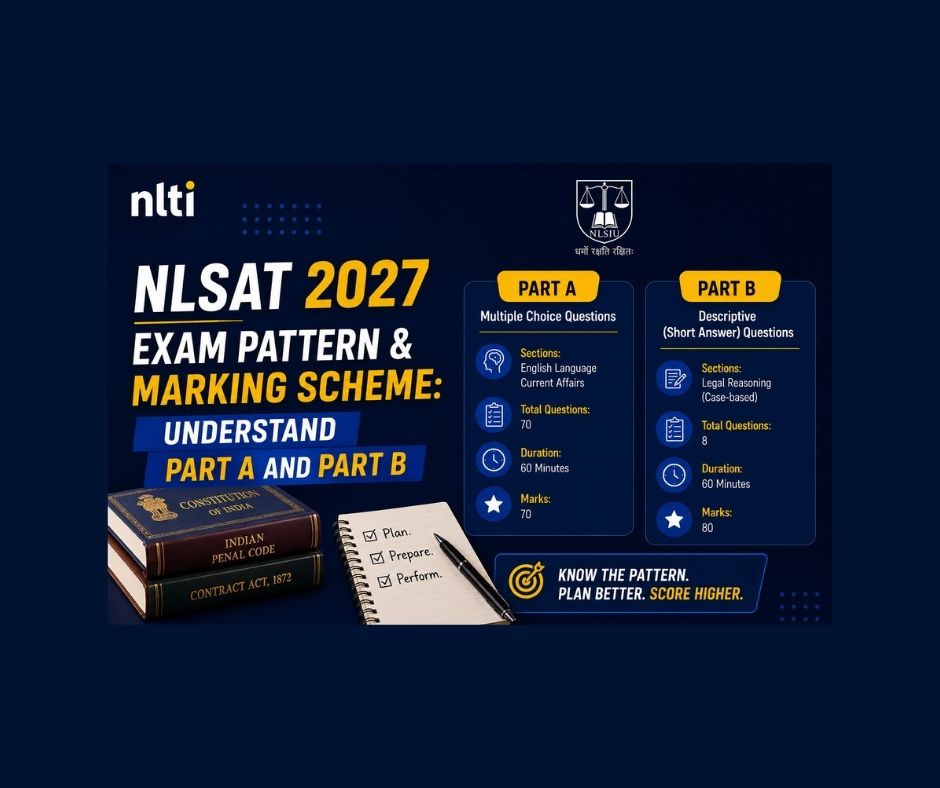
CLAT 2027 Exam Pattern (Post-2026 Context)
The CLAT 2027 exam pattern is entirely passage-based. Each section contains reading passages followed by multiple questions. The focus is on interpretation, not direct recall.
English Language
Tests reading comprehension, inference, tone, and vocabulary-in-context. Grammar rules are tested indirectly through comprehension.
Current Affairs & GK
Includes a mix of current issues and static background knowledge. Questions are often passage-linked, making understanding context crucial.
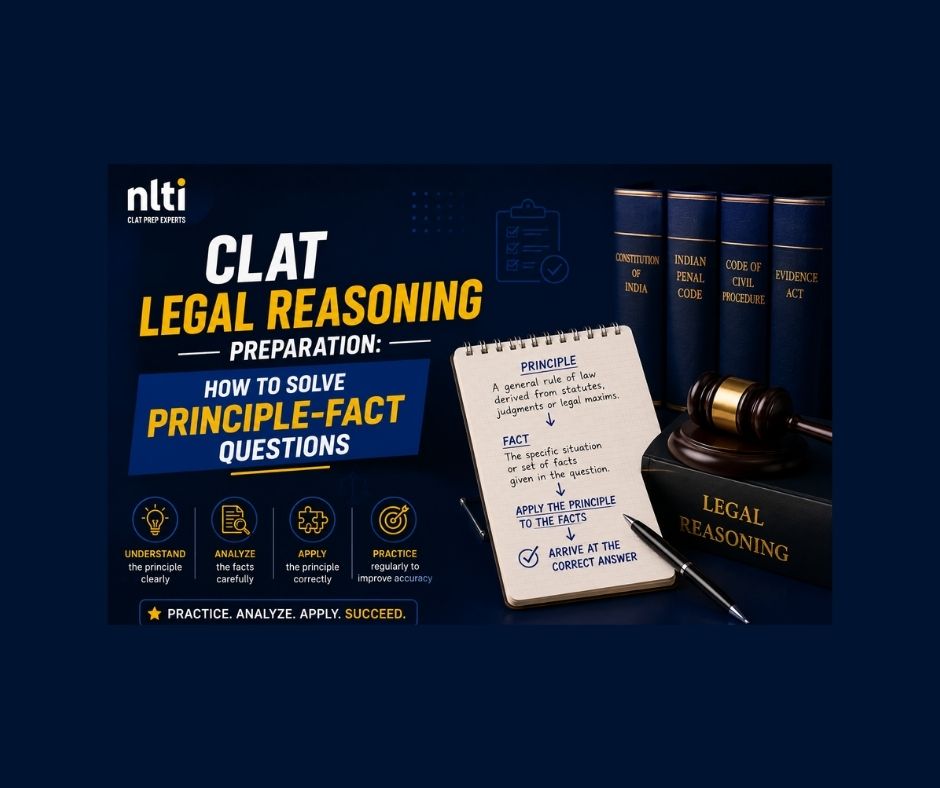
Legal Reasoning
Based on principle–fact questions. Aspirants must apply a given legal principle to a factual situation logically, without using external legal knowledge.
Logical Reasoning
Heavily analytical after CLAT 2026. Includes arguments, assumptions, conclusions, and analytical reasoning sets.
Quantitative Techniques
Focuses on data interpretation, ratios, percentages, and basic arithmetic. Calculation-light but logic-heavy.
This CLAT exam format rewards careful reading and disciplined thinking rather than speed alone.
Read More: Current Affairs Strategy for CLAT 2027 Preparation
CLAT Syllabus 2027: What It Covers and What It Doesn’t
The CLAT syllabus 2027 is skill-oriented, not topic-heavy. There is no officially prescribed topic list like board exams.
What it covers:
Reading comprehension skills
Logical and analytical reasoning
Legal aptitude through application
Quantitative reasoning using real-life data
What it does not cover:
Advanced mathematics
Memorisation-heavy GK lists
Legal theory or case law
Many CLAT 2027 aspirants confuse syllabus with preparation material. The syllabus defines skills, not chapters.
CLAT Eligibility 2027 (Explained Simply)
CLAT eligibility 2027 for UG courses is straightforward:
Educational qualification: Class 12 or equivalent
Minimum marks:
General/OBC/PwD: 45%
SC/ST: 40%
Age limit: No upper age limit
Gap years: Allowed
As long as these conditions are met, aspirants can appear for CLAT UG admission.
CLAT 2027 Marking Scheme & Negative Marking
The CLAT marking scheme plays a major role in rank determination:
+1 mark for every correct answer
–0.25 mark for every wrong answer
No penalty for unattempted questions
Due to negative marking, accuracy matters more than attempts. CLAT 2026 showed that aggressive guessing strategies fail badly. Controlled attempts lead to better ranks.
CLAT Application Process 2027 (Step-by-Step Overview)
The CLAT application process is conducted online through the Consortium’s official portal.
Steps include:
1. Online registration
2. Filling personal and academic details
3. Selecting NLU preferences
4. Uploading documents
5. Paying application fee
6. Downloading admit card
7. Appearing for the exam
Understanding this process early helps CLAT 2027 aspirants avoid last-minute errors.
CLAT Exam Structure vs School Exams (Key Differences)
CLAT exam structure is fundamentally different from school exams:
No direct questions
Heavy reading and interpretation
Decision-based answering
Severe time pressure
Unlike school exams, CLAT does not reward memorisation. It rewards clarity, logic, and calm execution.
What Skills Does CLAT 2027 Actually Test?
CLAT 2027 evaluates:
Reading comprehension
Logical application of information
Analytical thinking
Accuracy under pressure
Decision-making ability
These skills determine long-term success, not rote learning.
Read More: Best Books for CLAT 2027 – Section-Wise Preparation
How Difficult Is CLAT 2027 Really?
CLAT feels difficult because:
Passages are unfamiliar
Options are closely worded
Time pressure is constant
Difficulty is relative. Calm, structured candidates outperform fast but careless ones. Most CLAT 2027 aspirants underestimate the importance of mental discipline.
How CLAT 2026 Changed Expectations for CLAT 2027
CLAT 2026 reshaped preparation expectations:
Analytical reasoning dominated
Static GK returned unexpectedly
Accuracy beat high attempts
Rank gaps became narrower
These trends shape the CLAT preparation overview for 2027.
Common Misconceptions About CLAT 2027
“CLAT is a GK exam” – False
“Only toppers crack CLAT” – False
“Speed matters more than thinking” – False
“More attempts guarantee rank” – False
Misconceptions cause wrong preparation choices.
Read More: Reading Comprehension Strategy for CLAT 2027
Who Should Appear for CLAT 2027?
CLAT 2027 is suitable for:
Students interested in law and public policy
Those willing to read and think critically
Aspirants ready for long-term effort
Those seeking quick results without patience should reconsider.
NLTI Note
NLTI publishes CLAT exam-orientation resources that help aspirants understand exam structure, section behaviour, and post-2026 pattern shifts before beginning preparation.
Final Word
CLAT is not an intelligence test. It is a learnable, structured exam. CLAT 2027 rewards clarity, discipline, and accuracy, not panic or blind effort. Understanding CLAT exam details before starting preparation saves time, reduces stress, and improves outcomes. Right understanding always beats rushed preparation.
FAQs
What is CLAT 2027 in simple terms?
CLAT 2027 is a national law entrance exam for admission to NLUs, testing reading, reasoning, and decision-making skills.
How many questions are there in CLAT?
CLAT typically has around 120 questions, subject to official notification.
Is CLAT very difficult for beginners?
It feels difficult initially, but becomes manageable with proper understanding of the exam format.
What is the marking scheme of CLAT?
+1 for correct answers, –0.25 for wrong answers, no penalty for skipping.
Which colleges accept CLAT scores?
All participating National Law Universities and some private institutions.
Is maths compulsory in CLAT?
Yes, but it is basic quantitative reasoning, not advanced mathematics.
When should I start preparing for CLAT 2027?
As early as possible, but only after understanding the exam structure.
Can I crack CLAT without coaching?
Yes, provided you have structured guidance, discipline, and proper feedback systems.
Get In Touch
Have questions? We'd love to hear from you. Send us a message and we'll respond as soon as possible.