CLAT 2027 Syllabus Explained: Section-Wise Breakdown
Share this article:
One of the biggest reasons CLAT aspirants struggle in the first few months is a fundamental misunderstanding of the syllabus. Many students assume the CLAT 2027 syllabus is a long list of topics like board exams, where finishing chapters equals progress. That assumption is incorrect. CLAT 2026 clearly exposed how dangerous syllabus misconceptions can be, as students who focused on rote coverage struggled against analytical, passage-driven questions. The CLAT 2027 syllabus is not about how much you study, but how well you understand what the exam actually tests. Without clarity, aspirants waste months on irrelevant material, unnecessary memorisation, and wrong resources. Understanding the syllabus properly at the start saves time, reduces anxiety, and prevents burnout later.
This blog explains the CLAT 2027 syllabus section-wise in simple terms, what it includes, what it excludes, and how aspirants should interpret it correctly.
Best CLAT Coaching Online 2027–2028 by NLTI
What Does “CLAT Syllabus” Actually Mean?
The CLAT 2027 syllabus does not function like an NCERT syllabus. It is not a chapter-wise list that can be “completed.” It is also not comparable to the UPSC syllabus, which is content-heavy and memory-oriented. The CLAT exam syllabus is fundamentally skill-based. It defines abilities the exam will test, not topics you must memorise.
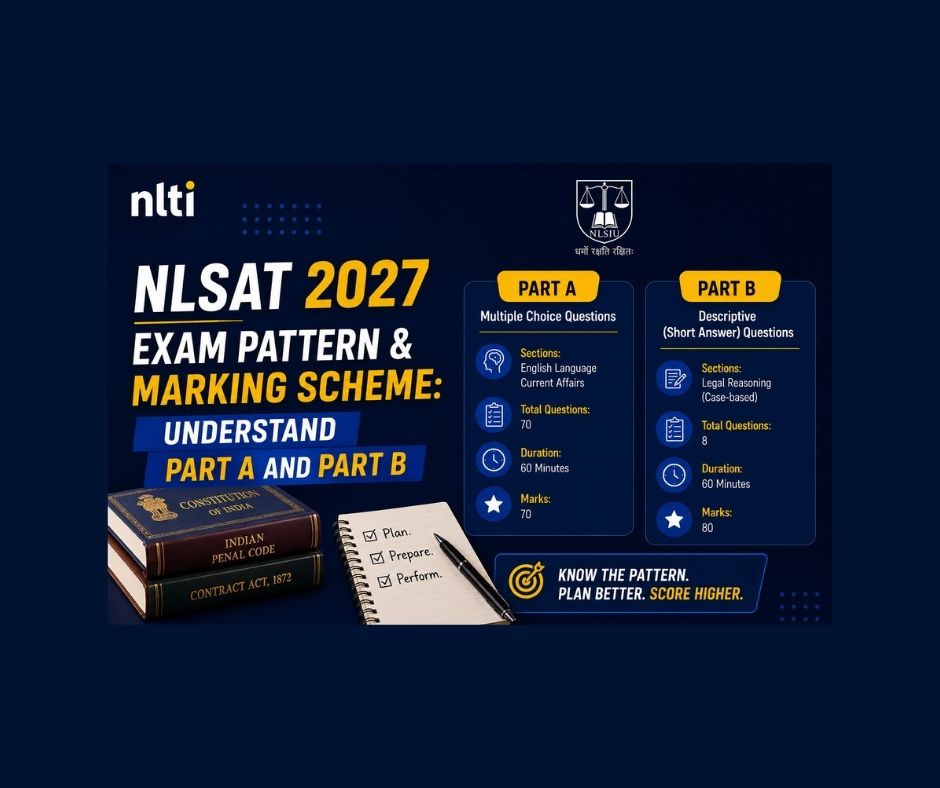
The syllabus tells you what kind of thinking is required, while the exam pattern shows how that thinking is tested. Confusing the two leads to preparation mistakes. Understanding this distinction is essential for interpreting the CLAT 2027 syllabus correctly.
CLAT 2027 Syllabus Overview (All Sections)
At a high level, the CLAT syllabus subjects are divided into five sections:
English Language
Current Affairs and General Knowledge
Legal Reasoning
Logical Reasoning
Quantitative Techniques
Each section tests reading, reasoning, and decision-making rather than direct factual recall. The CLAT UG syllabus remains consistent in structure, but the difficulty and framing of questions have evolved significantly after CLAT 2026.
CLAT English Syllabus 2027
The CLAT English syllabus focuses almost entirely on reading comprehension. Aspirants are given passages drawn from contemporary writing, literature, or opinion-based articles. Questions test whether the student can understand arguments, identify the author’s intent, and draw logical inferences.
Key components include:
Comprehension of long passages
Inference-based questions
Vocabulary in context
Tone, attitude, and central idea
What is not part of the CLAT English syllabus is equally important. There are no direct grammar rule questions, no sentence correction exercises, and no isolated vocabulary lists. Grammar is tested indirectly through comprehension accuracy. Treating English like a school subject is one of the most common CLAT syllabus misinterpretations.
Read More: How to Analyze CLAT Mock Tests Like a Topper
CLAT GK & Current Affairs Syllabus 2027
The CLAT GK syllabus combines current affairs with static general knowledge. Post-CLAT 2026, this section has become more passage-driven and analytical rather than purely factual.
The syllabus includes:
National and international current affairs
Static GK linked to history, polity, economy, and international relations
Context-based questions that require interpretation
Memorising monthly PDFs without revision or conceptual clarity is ineffective. The CLAT 2027 syllabus expects aspirants to understand issues, not just facts. Static GK often appears indirectly, embedded within current events. This is why many high-attempt strategies failed in CLAT 2026.
CLAT Legal Reasoning Syllabus 2027
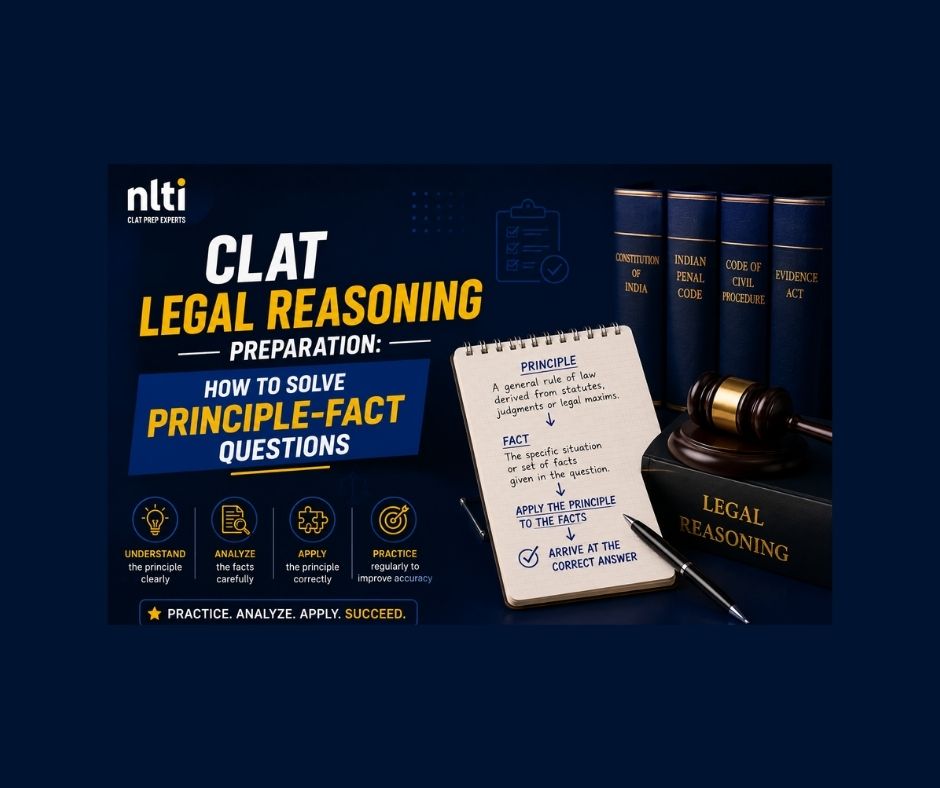
The CLAT legal reasoning syllabus does not test law as a subject. Instead, it evaluates how well a student can apply a given principle to a set of facts. Legal passages present hypothetical situations, followed by questions that test logical application.
Key elements include:
Principle–fact based questions
Application of rules to new situations
Limited static legal concepts at a very basic level
Bare acts, case laws, and detailed legal theory are not required. The CLAT 2027 syllabus rewards reasoning discipline, not prior legal knowledge. Students who rely on outside legal knowledge often make incorrect assumptions.
CLAT Logical Reasoning Syllabus 2027
The CLAT logical reasoning syllabus has shifted significantly after 2026. The focus is now on analytical reasoning through passages rather than traditional puzzle-heavy logic.
The syllabus covers:
Arguments, assumptions, and conclusions
Cause–effect relationships
Passage-based logical sets
Analytical reasoning over mechanical puzzles
Complex seating arrangements or time-distance puzzles play a limited role. Logical reasoning now overlaps with reading comprehension and analytical thinking, making clarity and calm decision-making essential.
CLAT Quantitative Techniques Syllabus 2027
The CLAT quantitative techniques syllabus is often misunderstood as a maths-heavy section. In reality, it is data interpretation focused.
The syllabus includes:
Tables, graphs, and charts
Ratios, percentages, averages
Basic arithmetic concepts
Advanced mathematics, algebra, or trigonometry are not tested. Formula memorisation has limited value. The CLAT 2027 syllabus rewards estimation, data reading, and selection logic more than calculation speed.
Here is a clean, SEO-friendly table you can directly insert into the blog.
It is structured for Google AI Overview, beginner clarity, and quick scanning.
Read More: Current Affairs Strategy for CLAT 2027 Preparation
CLAT 2027 Syllabus Section-Wise Overview
What Is NOT Included in the CLAT 2027 Syllabus (Important)
Many aspirants waste time studying areas that are not tested. The CLAT exam syllabus does not include:
Advanced mathematics
Legal case laws or theory
Memorisation-heavy GK lists
Grammar rule books
Puzzle-only logical reasoning
Ignoring these areas saves time and prevents syllabus overload, which is a major cause of burnout.
How CLAT 2026 Changed Syllabus Expectations for 2027
CLAT 2026 reshaped how aspirants must interpret the syllabus. Analytical reasoning carried more weight across sections. Static GK returned unpredictably, and accuracy consistently outperformed aggressive attempts. The reduced predictability of questions showed that surface-level syllabus coverage is insufficient. Understanding the behaviour of the CLAT exam syllabus is now as important as knowing its components.
How Beginners Should Read the CLAT Syllabus
For beginners, the CLAT syllabus for beginners should be read as a skills document. Instead of asking “Which topics are coming?”, aspirants should ask “What ability is being tested here?” Section behaviour matters more than topic lists. The syllabus is not preparation material; it is a framework to guide preparation decisions.
CLAT Syllabus vs CLAT Exam Pattern (Clear Difference)
A critical distinction:
Syllabus defines skills tested
Pattern defines how they are tested
Confusing the two leads to wrong preparation strategies. The CLAT exam subjects remain constant, but the pattern evolves in passage length, question framing, and difficulty.
Read More: Reading Comprehension Strategy for CLAT 2027
Common Misconceptions About CLAT 2027 Syllabus
Several myths persist around the CLAT syllabus explained:
“CLAT has a fixed topic list”
“You must study law subjects”
“More syllabus coverage guarantees rank”
“GK syllabus is infinite”
All these beliefs result in inefficient preparation. The CLAT 2027 syllabus rewards precision, not excess.
Read More: Best Books for CLAT 2027 – Section-Wise Preparation
How CLAT Syllabus Should Shape CLAT 2027 Preparation
A clear understanding of the CLAT 2027 syllabus ensures aspirants choose the right materials and avoid unnecessary content. Clarity beats volume. The syllabus should guide what to exclude as much as what to include. Exam behaviour must always be the reference point while preparing.
NLTI Note
NLTI publishes CLAT syllabus-orientation resources that explain section behaviour, skill expectations, and post-2026 shifts to help aspirants avoid syllabus overload.
Final Word
The CLAT 2027 syllabus is not about chapters, books, or memorisation. It is about skills, interpretation, and disciplined reasoning. Knowing what not to study is as important as knowing what to study. Clear syllabus understanding prevents burnout and wasted effort. CLAT 2027 rewards smart interpretation, not over-study.
FAQs
What is the CLAT 2027 syllabus?
The CLAT 2027 syllabus defines skills tested across English, GK, Legal, Logical, and Quantitative sections through passage-based questions.
Is CLAT syllabus very vast?
No. It feels vast only when misunderstood. The syllabus is skill-based, not content-heavy.
Does CLAT syllabus include law subjects?
No. Legal reasoning tests application skills, not law as an academic subject.
Is maths compulsory in CLAT syllabus?
Yes, but only basic arithmetic and data interpretation, not advanced mathematics.
How is CLAT syllabus different from boards?
Boards test memorisation; CLAT tests reasoning, reading, and decision-making.
Is GK syllabus unlimited for CLAT?
No. GK is limited to relevant current affairs with static linkages.
Can beginners understand CLAT syllabus easily?
Yes, if they focus on skills rather than topic lists.
Has CLAT syllabus changed after 2026?
The structure remains the same, but analytical depth and unpredictability have increased.
Get In Touch
Have questions? We'd love to hear from you. Send us a message and we'll respond as soon as possible.