CLAT 2027 FAQs: Most Searched Questions Answered
Share this article:

Preparing for CLAT often begins with repeated searches for the same doubts. Many aspirants spend months collecting scattered information instead of studying because CLAT common questions are answered inconsistently across different sources. Confusion around eligibility, exam pattern, preparation strategy, and counselling processes creates uncertainty even before preparation begins. The shift in exam behaviour after 2026, especially the emphasis on analytical reading and accuracy, has also changed the type of CLAT 2027 preparation doubts students ask today. A consolidated, factual FAQ guide therefore becomes essential for clarity and planning.
This guide answers the most searched CLAT 2027 FAQs, covering eligibility, preparation, exam pattern, strategy, counselling, and career questions in one place so aspirants can begin preparation with accurate understanding rather than assumptions.
Best CLAT Coaching Online 2027–2028 by NLTI
Section 1: CLAT Basics FAQs
What is CLAT?
CLAT is the Common Law Admission Test conducted for admission to undergraduate and postgraduate law programmes at National Law Universities (NLUs) and several affiliated institutions.
Who conducts CLAT?
The exam is conducted by the Consortium of National Law Universities on a rotational basis among member NLUs.
What courses does CLAT offer admission to?
CLAT primarily offers admission to 5-year integrated LL.B. programmes (UG) and LL.M. programmes (PG), along with certain government recruitment opportunities.
How many students appear for CLAT each year?
Approximately 60,000–80,000 candidates appear annually, making it one of the most competitive law entrance exam FAQs topics.
Is CLAT conducted once a year?
Yes. CLAT is held once every year, typically in December for the following academic session.
Is CLAT difficult compared to other law entrance exams?
CLAT is considered moderately difficult, but competition makes rank achievement challenging rather than the question difficulty alone.
CLAT 2027 Online Coaching: Benefits & Effectiveness
Section 2: CLAT 2027 Eligibility & Registration FAQs
What is CLAT eligibility 2027?
Candidates must have passed or be appearing in Class 12 with the minimum qualifying percentage prescribed in the official notification.
Is there an age limit?
Currently, there is no upper age limit specified in most recent CLAT eligibility FAQs, though candidates must check the official notification for confirmation.
Can Class 12 students apply?
Yes. Candidates appearing in Class 12 during the admission year are eligible to apply.
Can droppers appear for CLAT?
Yes. There is no restriction on the number of attempts as long as eligibility conditions are met.
When does registration begin?
Registration typically begins around July or August following the CLAT registration FAQs trend of recent years.
What documents are required for registration?
Basic documents include photograph, signature, identity proof, Class 10 and 12 certificates (or appearing proof), and category certificates if applicable.
Read More: Best Books for CLAT 2027 – Section-Wise Preparation
Section 3: CLAT Exam Pattern & Syllabus FAQs
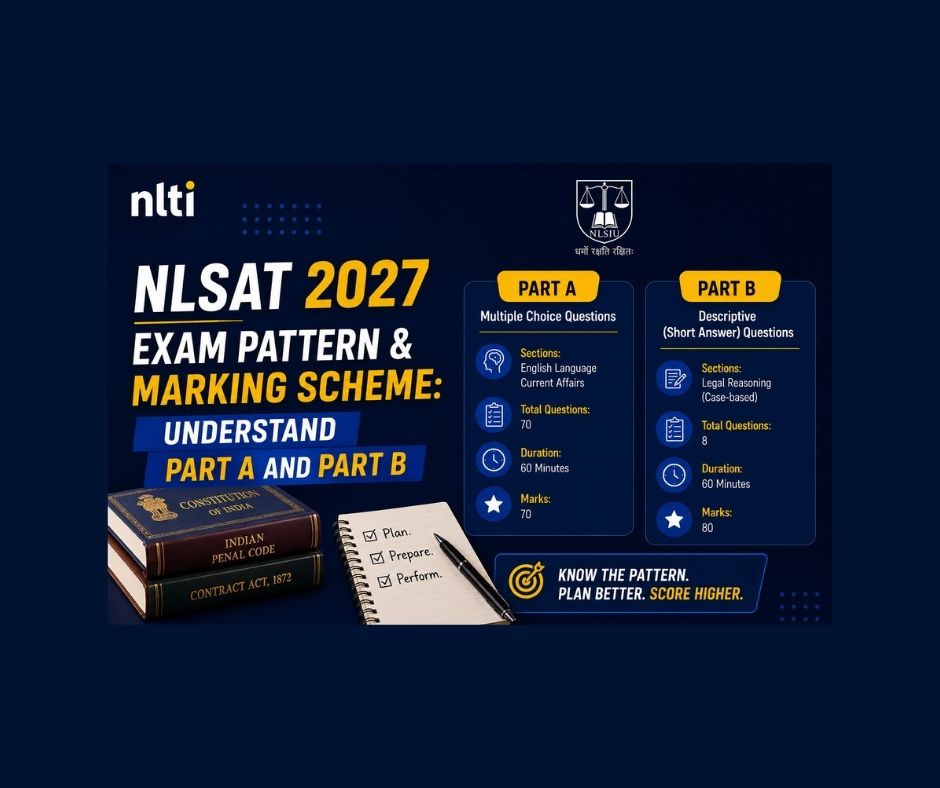
What is the CLAT 2027 exam pattern?
The exam consists of passage-based multiple-choice questions across five sections: English Language, Current Affairs including GK, Legal Reasoning, Logical Reasoning, and Quantitative Techniques.
How many questions are there?
The exam generally includes around 120 objective questions, though official confirmation comes in the notification.
What is the marking scheme?
Each correct answer carries +1 mark, and each incorrect answer results in –0.25 negative marking.
What subjects are included?
Subjects correspond to comprehension-based evaluation rather than traditional memorisation-heavy syllabus structures.
Has the syllabus changed after 2026?
The syllabus framework remains the same, but analytical reasoning emphasis has increased significantly, a key concern in CLAT exam pattern questions.
Is maths compulsory?
Quantitative Techniques includes basic arithmetic-based data interpretation questions, but advanced mathematics is not required.
Read More: How to Analyze CLAT Mock Tests Like a Topper
Section 4: CLAT Preparation & Strategy FAQs
How to start CLAT 2027 preparation?
Begin with reading-based skill development, followed by section-wise practice and later full-length mock integration.
How many hours should I study?
Consistency matters more than hours. Most CLAT preparation FAQs suggest 4–6 focused daily hours during early preparation stages.
Is coaching necessary?
Coaching is optional; disciplined self-study combined with structured mocks can also be effective.
What is the best CLAT study plan?
A balanced weekly plan including reading, sectional practice, GK revision, and mock analysis is generally recommended in CLAT study plan FAQs.
When should mocks start?
Sectional mocks should begin early, while full-length mocks should start after conceptual familiarity is achieved.
How many mocks are enough?
Quality analysis matters more than quantity; typically 30–40 well-analysed mocks are sufficient.
How to improve accuracy?
Accuracy improves through error-tracking, elimination practice, and revisiting incorrect reasoning patterns.
How to revise GK effectively?
Monthly consolidation notes combined with periodic revision cycles are more effective than daily fragmented reading.
Read More: CLAT 2027 Application Fees: Category-Wise Fee Structure
Section 5: CLAT Mock Tests & Score FAQs
What is a good mock score?
A consistently improving score rather than a fixed number indicates effective preparation.
Why do mock scores fluctuate?
Variations occur due to different difficulty levels, decision-making errors, or incomplete revision.
How should I analyse mocks?
Sould include identifying wrong reasoning, skipped opportunities, and time allocation mistakes, central to CLAT mock test FAQs.
How many attempts are ideal in CLAT?
Attempts should be accuracy-driven rather than maximum volume-based.
Can fewer attempts still secure rank?
Yes. High accuracy attempts often outperform high-volume inaccurate attempts in the CLAT score and rank FAQs context.
Section 6: CLAT Counselling & Admission FAQs
How does CLAT counselling work?
Counselling is conducted centrally by the Consortium through multiple rounds of seat allotment.
How many counselling rounds are there?
Usually five counselling rounds are conducted, though the number may vary.
Can I upgrade my NLU?
Yes. Candidates can opt for upward revision during counselling rounds.
What if I miss counselling deadlines?
Missing deadlines may lead to forfeiture of allotted seats, making CLAT counselling FAQs extremely important.
When does counselling start?
Counselling typically begins within a few weeks after result declaration.
Section 7: CLAT Career & Future FAQs
What career options are available after CLAT?
Graduates may pursue corporate law, litigation, judiciary exams, public policy, academia, or international law careers.
Is NLU necessary for success in law?
While NLUs provide strong exposure, long-term success depends on internships, skill development, and professional networking.
Can private college students enter top firms?
Yes, though it often requires additional effort in internships and networking.
Is litigation possible after any law college?
Yes. Litigation depends more on mentorship and court exposure than institutional ranking.
What skills matter most after CLAT?
Research, drafting, analytical reasoning, and professional communication are key career-building skills.
What CLAT 2026 Changed About Aspirant Questions
The 2026 paper highlighted several shifts influencing CLAT 2027 preparation doubts:
Greater analytical reasoning dominance
Passage-heavy reading requirements
Reduced reliance on rote memorisation
Accuracy becoming more decisive than attempt volume
Narrow rank differences due to competitive scoring
These changes have shifted CLAT common questions toward decision-making, mock usage, and reading discipline rather than booklists alone.
How CLAT 2027 Aspirants Should Use FAQs Effectively
CLAT 2027 aspirants should treat FAQs as conceptual clarity tools rather than shortcuts. Always verify information through official Consortium notifications, avoid relying on informal summaries, and update preparation approaches as exam patterns evolve. Clear answers to frequently searched doubts prevent wasted preparation months and reduce decision confusion.
NLTI Note
NLTI publishes CLAT exam-orientation resources answering the most common aspirant doubts related to eligibility, preparation sequencing, and exam pattern interpretation based on post-2026 exam behaviour.
Final Word
Understanding the correct answers to CLAT common questions is the first step toward structured preparation. Reliable information prevents unnecessary stress, saves preparation time, and ensures that effort is directed toward skills that the exam actually evaluates. A clear conceptual base allows aspirants to plan preparation confidently rather than repeatedly searching for fragmented answers.
FAQs
Can I crack CLAT in one year?
Yes, consistent preparation over one focused year is sufficient for most aspirants.
Is CLAT GK very difficult?
Difficulty lies in retention and revision rather than conceptual complexity.
Which section is hardest in CLAT?
Difficulty varies by candidate; Legal and Logical reasoning often appear most analytical.
How many attempts should I target?
Attempt only questions where accuracy probability is high.
Does CLAT require coaching?
No. Coaching is optional if structured self-study is followed.
Is CLAT tougher than AILET?
Competition level differs, but both exams require strong reasoning ability.
How important is reading speed?
Reading comprehension efficiency significantly affects performance.
When should I start revision?
Revision should begin early through weekly consolidation cycles.
Is self-study enough for CLAT?
Yes, provided mock analysis and disciplined reading are maintained.
How many hours should I read daily?
At least 1–2 hours of focused reading is recommended.
Are previous year papers useful?
Yes, they help understand passage structure and reasoning patterns.
Does CLAT pattern change every year?
Core structure remains stable, but difficulty and section emphasis vary.
Is Quantitative Techniques scoring?
Yes, due to fewer questions but high accuracy potential.
How early should I start GK preparation?
At least 10–12 months before the exam.
Can weak students in maths still crack CLAT?
Yes, because Quantitative Techniques requires only basic arithmetic reasoning.
Get In Touch
Have questions? We'd love to hear from you. Send us a message and we'll respond as soon as possible.