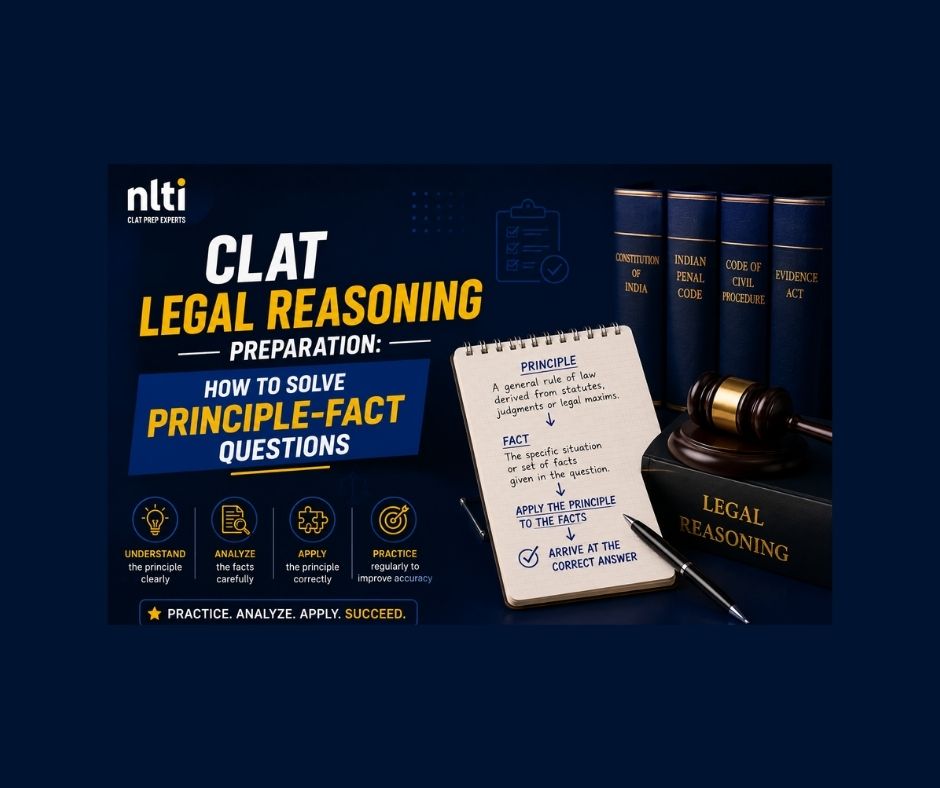
Master Legal Reasoning for CLAT 2027: Passage Approach
Share this article:

Legal reasoning consistently determines top ranks in CLAT. Under the 120-question format, the legal section carries significant weight, and its analytical nature makes it one of the most decisive areas for score stability. CLAT 2026 reinforced an important lesson: memorising legal provisions or bare acts does not guarantee marks.
Many aspirants misunderstand legal reasoning for CLAT 2027 as a knowledge-based section. It is not. It is an application-based reasoning test where principles are given, and logical consistency is rewarded. Under the current CLAT exam pattern 2027, answer choices are closer, passages are longer, and accuracy determines rank stability.
Small elimination errors now cost disproportionately in terms of rank due to compression trends. Therefore, mastering legal reasoning for CLAT 2027 requires structured principle extraction, disciplined reading, and controlled decision-making.
This guide explains how to master legal reasoning for CLAT 2027 using a structured passage + principle approach designed for analytical dominance and accuracy-first scoring.
Best CLAT Coaching Online 2027–2028 by NLTI
Understanding the Legal Reasoning Section in CLAT 2027
The CLAT legal reasoning section 2027 typically includes 28–32 questions under the 120-question format.
Each set contains passage-based legal discussions followed by hypothetical scenarios. These passages often address contemporary legal issues, policy debates, constitutional principles, tortious liability, criminal law basics, or contract doctrines.
What is tested is not legal memory but reasoning ability.
Legal knowledge = recalling statutes.
Legal reasoning = applying provided principles logically.
Under the revised structure seen in CLAT preparation after 2026, the section demands:
• Deep passage comprehension
• Logical condition matching
• Strict principle application
• Precise elimination
This makes legal reasoning for CLAT 2027 both analytical and pattern-sensitive.
Read More: CLAT 2027 Last 3 Months Strategy: Study & Revision Plan
What CLAT 2026 Changed in Legal Reasoning
CLAT 2026 introduced subtle but impactful shifts.
Passages became longer.
Principles were layered with qualifiers such as “unless,” “provided that,” and “subject to.”
Answer options became narrower and closely worded.
Direct application questions reduced; analytical elimination increased.
This shift strengthened the role of CLAT analytical legal reasoning.
Under CLAT preparation after 2026, rote preparation became ineffective. Accuracy became the deciding factor.
The Core Structure of Legal Reasoning for CLAT 2027
Mastering legal reasoning for CLAT 2027 depends on three pillars:
1. Passage comprehension
2. Principle extraction
3. Fact application
Failure in any one pillar collapses the entire attempt.
The controlling principle must be isolated before reading answer choices.
This structured CLAT legal reasoning approach strengthens performance consistency and improves the CLAT principle application method.
Read More: Best Books for CLAT 2027 – Section-Wise Preparation
Step-by-Step Passage + Principle Approach
Step 1: Read the Passage Actively
Do not skim.
Identify:
• Core issue
• Definitions
• Exceptions
• Conditions
In CLAT passage based legal reasoning, missing a qualifier leads to wrong elimination.
Step 2: Convert Principle into Logical Format
Rewrite principle into IF–THEN format.
Example:
If Condition A + Condition B are satisfied, then Outcome C follows.
This logical framing is central to solving CLAT principle fact questions.
Step 3: Match Facts to Conditions
Do not jump to answer choices.
Slowly align each fact element with each condition.
Avoid moral judgement. Apply mechanically.
This mechanical reasoning strengthens legal reasoning for CLAT 2027.
Step 4: Eliminate Precisely
Reject options that:
• Add new assumptions
• Ignore a required condition
• Misinterpret an exception
• Extend beyond principle scope
Precision determines CLAT legal reasoning accuracy.
CLAT 2027 Online Coaching: Benefits & Effectiveness
How to Convert Legal Principles into Logical Rules
Principles often contain layered wording.
Example format:
If (A) intentionally causes harm without lawful justification, then liability arises.
Here:
Necessary condition → intentional harm
Qualifier → without lawful justification
Outcome → liability
Missing qualifiers leads to wrong answers.
Strong transformation ability improves CLAT legal aptitude 2027 and core CLAT reasoning skills.
Common Types of Legal Reasoning Questions
Understanding patterns improves CLAT legal reasoning preparation.
1. Straight application
2. Exception testing
3. Analogy comparison
4. Fact variation
5. Principle strengthening
Each requires slightly different elimination discipline.
Recognising type quickly improves performance in the CLAT legal reasoning section 2027.
Read More: CLAT 2027 Admission Process for NLUs Explained
Why Students Lose Marks in Legal Reasoning
Common CLAT legal reasoning mistakes include:
• Using outside knowledge
• Rushing reading
• Ignoring qualifiers
• Applying fairness logic
• Overthinking simple principles
Improving CLAT legal reasoning accuracy requires strict internal logic discipline.
Accuracy Framework for Legal Reasoning
To master legal reasoning for CLAT 2027, track:
• Sectional accuracy %
• Careless vs conceptual errors
• Average time per passage
• Error type frequency
Target 75–80% accuracy before final months.
This structured system improves CLAT legal reasoning mock strategy execution and long-term stability.
Read More: CLAT 2027 Application Fees: Category-Wise Fee Structure
Time Management Strategy for Legal Section
Ideal time: 35–40 minutes.
Per passage: 7–8 minutes.
Suggested approach:
• Start with moderate-length passage
• Avoid longest passage first
• Skip one difficult question if stuck beyond 60 seconds
Strong CLAT legal section time management protects accuracy.
A disciplined CLAT aspirant strategy prioritises controlled pace over speed.
Mock Strategy for Legal Reasoning
Sectional mocks should precede full mocks.
Follow 3-hour review structure:
1. Error classification
2. Principle re-extraction
3. Reattempt wrong questions
Blindly solving 50+ mocks does not improve legal reasoning for CLAT 2027.
Structured analysis improves precision.
High-Yield Legal Areas in CLAT 2027
Trend-based focus areas include:
• Constitutional law principles
• Criminal liability basics
• Contract formation and breach
• Tort principles
• Public policy and rights debates
Conceptual clarity matters more than statutory memorisation in the CLAT legal reasoning section 2027.
Read More: How to Start CLAT 2027 Preparation from Zero Guide
Daily Legal Reasoning Practice Model
For consistent improvement in legal reasoning for CLAT 2027:
• Solve 1 passage daily
• Extract principle separately
• Maintain principle log
• Weekly timed section
This builds elimination muscle memory.
Can Legal Reasoning Boost Rank Significantly?
Yes.
With 28–32 questions, a 4–5 mark swing can shift hundreds of ranks.
High accuracy in legal reasoning for CLAT 2027 stabilises total score and reduces volatility.
Because of rank compression, small improvements create significant rank movement.
Psychological Discipline in Legal Section
Legal reasoning demands neutrality.
• Avoid emotional bias
• Ignore personal fairness
• Treat principle as absolute
• Stay logically mechanical
Emotional reading destroys legal reasoning for CLAT 2027 accuracy.
Read More: CLAT 2027 Study Timetable: Month-by-Month Plan
Legal Reasoning Improvement Tracker
Passage + Principle Solving Model
How Legal Reasoning Interacts With Overall Score
Under the 120-question model, stability in legal reasoning for CLAT 2027 reduces overall score variance.
Since answer choices are close, accuracy improvements compound over full mock series.
Legal reasoning often differentiates candidates scoring within 5–7 mark bands.
Therefore, mastery in this section directly impacts merit list movement.
Final Word
Legal reasoning for CLAT 2027 is logic, not law.
Principle extraction is the core skill.
Accuracy beats speed.
Elimination precision determines marks.
Structured daily practice, mechanical application, and disciplined review convert legal reasoning into a predictable, high-scoring section.
FAQs
How to improve legal reasoning for CLAT 2027?
Focus on principle extraction, structured elimination, and maintaining a detailed error log.
Is prior legal knowledge required?
No. The principle is always provided in the passage.
How many legal reasoning questions come in CLAT?
Usually around 28–32 questions under the 120-question format.
What is the ideal accuracy in legal reasoning?
Target 75–80% sectional accuracy before the final phase.
How much time should I allocate to legal reasoning?
Approximately 35–40 minutes in the exam.
Can legal reasoning significantly improve rank?
Yes. A 4–5 mark improvement can shift hundreds of ranks due to compression.
Get In Touch
Have questions? We'd love to hear from you. Send us a message and we'll respond as soon as possible.