Section-Wise Strategy for CLAT 2027: English, Legal, Logical, QT
Share this article:

Preparing for CLAT effectively requires more than simply studying topics. The exam tests how well candidates apply reasoning, interpret passages, and make accurate decisions under time pressure. Because the paper now follows a 120-question passage-based format, success depends heavily on section-wise planning.
Many aspirants prepare with a general study routine but struggle in the actual exam because each section demands a different approach. The English section tests reading comprehension and inference, legal reasoning focuses on applying principles to facts, logical reasoning examines argument evaluation, and quantitative techniques require quick interpretation of data.
CLAT 2026 reinforced an important lesson: the exam rewards accuracy and reasoning discipline rather than aggressive attempts. Students who apply the same strategy across all sections often make avoidable mistakes. Some rush through reading passages, others attempt too many questions in quant, while many struggle with elimination in logical reasoning.
A structured CLAT section strategy helps solve this problem. When aspirants understand how each section behaves, they can allocate time better, reduce negative marking, and maintain performance stability. This section-wise preparation approach improves accuracy and prevents uneven scores that hurt overall rank.
This guide explains the CLAT section strategy for English, Legal Reasoning, Logical Reasoning, and Quantitative Techniques, helping aspirants optimise accuracy, manage time efficiently, and maintain rank stability in CLAT 2027.
Best CLAT Coaching Online 2027–2028 by NLTI
Understanding the CLAT 2027 Exam Pattern First
Before building a section-wise plan, aspirants must understand the CLAT 2027 exam pattern. The test contains 120 questions distributed across five sections, though most of them are passage-based.
The exam includes:
English Language
Legal Reasoning
Logical Reasoning
Quantitative Techniques
Current Affairs and General Knowledge
Each question carries one mark, while incorrect answers attract a –0.25 negative marking penalty.
The key feature of the modern CLAT 120 question pattern is that almost every section uses reading passages. Instead of isolated questions, candidates analyse text and answer inference-based problems.
This shift toward CLAT passage based preparation means reading comprehension and analytical reasoning are central skills across sections.
CLAT 2027 Study Plan for Class 11 Students: Full Guide
How Section-Wise Strategy Improves Rank
One common problem among aspirants is uneven scoring. Some students perform well in English but struggle with quant, while others excel in legal reasoning but lose marks in logical sections.
Such inconsistency creates rank instability.
A strong CLAT section strategy aims to balance performance across sections. When candidates maintain stable accuracy in all major areas, they minimise score volatility.
Balanced preparation improves overall outcomes because:
Weak sections stop dragging down total marks
Time allocation becomes predictable
Accuracy improves across the paper
This directly strengthens the CLAT rank improvement strategy.
Read More: CLAT 2027 Mock Planner: How Many Mocks Each Month
Section Weightage Overview
Understanding this distribution helps aspirants design effective CLAT section wise preparation plans.
English Section Strategy for CLAT 2027
The English section is primarily a reading comprehension test. It evaluates how well students interpret passages, understand tone, and infer meaning from context.
A strong CLAT English preparation plan focuses on developing reading speed and analytical interpretation.
Questions in this section typically include:
Central idea identification
Tone analysis
Vocabulary in context
Logical inference
This requires mastering a consistent CLAT English RC strategy.
How to Approach English Passages
A reliable passage-solving method improves accuracy significantly.
Step 1: Read the introduction paragraph carefully.
This often reveals the author’s viewpoint.
Step 2: Identify the passage tone.
Tone recognition helps eliminate extreme answer options.
Step 3: Locate the author’s main argument.
Understanding this clarifies most inference questions.
Step 4: Apply the CLAT elimination technique to remove incorrect options.
Developing this systematic reading process improves CLAT reading speed improvement while maintaining comprehension.
CLAT 2027 Study Timetable: Month-by-Month Plan
Common English Section Mistakes
Many aspirants lose marks in English due to avoidable errors.
Typical mistakes include:
Skimming passages too quickly
Ignoring tone shifts
Choosing emotionally appealing answers
The correction lies in disciplined reading and careful elimination.
Legal Reasoning Strategy for CLAT 2027
The legal reasoning section tests analytical thinking rather than legal knowledge. Candidates are expected to apply principles presented in the passage to hypothetical scenarios.
Success in Legal reasoning CLAT 2027 depends on disciplined application of logic rather than memorisation of laws.
Key question types include:
Principle-fact application
Policy interpretation
Public law reasoning
A focused CLAT legal reasoning strategy helps candidates maintain high accuracy.
CLAT 2027 Study Timetable: Month-by-Month Plan
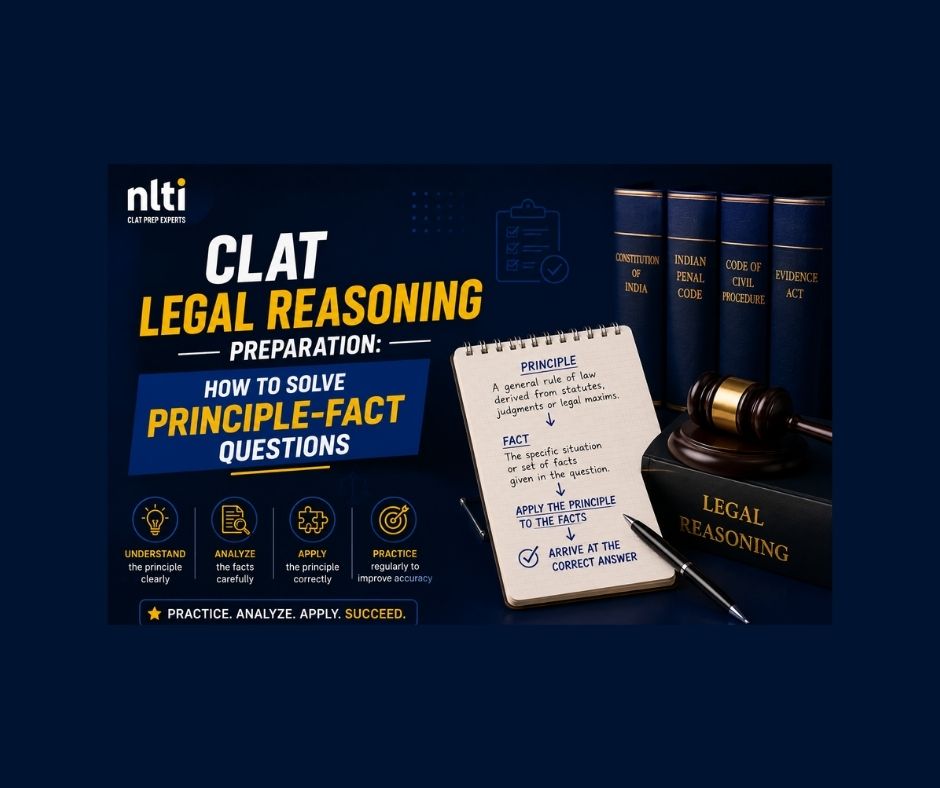
The Principle-Fact Method
The principle-fact method is the core framework for solving legal questions.
Step 1: Identify the legal principle stated in the passage.
Step 2: Apply the principle strictly to the given facts.
Step 3: Avoid personal moral judgement.
This structured reasoning process forms the foundation of Legal reasoning CLAT 2027.
Legal Reasoning Elimination Strategy
Legal reasoning questions often contain options that appear very similar.
Candidates should focus on:
Matching the principle precisely
Identifying subtle differences between options
Strong CLAT reasoning skills help aspirants eliminate misleading answers.
Common Legal Section Mistakes
Typical errors include:
Using outside legal knowledge
Interpreting the principle morally
Ignoring keywords within the principle
Avoiding these mistakes strengthens CLAT legal reasoning strategy.
Logical Reasoning Strategy for CLAT 2027
Logical reasoning questions test the ability to analyse arguments and evaluate conclusions.
This section often includes:
Strengthen or weaken arguments
Identify assumptions
Draw logical inferences
Strong CLAT logical reasoning tips focus on understanding the argument structure.
Logical Passage Solving Framework
A systematic approach improves logical accuracy.
Step 1: Identify the conclusion.
Step 2: Determine the supporting premises.
Step 3: Evaluate the assumption connecting them.
This framework builds strong CLAT analytical reasoning skills.
Read More: CLAT 2027 Without Coaching: Can Self Study Get You Into NLU
Logical Section Mistakes
Many aspirants struggle with logical reasoning due to:
Confusing inference with assumption
Agreeing emotionally with arguments
Correcting these errors improves CLAT logical reasoning strategy.
Quantitative Techniques Strategy
The quantitative techniques section primarily consists of data interpretation sets. Questions require students to interpret tables, charts, and graphs.
The focus of CLAT quantitative techniques strategy is not advanced mathematics but quick analysis.
Typical topics include:
Ratio and proportion
Percentages
Averages
Graph interpretation
DI Solving Strategy
To solve DI passages effectively:
1. Read the table or graph carefully.
2. Identify the required numbers.
3. Perform only necessary calculations.
Selective solving improves efficiency.
Quant Section Mistakes
Common mistakes include:
Spending excessive time on one DI set
Making calculation errors
Effective time control is critical.
Accuracy vs Attempts Across Sections
Different sections require different attempt strategies.
English and logical sections require careful elimination. Legal reasoning may allow slightly higher attempts because principles guide answers. Quantitative techniques require selective attempts.
Balancing CLAT accuracy vs attempts is essential for score stability.
The CLAT attempt optimisation model suggests adjusting attempts based on accuracy consistency rather than targeting a fixed number of questions.
Read More: CLAT 2027 vs AILET 2027: Which Exam Should You Prioritise
Accuracy Strategy by Section
Maintaining these levels supports CLAT performance stabilisation.
How Mocks Improve Section-Wise Performance
Mock tests reveal which sections require improvement.
Students should track:
Section-wise accuracy
Time spent per section
Negative marking patterns
This data-driven approach improves CLAT mock test strategy 2027.
Common Preparation Mistakes by Section
Different sections require different preparation habits.
English mistakes often involve neglecting daily reading.
Legal reasoning errors occur when students memorise legal provisions rather than practising principles.
Logical reasoning mistakes arise from rushing argument analysis.
Quant errors occur when aspirants avoid practising data interpretation.
Avoiding these problems is central to CLAT preparation mistakes to avoid.
What CLAT 2026 Taught Us: Lessons for CLAT 2027 Aspirants
Psychological Discipline During Section Solving
Mental stability during the exam is equally important.
Students must avoid panic if a section appears difficult. Instead, they should follow a predetermined section order and maintain focus.
This disciplined mindset forms an essential part of any CLAT 2027 aspirants guide.
NLTI Note
Preparation models used by institutions such as NLTI emphasise section-wise accuracy tracking and passage-analysis discipline aligned with the modern CLAT exam structure.
Final Section Strategy Blueprint
A successful CLAT section strategy follows five core principles.
1. Develop daily reading habits to strengthen English comprehension.
2. Apply the principle-fact method consistently in legal reasoning.
3. Analyse arguments carefully in logical reasoning.
4. Solve DI sets selectively in quantitative techniques.
5. Maintain accuracy above 75 percent across sections.
This structured approach improves overall performance stability.
Read More: CLAT 2027 Without Coaching: Can Self Study Get You Into NLU
Final Word
CLAT preparation is no longer about mastering isolated topics. The modern exam demands strong reading comprehension, analytical reasoning, and disciplined decision-making.
A balanced CLAT section strategy ensures that no single section undermines overall performance. When aspirants maintain stable accuracy across English, Legal, Logical, and Quant sections, they significantly improve their chances of securing a high rank.
Strategic section management, accurate elimination, and disciplined time allocation ultimately determine success in CLAT 2027.
FAQs
1. Which section is hardest in CLAT?
Many aspirants find legal reasoning challenging because it requires careful principle application rather than memorisation.
2. How can I improve CLAT English comprehension?
Daily editorial reading and practising passage-based questions significantly improve comprehension skills.
3. Is legal knowledge required for CLAT legal reasoning?
No. The section tests logical application of principles provided in the passage.
4. How many questions should I attempt in logical reasoning?
Attempt as many questions as possible while maintaining at least 75 percent accuracy.
5. How do I solve CLAT quantitative techniques quickly?
Focus on identifying key numbers and avoid unnecessary calculations.
6. Can one weak section affect rank?
Yes. Low performance in a single section can significantly reduce the overall score.
7. How much time should I allocate per section?
English and legal sections usually require the most time due to passage reading.
8. Are DI questions difficult in CLAT?
They are manageable if candidates practise interpreting tables and graphs regularly.
9. What accuracy should I aim for in CLAT?
Maintaining accuracy above 75 percent is generally considered safe.
10. Do mocks help improve section strategy?
Yes. Mock tests reveal weak sections and help refine time allocation strategies.
Get In Touch
Have questions? We'd love to hear from you. Send us a message and we'll respond as soon as possible.