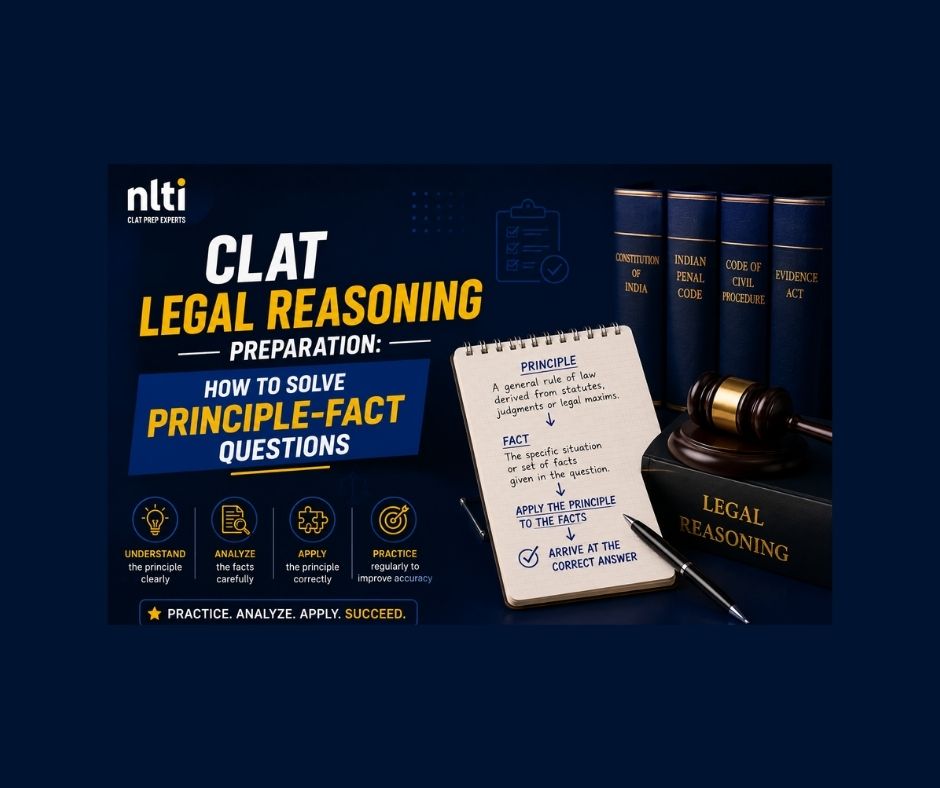
Legal Reasoning Strategy for CLAT 2027: Step by Step Guide
Share this article:

Legal Reasoning is one of the most decisive sections in the CLAT exam. For many aspirants, performance in this section often determines whether they secure admission into top National Law Universities or fall short of their expected rank. Because of its high weightage and analytical nature, a strong CLAT legal reasoning preparation strategy is essential for achieving a competitive score.
Many students assume that success in the legal section requires extensive legal knowledge. However, the modern CLAT exam is designed differently. The CLAT legal passages primarily test reasoning ability rather than memorised law. Students are given a legal principle within the passage and must apply that principle logically to a set of facts. This means that strong reading comprehension, logical thinking, and elimination skills matter more than prior knowledge of law.
Despite this structure, aspirants frequently struggle with legal reasoning questions. Some rush through passages without identifying the principle correctly. Others rely on their personal understanding of law rather than the principle provided in the question. Such mistakes reduce accuracy and create confusion during the exam.
A structured approach can significantly improve performance in this section. By understanding how legal passages work, practising the principle-fact method, and developing elimination strategies, aspirants can increase both speed and accuracy. In addition, consistent practice with past papers and mock tests helps build the analytical reasoning skills required for the CLAT exam.
This guide explains a step-by-step CLAT legal reasoning preparation strategy for CLAT 2027. It covers passage interpretation, the principle-fact method, elimination techniques, time management, and mock-test strategies that can help aspirants approach the legal section with confidence and clarity.
Best CLAT Coaching Online 2027–2028 by NLTI
Understanding the CLAT Legal Reasoning Section
The legal reasoning section is typically the largest portion of the CLAT paper. Under the current CLAT exam pattern 2027, this section usually contains around 28–32 questions based on multiple legal passages.
Each passage introduces a legal principle, rule, or concept. After reading the passage, candidates must answer several questions that require applying the principle to different factual scenarios. These questions are designed to evaluate reasoning ability rather than legal knowledge.
Because the section relies heavily on reading comprehension, aspirants must develop strong analytical reading skills. The CLAT legal passages often contain complex arguments and nuanced interpretations. Understanding the structure of these passages is therefore crucial.
Unlike traditional law entrance exams, CLAT does not require memorisation of statutes or case laws. Instead, the focus remains on logical interpretation and reasoning. This means that even students without prior legal background can perform well if they follow a structured CLAT legal reasoning strategy.
Read More: CLAT 2027 Mock Planner: How Many Mocks Each Month
Why Legal Reasoning Is Crucial for CLAT Rank
The legal section plays a critical role in determining overall performance in CLAT. Since it contains one of the highest numbers of questions in the exam, strong performance here significantly improves the total score.
A candidate who consistently answers legal reasoning questions correctly gains a major advantage over competitors. This is because accuracy in this section contributes heavily to the final score calculation.
In addition, the legal section often contains questions that reward analytical reasoning rather than rote learning. Aspirants who develop a clear CLAT legal reasoning preparation approach can therefore gain marks more reliably than those relying on guesswork.
Consistent performance in this section contributes directly to CLAT rank improvement strategy, making it a key area of focus during preparation.
CLAT 2027 Study Plan for Class 11 Students: Full Guide
Types of Questions in CLAT Legal Reasoning
Understanding question patterns is essential for effective CLAT legal reasoning practice.
Common types of questions include:
Principle Application Questions
These questions require applying the legal rule provided in the passage to a factual situation.
Inference Questions
Candidates must interpret the logical implications of the legal principle.
Legal Argument Analysis
Some questions evaluate the strength of arguments presented in the passage.
Fact-Based Reasoning
These questions test whether a factual scenario falls within the scope of the principle.
Recognising these patterns helps students approach legal passages with greater clarity.
The Principle-Fact Method Explained
The principle-fact method is the most important technique for solving legal reasoning questions.
This method involves four steps.
1. Identify the legal principle mentioned in the passage.
2. Understand the factual situation described in the question.
3. Apply the principle strictly to the facts.
4. Avoid introducing personal judgement or outside knowledge.
Many aspirants make the mistake of applying their own understanding of law instead of the rule given in the passage. However, CLAT questions are designed to be solved strictly using the provided principle.
Mastering CLAT principle fact questions through this method greatly improves reasoning accuracy.
Real More: CLAT 2027 Study Timetable: Month-by-Month Plan
Principle-Fact Application Model
Using this framework strengthens overall CLAT legal reasoning strategy.
How to Read CLAT Legal Passages Efficiently
Reading legal passages efficiently is crucial for success.
A useful approach involves three steps.
First, quickly skim the introduction of the passage to understand the topic. Second, identify the legal principle or rule being discussed. Third, observe how the passage explains or applies that principle.
Tracking the argument structure allows students to answer questions more quickly. Instead of re-reading the entire passage, they can locate relevant sections easily.
Developing strong CLAT legal passage interpretation skills helps improve both speed and comprehension.
Read More: CLAT 2027 Study Plan for Droppers: Smart Prep Strategy
Legal Reasoning Elimination Strategy
CLAT options are often designed to confuse candidates. Learning how to eliminate incorrect options is therefore an essential skill.
Common incorrect options include:
exaggerated interpretations of the principle
answers based on irrelevant facts
options that rely on moral judgement rather than legal reasoning
Using a systematic CLAT elimination technique helps remove such options quickly and improves accuracy.
Read More: CLAT 2027 Without Coaching: Can Self Study Get You Into NLU
Common Mistakes in CLAT Legal Reasoning
Several common mistakes reduce performance in the legal section.
One frequent error is applying personal legal knowledge instead of the principle provided in the passage. This leads to incorrect answers because the exam expects reasoning strictly based on the given rule.
Another mistake is ignoring keywords within the principle. Small words such as “only,” “unless,” or “except” often change the meaning of the rule significantly.
Rushing through passages without fully understanding the argument also leads to misinterpretation.
Recognising these CLAT legal reasoning mistakes allows aspirants to avoid them during the exam.
Step-by-Step Approach to Solving Legal Questions
A structured method improves efficiency when solving legal questions.
Step 1
Read the passage carefully and identify the main principle.
Step 2
Understand the factual scenario described in the question.
Step 3
Apply the principle logically to the facts.
Step 4
Evaluate each option based on the rule.
Step 5
Eliminate incorrect answers and choose the most accurate option.
Following this CLAT legal question solving method ensures consistent reasoning.
Read More: CLAT 2027 vs AILET 2027: Which Exam Should You Prioritise
Legal Reasoning Problem-Solving Framework
This process strengthens CLAT analytical reasoning skills.
Improving Legal Reasoning Through Practice
Practice plays a crucial role in improving legal reasoning ability.
Students should regularly solve previous CLAT legal passages to familiarise themselves with question patterns. Timed practice also helps improve speed and decision-making.
After solving questions, analysing mistakes carefully helps identify weaknesses in reasoning. This process builds stronger CLAT legal reasoning practice habits.
Using Mock Tests to Improve Legal Reasoning
Mock tests simulate the pressure of the actual exam.
They help aspirants test their ability to interpret legal passages quickly while maintaining accuracy. Mocks also reveal areas where reasoning breaks down.
An effective CLAT mock test strategy 2027 includes reviewing both correct and incorrect answers to understand reasoning gaps.
Read More: What CLAT 2026 Taught Us: Lessons for CLAT 2027 Aspirants
Legal Section Practice Plan
This structured routine supports effective CLAT legal reasoning preparation.
Time Management Strategy for Legal Section
Time management is critical during the exam.
Students should allocate roughly 35–40 minutes for the legal section. Spending too much time on a single passage can reduce overall attempts.
Balancing speed and comprehension ensures efficient performance. A well-planned CLAT time management strategy allows candidates to maintain accuracy without rushing.
How Legal Reasoning Affects CLAT Rank
Because the legal section contains a large number of questions, strong performance significantly influences final rank.
Candidates who maintain high accuracy here can compensate for weaker sections. Conversely, poor performance in legal reasoning can reduce overall scores.
Maintaining the right balance between CLAT accuracy vs attempts is therefore crucial.
Read More: CLAT 2027 Without Coaching: Can Self Study Get You Into NLU
Long-Term Legal Reasoning Preparation Plan
A structured preparation timeline helps build reasoning skills gradually.
Months 1–3
Focus on understanding principles and legal concepts.
Months 4–6
Begin solving legal passages regularly.
Months 7–12
Introduce timed reasoning practice.
Final Months
Focus on full mock tests and performance analysis.
This structured approach aligns with a strong CLAT 2027 preparation strategy.
Final Legal Reasoning Strategy Blueprint
1. Focus on mastering the principle-fact method.
2. Practice legal passages regularly.
3. Develop strong elimination skills.
4. Analyse mistakes carefully during practice.
5. Maintain accuracy above 75 percent.
These principles represent essential CLAT legal section tips for success.
Read More: CLAT 2027 Negative Marking Strategy: Attempt or Skip Tips
NLTI Insight: Legal Reasoning and CLAT Performance
Preparation frameworks used by NLTI (National Law Training Institute) emphasise structured analysis of CLAT legal passages and consistent reasoning practice. Studies of previous CLAT papers show that aspirants who master the principle-fact method and regularly practise passage interpretation perform more consistently in the legal section.
Because modern CLAT papers emphasise reasoning rather than prior legal knowledge, aspirants who develop strong analytical reading habits and elimination strategies often achieve higher accuracy. Combining passage practice with structured mock analysis helps students build the reasoning discipline required for competitive CLAT ranks.
Final Word
Legal reasoning is fundamentally a reasoning test rather than a law test. Students who focus on understanding principles and applying them logically tend to perform better than those relying on memorised legal knowledge.
Consistent practice with legal passages, careful analysis of mistakes, and disciplined reasoning techniques gradually improve both speed and accuracy.
With the right preparation strategy and regular practice, aspirants can approach the legal section confidently and significantly improve their performance in CLAT 2027.
FAQs
How should I prepare legal reasoning for CLAT 2027?
Focus on practising passage-based questions and mastering the principle-fact method.
Do I need prior legal knowledge for CLAT?
No. The exam tests reasoning ability rather than legal knowledge.
How many legal questions appear in CLAT?
Typically around 28–32 questions are included in the legal reasoning section.
What is the principle-fact method in CLAT?
It involves identifying a legal principle and applying it logically to the given facts.
How can I improve legal reasoning accuracy?
Regular practice, careful passage reading, and elimination strategies help improve accuracy.
How can I solve CLAT legal passages faster?
By identifying the principle quickly and focusing on relevant facts.
Are legal reasoning questions difficult in CLAT?
They are analytical but manageable with consistent practice.
How important is the legal section in CLAT?
It is one of the highest weightage sections and significantly affects rank.
Should I practise previous CLAT papers for legal reasoning?
Yes, they help understand question patterns and difficulty level.
How much time should I spend on the legal section in the exam?
Around 35–40 minutes is usually recommended.
Does elimination help in legal reasoning questions?
Yes, eliminating extreme or irrelevant options improves accuracy.
Can beginners score well in the legal section?
Yes, because the exam focuses on reasoning rather than prior law knowledge.
Get In Touch
Have questions? We'd love to hear from you. Send us a message and we'll respond as soon as possible.