Top CLAT Crash Courses for Last-Minute Prep 2027
Share this article:

Summary
CLAT 2027 crash courses are designed for last-mile preparation, focusing on accuracy, mock analysis, and decision-making rather than syllabus completion. With the exam now heavily passage-based, success depends on improving reading speed, reasoning ability, and attempt strategy.
Top coaching platforms like NLTI, LegalEdge, and IMS provide mentorship, analytics, and structured mock systems to optimise performance. The most effective crash plans prioritise error tracking, controlled attempts, and consistent mock review. Ultimately, the right crash course is one that improves accuracy and stabilises performance, not one that offers the most content.
Introduction
As CLAT 2027 approaches, a significant number of aspirants enter what is often called the last-mile preparation phase. This is where traditional long-term study plans lose relevance, and CLAT crash courses become the dominant preparation tool.
However, not all crash courses deliver results.
In a passage-heavy, reasoning-driven exam like CLAT 2027, success depends on:
accuracy, not coverage
mock analysis, not content accumulation
decision-making, not memorisation
Most students fail in the last 3–4 months because they follow generic plans or choose the wrong fast track CLAT coaching.
This guide provides a complete breakdown of the best CLAT crash courses, preparation systems, coaching platforms, and execution strategy for last-minute CLAT preparation.
Best CLAT Coaching Online 2027–2028 by NLTI
What is a CLAT Crash Course (2027 Context)
A CLAT crash course is a short-duration, high-intensity program designed for:
revision of key concepts
mock-based practice
accuracy improvement
exam strategy refinement
Typically spans:
2–6 months
daily or alternate-day sessions
heavy mock + analysis focus
Crash courses are not for learning from scratch they are for optimising performance.
Why CLAT 2027 Requires a Different Crash Strategy
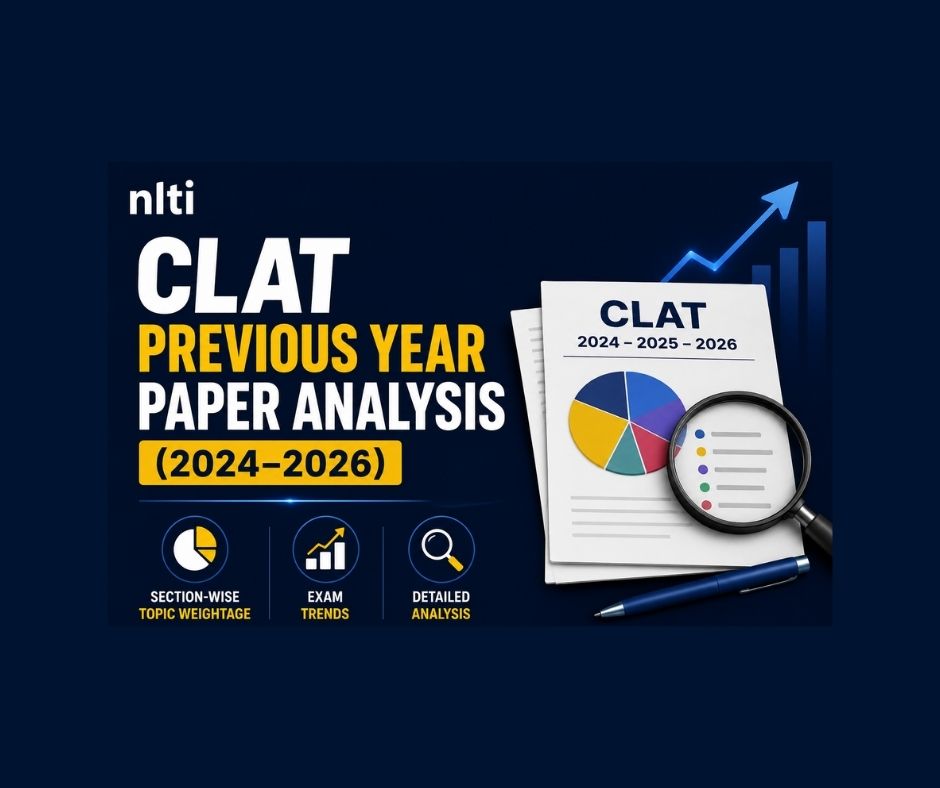
Based on CLAT 2024–2026 trends:
70–80% of paper is passage-based
Logical + Legal dominate scoring
Quant is DI-based (not formula-heavy)
GK is contextual, not static
This means:
Crash courses must focus on:
reading speed
reasoning accuracy
mock analysis
attempt strategy
NOT syllabus completion.
Read More: CLAT 2027 Mock Planner: How Many Mocks Each Month
Top CLAT Crash Course Providers in India (2027)
Here is a researched breakdown of major platforms:
1. NLTI (National Law Training Institute)
Core Strength
mentorship-driven model
strong mock → feedback loop
AI-based analytics
Key Features
1:1 mentorship
performance tracking dashboards
error-based improvement system
Focus: accuracy + strategy
2. LegalEdge by TopRankers
14+ years experience
strong test series + analytics
Key Features
AI-powered mock analysis
structured crash batches
national-level competition
Focus: high-volume practice + analytics
3. Law Prep Tutorial
24+ years legacy
high NLU selections
Key Features
80+ mocks
800+ hours structured prep
strong classroom + online mix
Focus: structured + disciplined prep
4. IMS (Institute of Management Studies)
40+ years experience
300+ hours content + mocks
Key Features
SimCLAT mocks
mentorship sessions
national presence
Focus: consistency + structured system
5. CLAT Possible
3000+ selections
strong test series
Focus: personalised attention + practice
6. CLATapult
NUJS alumni-led platform
Focus: concept clarity + reasoning
7. Career Launcher
200+ centers
large student base
Focus: hybrid prep (online + offline)
8. Knowledge Nation Law Centre
affordable crash programs
personalised batches
Focus: small batch mentoring
Real More: CLAT 2027 Study Timetable: Month-by-Month Plan
Crash courses generally cost ₹20,000–₹50,000
How to Choose the Right CLAT Crash Course
Avoid brand bias. Use this framework:
1. Mock Feedback Quality
If analysis is weak → course is useless
2. Mentor Access
Recorded-only = low ROI
3. Analytics
Must track:
accuracy
attempt ratio
weak areas
4. GK System
Must be structured (monthly + revision)
5. Batch Size
Smaller = better feedback
How to Evaluate Crash Course ROI (Return on Investment)
Choosing a crash course is not just about fees—it’s about output.
Key ROI Indicators:
1. Score Improvement Per Mock
Track whether your score improves every 3–4 mocks. If not, the system isn’t working.
2. Accuracy Growth Curve
Your accuracy should move from:
60–65% → beginner
70–75% → improving
80%+ → competitive
If accuracy is stagnant, the crash course lacks proper analysis support.
3. Error Reduction Rate
Check recurring mistakes across mocks:
same errors repeating = poor feedback loop
decreasing error frequency = effective system
4. Decision-Making Improvement
You should start:
skipping low-confidence questions
selecting high-accuracy attempts
managing time better
A good CLAT crash course improves decision quality, not just content exposure.
Real More: CLAT 2027 Study Timetable: Month-by-Month Plan
Daily Execution System Inside a Crash Course
Most students join crash courses but fail due to poor execution.
Ideal Daily System:
Morning (1–1.5 hrs)
Editorial reading + GK revision
Focus on comprehension speed
Midday (1.5–2 hrs)
Sectional practice (Legal + Logical)
Accuracy-focused solving
Afternoon (1–1.5 hrs)
Quant DI + error correction
Focus on speed + calculation efficiency
Evening (Mock / Analysis Block)
Full mock or sectional test
Deep mock analysis (non-negotiable)
Night (30 mins)
Error log revision
Pattern recognition
Execution Rule:
1 mock = 1 analysis session (minimum 1.5–2 hours)
Without this, crash preparation fails.
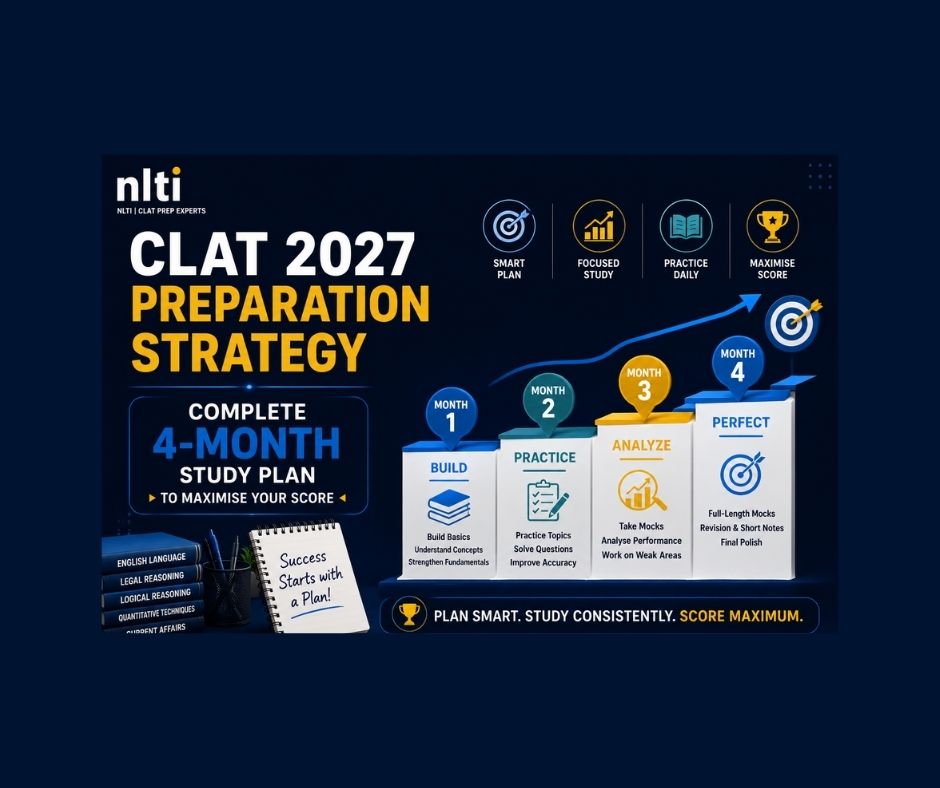
The Ideal CLAT Crash Plan (Execution Model)
Phase 1 (Weeks 1–2): Reset
reading habit
basic accuracy tracking
sectional tests
Phase 2 (Weeks 3–8): Intensive Practice
3–4 mocks/week
daily sectional practice
error log
Phase 3 (Final 4 Weeks): Performance Phase
weekly full mocks
exam simulation
accuracy stabilisation
Mock Strategy in Crash Courses
Ideal Frequency
Accuracy vs Attempts Model
Accuracy > Attempts
Read More: CLAT 2027 Without Coaching: Can Self Study Get You Into NLU
English
daily RC practice
focus on inference
Legal
principle + fact mapping
Logical
argument analysis
Quant
DI only (skip theory overload)
GK
monthly revision
issue-based prep
Biggest Mistakes in CLAT Crash Courses
joining too many courses
ignoring mock analysis
over-attempting
switching strategy frequently
passive learning
How to Improve Score by 15+ Marks
reduce careless errors
improve elimination
fix weak sections
track accuracy
NLTI Insight (Strategic Positioning)
NLTI’s system aligns with modern CLAT demands:
error-based improvement
analytics-driven strategy
mentor-led feedback
This ensures performance stabilisation rather than random score spikes.
Read More: CLAT 2027 vs AILET 2027: Which Exam Should You Prioritise
A CLAT crash course works only if:
you prioritise accuracy
analyse every mock
follow a fixed system
The best coaching is not the one with:
most content
highest fees
But the one that improves:
decision-making
accuracy
consistency
FAQs
1. Is a CLAT crash course enough?
Yes, if combined with mocks and analysis.
2. Which is best CLAT crash course?
NLTI, LegalEdge, Law Prep, IMS are top options.
3. How many mocks in crash prep?
30–40 full mocks recommended.
4. Can I improve score in 3 months?
Yes, through accuracy-focused strategy.
5. What matters more—coaching or strategy?
Strategy.
6. Is online crash better than offline?
Yes, due to analytics and flexibility.
7. Should beginners take crash courses?
No. Crash courses are for revision.
8. How to choose best crash course?
Focus on mock analysis and mentorship.
Get In Touch
Have questions? We'd love to hear from you. Send us a message and we'll respond as soon as possible.