CLAT 2027 Detailed Syllabus PDF Download
Share this article:
Summary
The CLAT 2027 syllabus focuses on five sections: English, Current Affairs & GK, Legal Reasoning, Logical Reasoning, and Quantitative Techniques. Understanding the CLAT UG syllabus 2027 helps students prepare strategically for this passage-based exam.
Downloading the official CLAT 2027 syllabus PDF, following the CLAT section wise syllabus, and practicing previous year questions are essential for effective preparation.
Introduction
Understanding the CLAT 2027 syllabus is the foundation of effective preparation. Before reading books, attending classes, or attempting mock tests, every aspirant must first understand exactly what the exam evaluates. Downloading the CLAT 2027 syllabus PDF and reviewing it carefully helps students avoid irrelevant preparation and stay focused on what matters.
The CLAT UG syllabus 2027 is designed to test comprehension, reasoning ability, legal awareness, and numerical interpretation, rather than rote memorization. The exam is passage-based, which means students must practice reading comprehension and logical thinking consistently.
This blog provides a complete guide to the CLAT section wise syllabus, explains the exam pattern, offers practical preparation tips, and shows you how to complete the CLAT 5 sections syllabus download from official and trusted sources.
By the end of this guide, you will understand:
The full CLAT 2027 syllabus PDF structure
The official exam pattern and marking scheme
Section-wise syllabus and weightage
How to prepare for each section effectively
How to download the official syllabus
Best CLAT Coaching Online 2027–2028 by NLTI
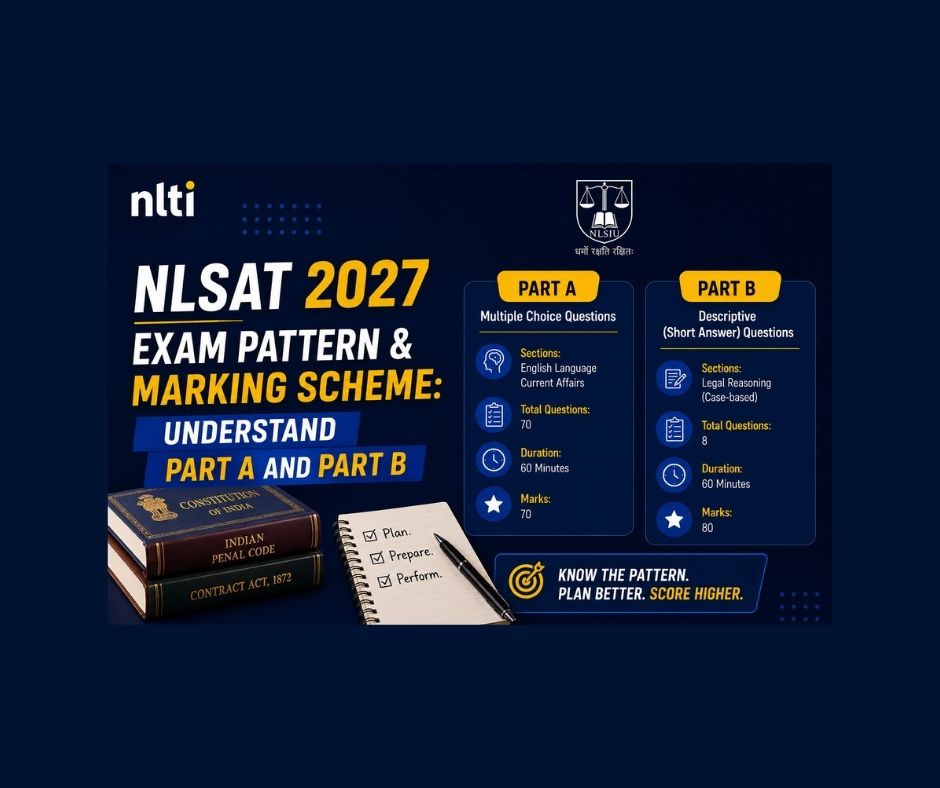
CLAT 2027 Exam Overview & Pattern
Before analyzing the CLAT section wise syllabus, it is important to understand the structure of the exam.
Mode of Examination
Conducted offline (pen-and-paper mode)
Duration: 120 minutes
Total questions: 120
Negative marking: –0.25 per incorrect answer
Question format: Passage-based MCQs
Section-Wise Weightage
The CLAT UG syllabus 2027 follows this five-section format, which makes the CLAT 5 sections syllabus download critical for structured preparation.
Each section evaluates a different skill set, and understanding the weightage helps prioritize your study plan. Students often underestimate low-weightage sections like Quant, but every mark counts when competition is intense.
Why the CLAT Syllabus Matters More Than Ever
CLAT is not a memory-based exam. It is a skill-based exam that tests:
Reading speed
Comprehension accuracy
Logical reasoning
Application of principles
Decision-making under time pressure
Without clarity on the CLAT section wise syllabus, students often:
Study irrelevant topics
Over-prepare some areas while ignoring others
Fail to align with the actual exam format
The CLAT 2027 syllabus PDF acts as a blueprint. It ensures that your preparation remains targeted and efficient.
Random preparation or relying only on coaching notes is risky. Instead, every aspirant should align their preparation with the official syllabus and structure their study plan accordingly.
Understanding the CLAT UG syllabus 2027 also helps in:
Designing a realistic study schedule
Selecting the right study material
Evaluating progress accurately
Read More: CLAT 2027 Mock Planner: How Many Mocks Each Month
CLAT Section-Wise Syllabus (Detailed Breakdown)
A. English Language
The English section of the CLAT UG syllabus 2027 accounts for roughly 20% of the exam. It primarily tests reading comprehension and interpretation skills.
Structure
Passage length: ~450 words
Questions per passage: 4–6
Total questions: 22–26
Skills Tested
Identifying main ideas
Drawing inferences
Understanding tone and purpose
Vocabulary in context
Grammar and sentence structure
Common Question Types
Central theme of the passage
Meaning of words in context
Author’s tone
Logical conclusions
Preparation Tips
Read newspapers and editorials daily
Practice RC passages consistently
Avoid reading passively; focus on comprehension
The CLAT section wise syllabus emphasizes comprehension rather than grammar drills alone. Strong reading habits are essential for success.
B. Current Affairs & General Knowledge
This section forms a significant part of the CLAT 2027 syllabus PDF, contributing nearly 25% of the exam.
Structure
Passage-based questions
Each passage: ~450 words
Topics Covered
National and international events
Indian polity and constitution
Economy and finance
Science and technology
Environment and sustainability
Awards, sports, and cultural developments
Preparation Tips
Follow current affairs consistently
Revise monthly compilations
Link static GK with current events
The CLAT section wise syllabus does not test random facts. Instead, it focuses on understanding the context behind events.
Read More: CLAT 2027 vs AILET 2027: Which Exam Should You Prioritise
The Legal Reasoning section is one of the most important components of the CLAT UG syllabus 2027, contributing roughly 25% of the total paper. This section does not test prior legal knowledge. Instead, it evaluates your ability to read, understand, and apply legal principles.
Structure
Passage length: ~450 words
Questions per passage: 4–6
Total questions: 28–32
Skills Tested
Ability to identify legal principles in a passage
Application of principles to given facts
Understanding of legal logic
Analytical reasoning based on rules
Common Topics Covered
Constitutional principles
Criminal law concepts
Contract law basics
Tort law fundamentals
Legal rights and duties
Public policy and governance
Important Note
No prior legal education is required. All necessary principles are provided within the passage. The challenge lies in interpreting them correctly.
Preparation Strategy
Focus on understanding, not memorizing legal terms
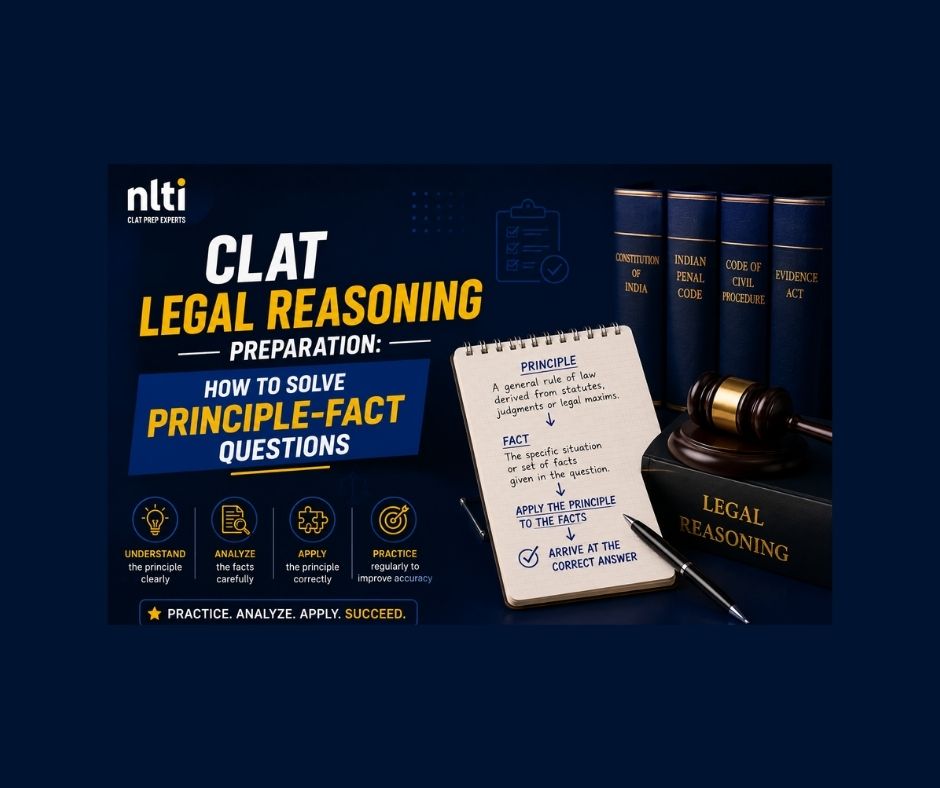
Practice principle–fact questions regularly
Avoid using personal opinions; rely only on the passage
Mastering this section of the CLAT section wise syllabus significantly boosts your overall score, as legal reasoning often decides top ranks.
D. Logical Reasoning
Logical Reasoning forms about 20% of the CLAT paper and tests critical thinking and analytical ability. It is a core part of the CLAT 2027 syllabus PDF.
Structure
Short passages (~300 words)
Questions per passage: 4–5
Total questions: 22–26
Skills Tested
Identifying arguments
Recognizing assumptions
Evaluating conclusions
Strengthening or weakening arguments
Drawing logical inferences
Common Question Types
Statement and conclusion
Assumptions
Cause and effect
Strengthen / weaken arguments
Logical consistency
Preparation Strategy
Practice argument-based questions daily
Focus on identifying conclusions and assumptions
Avoid overthinking beyond the passage
Logical Reasoning in the CLAT UG syllabus 2027 is not about speed alone but accuracy in understanding arguments.
E. Quantitative Techniques
Quantitative Techniques is the smallest section of the CLAT 5 sections syllabus download, but it can be a strong scoring area if prepared well.
Structure
Data interpretation based
Graphs, charts, tables
Total questions: 10–14
Topics Covered
Percentages
Ratios and proportions
Averages
Simple algebra
Profit and loss
Data interpretation
Preparation Strategy
Revise Class 10 level mathematics
Practice data interpretation sets
Focus on accuracy over speed
Even though this section carries lower weightage, strong performance here can give a competitive edge.
Real More: CLAT 2027 Study Timetable: Month-by-Month Plan
How to Download the CLAT 2027 Syllabus PDF
The most reliable way to access the official syllabus is through the Consortium of National Law Universities.
Step-by-Step Process
1. Visit the official website: consortiumofnlus.ac.in
2. Navigate to the CLAT 2027 section
3. Click on Syllabus or Information Brochure
4. Download the CLAT 2027 syllabus PDF
Why Use the Official Source?
Most accurate and updated information
Reflects latest exam structure
Avoids misinformation
Limitations
No strategy guidance
No preparation roadmap
This is why students often supplement the official syllabus with structured coaching materials.
Alternative Sources for Syllabus & Study Material
While the official CLAT 2027 syllabus PDF is essential, students also use:
Coaching institute portals
Educational websites
Online preparation platforms
However, the official syllabus should always remain the primary reference.
How to Use the CLAT 2027 Syllabus Effectively
Simply downloading the CLAT 2027 syllabus PDF is not enough. The real value comes from using it strategically. Many students make the mistake of reading the syllabus once and then ignoring it. Instead, treat the CLAT UG syllabus 2027 as a working document throughout your preparation.
1. Break the Syllabus into Weekly Targets
Divide the CLAT section wise syllabus into manageable weekly goals. For example:
Week 1–4: English + Legal Reasoning basics
Week 5–8: Logical Reasoning + Quant fundamentals
Week 9–12: GK revision + mock integration
This helps prevent burnout and keeps progress measurable.
2. Link the Syllabus to PYQs
Every topic listed in the CLAT 5 sections syllabus download should be mapped to past questions. This ensures you are preparing exam-relevant content rather than generic theory.
3. Track Weak Areas
Regular
Topics with low accuracy
Slow-solving areas
Repeated mistakes
This makes preparation data-driven instead of random.
4. Revise Regularly
Revision is non-negotiable. Set aside at least one day per week solely for revision.
Common Mistakes Students Make
Even with access to the CLAT 2027 syllabus PDF, many aspirants struggle due to poor execution.
1. Ignoring the Official Syllabus
Students often rely entirely on coaching notes and ignore the official syllabus, leading to gaps in preparation.
2. Over-Reliance on Coaching Material
Coaching material is helpful, but it should not replace the official CLAT UG syllabus 2027.
3. Skipping Revision
Without revision, retention drops significantly, especially in GK and legal concepts.
4. Not Practicing Enough PYQs
Ignoring previous year questions reduces familiarity with exam patterns.
Real More: CLAT 2027 Study Timetable: Month-by-Month Plan
Recommended Study Strategy (Section-Wise)
English
Read editorials daily
Practice 2–3 RC passages daily
Focus on inference-based questions
Current Affairs & GK
Follow monthly compilations
Revise static GK linked to current events
Legal Reasoning
Practice principle–fact questions
Avoid assumptions outside the passage
Logical Reasoning
Solve argument-based questions daily
Analyze conclusions and assumptions carefully
Quantitative Techniques
Practice DI sets regularly
Focus on accuracy over speed
This structured approach aligns perfectly with the CLAT section wise syllabus.
Read More: CLAT 2027 Without Coaching: Can Self Study Get You Into NLU
Conclusion
Understanding the CLAT 2027 syllabus PDF is the first and most important step toward effective preparation. The CLAT UG syllabus 2027 clearly defines what is tested and how questions are structured. By thoroughly analyzing the CLAT section wise syllabus and following a disciplined strategy, aspirants can significantly improve their performance.
The smartest approach is to:
Download the CLAT 5 sections syllabus
Align preparation with official guidelines
Practice consistently
Track performance and revise regularly
CLAT is predictable if prepared systematically. The syllabus is your roadmap, use it wisely.
FAQs
1. Is the CLAT 2027 syllabus released?
The syllabus follows the standard structure released by the Consortium of NLUs. Any updates will be reflected in the official notification.
2. How many sections are there in CLAT?
There are five sections: English, GK, Legal Reasoning, Logical Reasoning, and Quantitative Techniques.
3. Is maths compulsory in CLAT?
Yes, Quantitative Techniques is a compulsory section, though it carries lower weightage.
4. Where can I download the CLAT 2027 syllabus PDF?
From the official Consortium website.
Get In Touch
Have questions? We'd love to hear from you. Send us a message and we'll respond as soon as possible.