CLAT 2027 Legal Reasoning Section Guide
Share this article:
Introduction
The CLAT Legal Reasoning section is the most decisive part of the paper. It does not test law as a subject. It tests how you think like a lawyer. Every question is built around passages where you must identify a rule, apply it to facts, and eliminate incorrect options.
This is why many students struggle despite “studying law.” The issue is not lack of knowledge. It is poor application. The CLAT legal reasoning syllabus 2027 is designed to test interpretation, not memorization.
If you look at recent papers, almost every question comes from CLAT legal principles questions embedded inside passages. To solve them correctly, you need clarity, structured thinking, and strong passage handling.
This blog gives a complete roadmap:
Understanding the CLAT legal reasoning syllabus 2027
Mastering CLAT legal passage tips
Practicing application-based questions
Using landmark judgments for CLAT strategically
Best CLAT Coaching Online 2027–2028 by NLTI
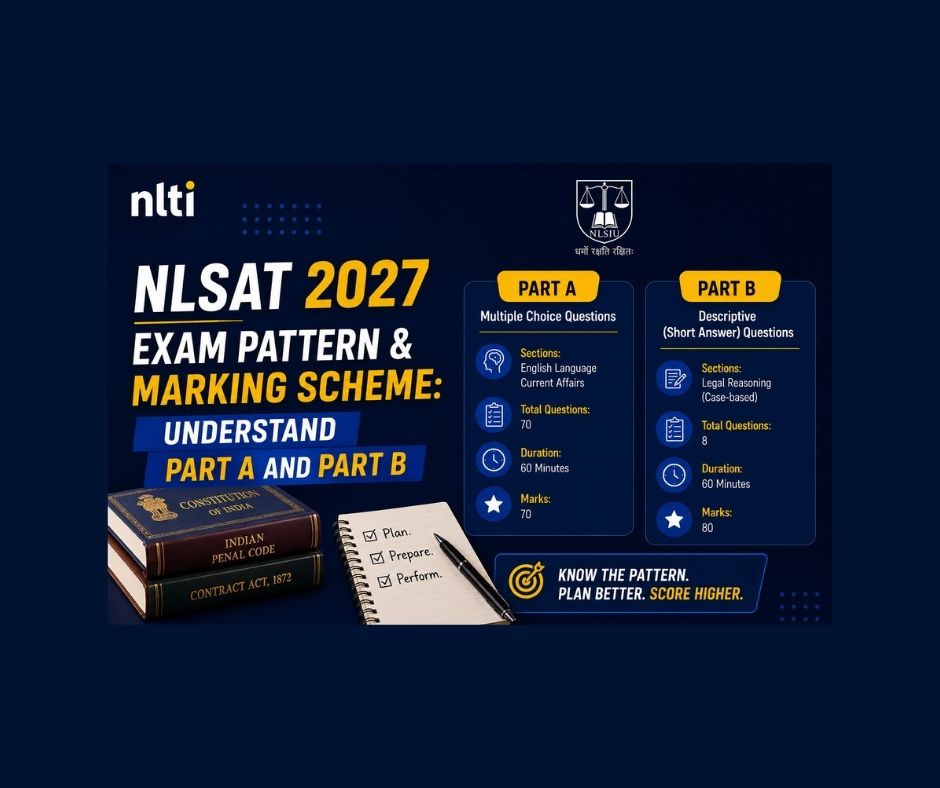
CLAT 2027 Legal Reasoning Section Overview
The Legal Reasoning section carries:
Around 28–32 questions (~25% weightage)
Passage-based format
Each passage ~450 words
The section includes:
5–6 passages
5–6 questions per passage
What the Section Tests
Application of legal principles
Logical reasoning
Reading comprehension
The most important insight: CLAT Legal Reasoning = Reading + Application + Elimination
You are NOT required to know law beforehand. The principle is always given in the passage.
CLAT Legal Reasoning Syllabus 2027
The CLAT legal reasoning syllabus 2027 is not topic-based in a traditional sense. It is skill-based.
Core Skills Tested
1. Understanding Legal Principles
Identify rules from passage
Recognize conditions and exceptions
2. Applying Principles to Facts
Match facts with rules
Avoid assumptions
3. Logical Reasoning
Identify arguments
Draw conclusions
4. Analytical Thinking
Evaluate situations
Compare options
Important Topics (From PYQs)
Even though syllabus is skill-based, recurring topics include:
Constitutional law
Law of torts
Contract law
Criminal law basics
Legal current affairs
Recent Trends (PYQ Analysis)
Same-sex marriage debates
Data protection laws
Juvenile justice
Electoral bonds
Key Insight
The CLAT legal reasoning syllabus 2027 focuses on:
Application
Interpretation
Logical consistency
Not memorization.
Read More: CLAT 2027 Mock Planner: How Many Mocks Each Month
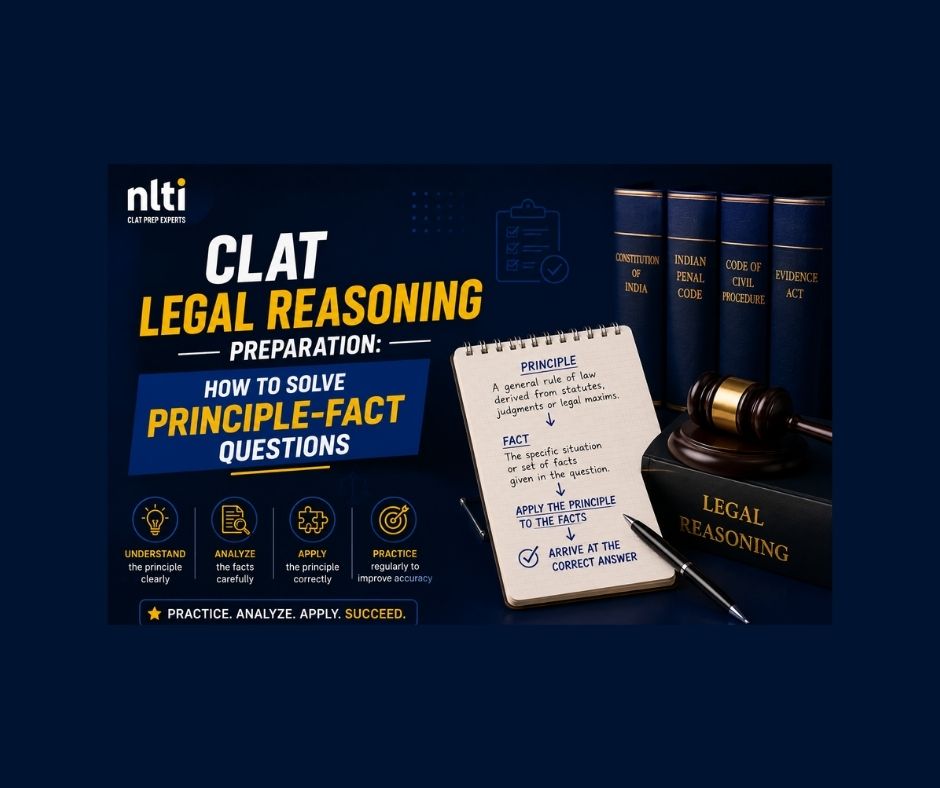
CLAT Legal Principles Questions – Deep Understanding
Most questions in CLAT are CLAT legal principles questions.
What They Look Like
A passage gives:
A legal rule
Conditions
Exceptions
Then:
You apply it to new facts
Types of Question
1. Principle Identification
Identify rule from passage
2. Application-Based Questions
Apply rule to facts
3. Inference Questions
Draw logical conclusions
4. Variation Questions
Change facts → check outcome
Common Trap
Students:
Use real-world knowledge
Ignore passage
Correct approach: Stick strictly to passage principle
CLAT Legal Passage Tips (Most Important Section)
Mastering passages is everything.
Step-by-Step Approach
1. Read for Big Idea
Understand:
Topic
Context
2. Identify the Principle
Look for:
“If”, “only if”, “unless”
Conditions
Exceptions
3. Break Facts into Points
Simplify:
Who did what
What happened
4. Apply Principle Line-by-Line
Match:
Each fact → each condition
5. Eliminate Wrong Options
Remove:
Options adding assumptions
Options ignoring conditions
6. Check Exceptions
Many answers change due to:
Small factual differences
Key CLAT Legal Passage Tips
Don’t assume real law
Focus only on passage
Avoid emotional reasoning
Use elimination
Landmark Judgments for CLAT – How Much to Study?
Students often over-focus on landmark judgments for CLAT.
Reality
You do NOT need:
Case details
Judgments memorized
But you SHOULD know:
Basic context
Legal themes
Important Areas to Cover
Right to privacy
Fundamental rights
Equality and liberty
Criminal law reforms
Why They Matter
Landmark judgments:
Influence passage topics
Provide context
Smart Strategy
Understand concepts, not cases
Focus on application
Why Students Struggle in Legal Reasoning
Common Problems
Using personal logic instead of passage
Ignoring exceptions
Overthinking
Not practicing enough
Core Issue
Students try to:
“Know law”
Instead of:
“Apply law”
Real Scenario
Student scoring 18–20:
Knows concepts
But misapplies principles
Read More: CLAT 2027 vs AILET 2027: Which Exam Should You Prioritise
CLAT Legal Reasoning Preparation Strategy 2027
1. Build Concept Clarity
Start with:
Basic legal concepts
Rights, duties, liability
2. Practice Daily Passages
Solve:
10–15 CLAT legal principles questions daily
3. Focus on Application
Always ask:
What is the rule?
Does fact satisfy condition?
4. Maintain Mistake Notebook
Track:
Wrong concepts
Repeated errors
5. Use Mock Tests
Mocks improve:
Speed
Accuracy
6. Revise Through Examples
Don’t revise theory
Revise:
Questions
7. Improve Reading Speed
Legal passages are dense. Practice reading daily.
CLAT Legal Passage Tips 2027 (Scoring Section)
1. Principle First, Opinion Later
Always prioritize rule
2. Avoid Extreme Options
Words like:
Always
Never
Are usually wrong
3. Focus on Conditions
Missing one condition = wrong answer
4. Don’t Add External Knowledge
Stick to passage
5. Practice Elimination
Most answers are found by eliminating
Real More: CLAT 2027 Study Timetable: Month-by-Month Plan
Daily Study Plan for Legal Reasoning
Daily
2 passages
10–15 questions
Weekly
5–6 passages
1 sectional test
Monthly
Full mocks
Error analysis
Best Resources for Legal Reasoning
Concepts
Basic legal notes
Practice
PYQs
Mock tests
Platforms
NLTI
LegalEdge
CL
Common Mistakes to Avoid
Memorizing instead of applying
Ignoring passage logic
Not analyzing mocks
Overconfidence
Future Trend: CLAT Legal Reasoning 2027
Trends show:
More passage-based questions
More inference
Less direct law
The exam is moving toward: application-heavy reasoning
Real More: CLAT 2027 Study Timetable: Month-by-Month Plan
The CLAT Legal Reasoning section is not about law knowledge. It is about structured thinking.
If you:
Understand the CLAT legal reasoning syllabus 2027
Practice CLAT legal principles questions daily
Apply strong CLAT legal passage tips
Use landmark judgments for CLAT smartly
You will improve consistently.
FAQs
1. What is CLAT legal reasoning syllabus 2027?
It focuses on applying legal principles to fact-based situations.
2. Do I need legal knowledge for CLAT?
No, principles are given in passages.
3. What are CLAT legal principles questions?
Questions requiring application of rules to facts.
4. How to improve in legal reasoning?
Practice passages and analyze mistakes.
5. Are landmark judgments important?
Only for context, not memorization.
Get In Touch
Have questions? We'd love to hear from you. Send us a message and we'll respond as soon as possible.