Biggest CLAT 2027 Myths You Must Avoid
Share this article:
Every year, thousands of brilliant law aspirants sit down with a heavy stack of thick notebooks, a pile of highlighters, and a massive amount of anxiety. They are all chasing the same dream: walking through the gates of a top-tier National Law University (NLU).
But here is a harsh reality that coaching centers rarely whisper out loud: many students fail their exams not because they didn't work hard, but because they spent months working hard on the wrong things.
The Common Law Admission Test (CLAT) has evolved dramatically over the last few years. The shift from a 150-question paper to a tighter, 120-question, 2-hour format proved that the Consortium of NLUs values analytical thinking over memorization. Yet, outdated advice and old internet forums continue to pass down ancient strategies.
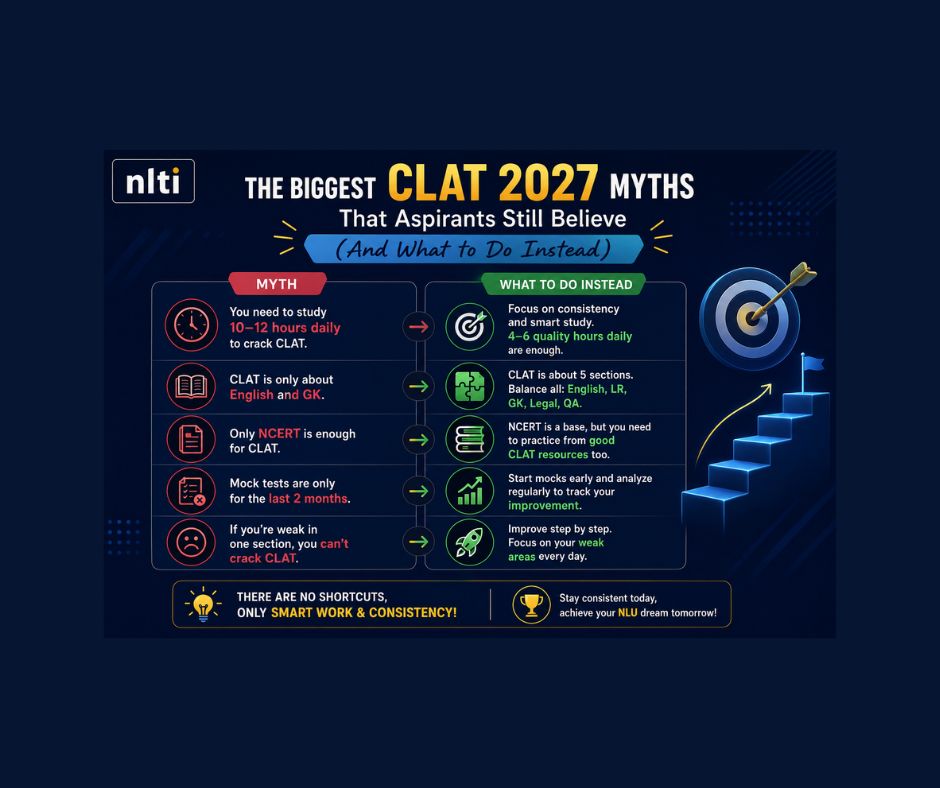
If you are aiming for a seat in the top NLUs, it is time to clear the noise. Let’s dismantle the biggest CLAT myths that are still holding students back, map out some crucial CLAT 2027 guidance, and highlight the critical CLAT preparation mistakes you must avoid at all costs.
Best CLAT Coaching Online 2027–2028 by NLTI
Myth 1: "You Need to Memorize Real Law to Crack Legal Reasoning"
This is arguably the most common trap for beginners. Many students buy heavy undergraduate law textbooks on Torts, Contracts, or Constitutional Law, believing they need to think like a seasoned lawyer before day one.
The Reality:
CLAT is an aptitude test, not a bar exam. The Legal Reasoning section does not test your prior knowledge of the law; it tests your ability to read a passage, extract a legal principle, and apply that principle to a given set of facts.
In fact, bringing outside legal knowledge into the exam can actually backfire. If you use a real-world legal exception that wasn't mentioned in the provided passage, you will likely mark the wrong answer.
CLAT Exam Tips:
Treat the legal principles in the passage as absolute truth even if the passage claims the sky is pink. Focus your preparation on understanding core legal vocabulary (like prima facie, mens rea, or vicarious liability) so you don't slow down when reading, but leave the heavy textbook memorization alone.
Myth 2: "GK Means Cramming Year-Long Static Facts at the Last Minute"
We have all seen the classic image of an aspirant desperately flipping through a 500-page current affairs compilation two weeks before the exam. Many believe that General Knowledge is just a massive memory game that can be won via short-term cramming.
The Reality:
Recent trends show that the GK and Current Affairs section is deeply contextual. The passages are pulled from major national events, international relations, and significant policy changes over the past 8 to 12 months.
Cramming a year's worth of facts in November won't build the conceptual depth required to answer multi-layered questions. If a passage appears on a major international summit or a landmark Supreme Court judgment, the questions will test your understanding of why it happened and its broader implications, not just the date it occurred.
The Consistency Rule:
Current affairs is a marathon, not a sprint. A single month of panic-studying cannot replace twelve months of reading a daily newspaper like The Hindu or The Indian Express.
CLAT 2027 Complete Guide: Exam Date, Eligibility & Syllabus
Myth 3: "Quantitative Techniques Can Be Safely Skipped If Your English is Strong"
Because the Quantitative Techniques (Math) section only accounts for about 10% of the paper (10 to 14 questions), a dangerous rumor persists: "If you score perfectly in English and Legal, you can leave Math entirely blank."
The Reality:
This is one of the most fatal CLAT preparation mistakes an aspirant can make. Because the competition for the top 5 NLUs is incredibly tight, a single mark can shift your All India Rank (AIR) by hundreds of positions.
Moreover, CLAT math is entirely based on Class 10-level concepts like percentages, ratios, profit & loss, and basic data interpretation. It is arguably the most predictable and objective section on the paper. While English and Logical Reasoning options can sometimes feel ambiguous, a math problem has exactly one undeniably correct answer.
CLAT 2027 Preparation Tips: Subject-Wise Strategy for 90+ Marks
Myth 4: "Solving 100+ Mocks is the Only Way to Ensure a Top Rank"
There is a massive obsession in the aspirant community with "mock counts." Students brag about solving 80, 90, or 100 full-length mock tests before the exam, treating the numbers like a badge of honor.
The Reality:
Hoarding and blindly solving mocks without a strategy is completely useless. If you score 70 on a mock test, give yourself a high-five, and immediately print out the next mock without analyzing your mistakes, your score on the next one will likely still be 70.
High-scoring aspirants don't just take mocks; they dissect them. Proper analysis takes time often longer than the 2-hour exam itself.
How to Analyze a Mock Correctly:
The Error Log:
Maintain a notebook specifically for your mistakes. Categorize them into Conceptual Errors (you didn't understand the concept), Time Crushes (you ran out of time), and Silly Mistakes (you misread the question).
The Unattempted Review:
Go back to the passages you skipped entirely. Try solving them without a timer to see if the issue was difficulty or pure speed.
CLAT 2027 Complete Guide: Exam Date, Eligibility & Syllabus
Myth 5: "CLAT is Purely an Exam of Language and Grammar"
Since every single section of the modern CLAT paper including Math and Logic is presented via dense text passages, many believe that having an elite, literary English background is a mandatory prerequisite to clear the exam.
The Reality:
While strong reading comprehension skills are undeniably vital, CLAT does not care about fancy, obscure vocabulary or complex grammatical jargon. The exam is designed to test your processing speed and critical thinking.
The Consortium includes text from diverse fields like science, history, and social commentary to see if you can maintain focus under pressure and identify the core argument of a text. You don't need to be a literature major; you just need to be an active, disciplined reader who can filter out filler text to find the underlying logic.
Actionable Strategy: Your Blueprint for CLAT 2027
To bypass these common pitfalls, let's pivot from what doesn't work to a concrete action plan for your CLAT 2027 guidance:
1.Build Reading Stamina First
Dedicate 45 minutes every morning to reading complex editorials. Practice summarizing a 500-word piece into three bullet points. This directly sharpens your performance for both the English and Logical Reasoning sections.
2. Learn to Eliminate, Not Just Select:
In passage-based multiple-choice questions, two options often look deceptively correct. Train your brain to look for flaws that make an option wrong rather than trying to find the one that sounds pretty.
3. Respect the Negative Marking
With a penalty of -0.25 for every incorrect answer, wild guessing is academic suicide. An unattempted question costs you nothing, but three blind guesses can destroy an entire section's hard work.
4. Embrace the Analytical Shifts
As seen in recent papers, sections like Logical Reasoning can occasionally shift toward more structural or analytical puzzles. Don't rely on a single rigid format; keep your preparation flexible.
CLAT 2027 Quantitative Techniques Guide
Final Thoughts
Don't let the ghost of old exam patterns dictate how you study today. CLAT 2027 will reward students who possess clarity of thought, emotional stability under a ticking clock, and a consistent daily routine.
Stop trying to memorize the entire Indian Penal Code, close the endless tabs of unanalyzed PDF material, and focus on the fundamentals: read daily, analyze your errors ruthlessly, and treat every section with respect. You've got this!
Frequently Asked Questions (FAQs)
1. What are the biggest CLAT 2027 preparation mistakes students make?
Some of the most common mistakes include relying on rote memorization, skipping the Quantitative Techniques section, ignoring mock test analysis, and cramming current affairs just before the exam instead of preparing consistently.
2. Do I need to study law before preparing for CLAT 2027?
No. CLAT is an aptitude-based exam that evaluates your legal reasoning skills rather than prior legal knowledge. You only need to understand the legal principles provided in the passage and apply them logically.
3. Is it necessary to memorize legal concepts for the CLAT Legal Reasoning section?
No. Memorizing law books is not required. Instead, focus on improving reading comprehension, understanding basic legal terminology, and practicing passage-based legal reasoning questions.
4. How should I prepare current affairs for CLAT 2027?
Read a quality newspaper like The Hindu or The Indian Express every day, make monthly notes, and understand the background and significance of major national and international events rather than memorizing isolated facts.
5. Can I skip the Quantitative Techniques section in CLAT?
No. Although the Quantitative Techniques section carries fewer questions, every mark matters in CLAT. Strong performance in this section can significantly improve your overall rank.
6. How many mock tests should I take for CLAT 2027?
The number of mock tests is less important than the quality of analysis. Instead of focusing only on completing more mocks, spend sufficient time reviewing mistakes, identifying weak areas, and improving your strategy after every test.
7. Why is mock test analysis important for CLAT preparation?
Mock test analysis helps you identify conceptual errors, time management issues, and careless mistakes. Reviewing your performance after every mock enables continuous improvement and better exam strategies.
8. Does strong English guarantee success in CLAT 2027?
No. While good reading comprehension is essential, CLAT primarily tests analytical thinking, logical reasoning, and the ability to understand and interpret passages under time pressure.
9. How can I improve my reading speed for CLAT?
Develop a daily habit of reading editorials, legal news, and opinion articles. Practice summarizing passages, identifying key arguments, and answering comprehension questions within a time limit to improve both speed and accuracy.
10. What is the best strategy to crack CLAT 2027?
The most effective strategy is to build consistent reading habits, stay updated with current affairs, practice sectional and full-length mock tests regularly, analyze every mock thoroughly, and avoid common CLAT preparation myths that lead to ineffective study habits.
Get In Touch
Have questions? We'd love to hear from you. Send us a message and we'll respond as soon as possible.