CLAT 2027 Preparation Plan for Average Students
Share this article:
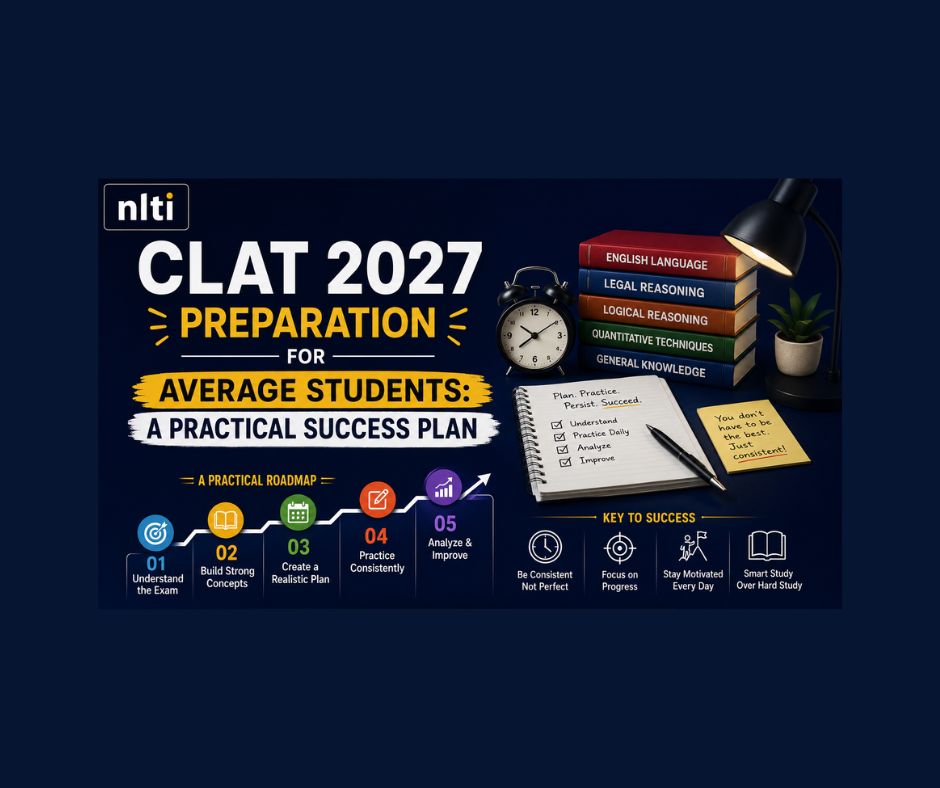
Let’s be entirely honest: the internet is flooded with profiles of “prodigies” who allegedly cracked the Common Law Admission Test (CLAT) by studying for just two weeks, or top scorers who have been reading legal journals since the 8th grade.
If you consider yourself an average student someone who gets decent but not extraordinary marks, struggles to stay focused for six hours straight, or finds dense prose intimidating those stories can feel incredibly disheartening.
But here is the real secret: CLAT is not an IQ test. It is an aptitude and endurance test. Because the exam structure evaluates reading speed, comprehension, and consistent decision-making rather than rote memorization, it is one of the most egalitarian competitive exams out there. An "average" student with a highly disciplined, systematic approach can easily outperform a brilliant but disorganized counterpart.
Best CLAT Coaching Online 2027–2028 by NLTI
If you are aiming for top National Law Universities (NLUs), this realistic, step-by-step CLAT 2027 preparation guide is built specifically for your success.
Debunking the Myth: Can an Average Student Crack CLAT?
The short answer is an absolute yes.
To understand why, you have to look at how the exam is designed. Ever since the Consortium of NLUs trimmed the paper down to 120 questions to be solved in 120 minutes, the test shifted entirely away from who can memorize the most facts. Instead, it tests how well you can process information under pressure.
An average student often struggles with traditional exams because they require massive amounts of data memorization. CLAT requires skill. Skills like reading faster, identifying the central theme of a text, and basic data interpretation can be systematically trained over a 12 to 18-month timeline.
CLAT for Beginners: Understanding Your Starting Point
If you are looking at CLAT for beginners resources, the sheer volume of passage-based questions can look overwhelming. Your first step should not be buying ten different books. It should be understanding the five distinct pillars of the exam:
As an average student, do not look at this list as a mountain. Look at it as a set of individual games, each with its own set of rules that you can master one by one.
CLAT 2027 Complete Guide: Exam Date, Eligibility & Syllabus
The Realistic 12-Month CLAT Study Plan
Trying to study eight hours a day from month one is a fast track to burnout. A practical CLAT study plan for an average student relies on progressive consistency. It is split into three deliberate phases.
Phase 1: The Foundation Builder (Months 1–4)
Your entire focus in this phase is developing a reading habit and understanding basic concepts.
The Daily Ritual: Read The Hindu or The Indian Express editorials daily. Do not just skim; try to summarize what the author is saying in two sentences.
Concept Clearing: Master the foundational elements of law (Law of Torts, Contracts, Criminal Law, and Constitutional basics). Remember, you do not need to memorize sections or articles, just learn how legal principles operate.
Basic Math: Spend 30 minutes a day brushing up on ratios, percentages, and averages.
Phase 2: The Sectional Specialist (Months 5–8)
Now that you can read without getting a headache after twenty minutes, it is time to build speed and precision.
Topic Tests: Start taking untimed, section-specific quizzes. Focus entirely on accuracy. If you get a question wrong, spend ten minutes figuring out why your logic diverged from the answer key.
Current Affairs Consolidation: Supplement your newspaper reading with trusted monthly GK compendiums to ensure no critical events slip through the cracks.
Phase 3: The Mock Season (Months 9–12)
This is where average students turn into NLU candidates.
Take two full-length mocks per week.
Simulate the exact exam environment: sit at a desk, turn off your phone, use an OMR sheet, and stick strictly to the 2-hour limit.
CLAT 2027 Preparation Tips: Subject-Wise Strategy for 90+ Marks
The Ultimate CLAT Success Strategy for Consistent Scoring
To maximize your score without getting overwhelmed, you need an intelligent CLAT success strategy that leverages your strengths and protects your weaknesses.
Prioritize High-Yield Sections First: Legal Reasoning and Current Affairs make up half the entire paper. Spend your highest-energy hours here. If your GK is sharp, you can finish that entire 30-question block in 10-12 minutes, saving massive amounts of time for tougher sections.
Meticulously Review Every Single Mock: Do not just look at your final score and feel bad. Create a spreadsheet. Track every mistake: Was it a silly misread? Did you run out of time? Or did you genuinely not understand the concept? Fixing your mistakes is more valuable than solving a new mock.
Master the Art of Elimination: With a negative marking penalty of 0.25 for every incorrect choice, random guessing will destroy your rank. Instead, train yourself to find why three options are wrong, rather than just hunting for the one that "feels" right.
Never Skip Quantitative Techniques: Most law aspirants hate math and skip this 10% portion entirely. This is a massive mistake. Because it is basic Class 10 math, with just a bit of practice, you can easily secure 8-10 certain marks here giving you a massive edge over thousands of other candidates.
Overcoming Mental Hurdles and Staying Consistent
The hardest part of this journey isn't the difficulty of the material; it’s the psychological battle. You will face weeks where your mock scores plateau or even drop. It is easy to conclude, "Maybe I'm just not smart enough for this."
When that happens, remind yourself that mock scores fluctuate because different papers test different areas. A drop in scores isn't a failure; it’s just a diagnostic report telling you exactly where your blind spots are. Protect your sleep, take one day off every week to decompress, and focus entirely on your daily routine rather than the distant end result.
CLAT 2027 Complete Guide: Exam Date, Eligibility & Syllabus
Final Words of Advice
Cracking CLAT 2027 doesn't require a photographic memory or an elite academic background. It requires a willingness to sit with boring, dense paragraphs day after day until they stop looking intimidating.
By starting early, sticking to a structured study plan, and prioritizing deep mock analysis over mindless cramming, you can build the exact skill set needed to clear the cutoffs. Stop worrying about being an average student start executing a practical plan, and let the results speak for themselves.
Here are 10 SEO-friendly FAQs with answers based on your blog. They naturally target keywords such as CLAT 2027 preparation, CLAT for beginners, CLAT study plan, and CLAT success strategy.
Frequently Asked Questions (FAQs)
1. Can an average student crack CLAT 2027?
Yes. CLAT is an aptitude-based exam that rewards consistent preparation, strong reading habits, logical thinking, and effective time management. With a structured study plan and regular practice, an average student can secure admission to a top National Law University.
2. How should a beginner start preparing for CLAT 2027?
Beginners should first understand the exam pattern and focus on building reading comprehension, legal reasoning, logical reasoning, current affairs, and basic mathematics. Starting with newspaper reading and concept-building creates a strong foundation.
3. What is the best 12-month study plan for CLAT 2027?
A practical 12-month plan includes three phases: building fundamentals during the first four months, improving sectional accuracy over the next four months, and focusing on full-length mock tests and performance analysis in the final four months.
4. How many hours should an average student study for CLAT every day?
Most average students can prepare effectively by studying 3 to 5 focused hours daily. Quality study sessions with consistent revision and mock analysis are more beneficial than spending long hours without concentration.
5. Which section should I prioritize during CLAT 2027 preparation?
Legal Reasoning and Current Affairs deserve special attention because together they account for nearly half of the total questions. However, every section should receive regular practice to maximize your overall score.
6. Are mock tests necessary for CLAT 2027 preparation?
Yes. Mock tests help improve time management, identify weak areas, and build exam temperament. Equally important is analyzing every mock to understand mistakes and improve future performance.
7. Do I need prior legal knowledge to crack CLAT?
No. CLAT does not require prior legal education. The Legal Reasoning section tests your ability to understand legal principles provided in passages and apply them logically to different situations.
8. Can I skip the Quantitative Techniques section if I am weak in math?
No. Quantitative Techniques carry valuable marks that can significantly improve your rank. Since the syllabus is based on Class 10 mathematics, regular practice can help even average students score well.
9. How can I stay motivated during CLAT 2027 preparation?
Focus on following your daily study routine instead of worrying about mock scores. Take regular breaks, maintain a healthy lifestyle, track your progress, and remember that consistent improvement matters more than temporary setbacks.
10. What is the best success strategy for average students preparing for CLAT 2027?
The best strategy is to build strong reading habits, practice every section consistently, stay updated with current affairs, solve regular mock tests, analyze mistakes carefully, and remain disciplined throughout your preparation journey.
Get In Touch
Have questions? We'd love to hear from you. Send us a message and we'll respond as soon as possible.