CLAT 2027 Admission Process: Step-by-Step Guide
Share this article:

Securing a seat at a premier National Law University (NLU) is a dream for thousands of law aspirants across India. The gateway to this dream is the Common Law Admission Test (CLAT), a highly competitive examination that evaluates your reading comprehension, critical thinking, and analytical abilities.
Navigating the admission cycle can feel overwhelming with its strict deadlines, multi-step registration process, and intricate counseling rounds. This guide breaks down the complete CLAT 2027 admission process into simple, actionable steps to help you stay ahead of the curve.
Best CLAT Coaching Online 2027–2028 by NLTI
Quick Overview of the Admission Journey
The CLAT 2027 admission process is a structured sequence that transitions you from an aspirant to a law student. Here is a brief look at the milestones you will cross:
Eligibility Check: Confirming you meet the minimum academic standards.
Online Application: Registering on the Consortium website and uploading documents.
NLU Preference List: Strategically ranking the universities before the exam.
Admit Card Download: Obtaining your hall ticket for the offline exam.
The Entrance Exam: Attempting the paper in December.
Results and Merit List: Checking your score and overall rank.
Centralized Counseling: Engaging in the seat allocation rounds (Freeze, Float, or Exit).
CLAT 2027 Complete Guide: Exam Date, Eligibility & Syllabus
Step 1: Meet the CLAT 2027 Eligibility Requirements
Before you fill out any application forms, you must ensure that you satisfy the official eligibility rules laid down by the Consortium of NLUs. The criteria are built to be inclusive, allowing students from all academic streams to apply.
Minimum Educational Qualifications
You must have passed your Class 12 (10+2) or an equivalent examination from a recognized national or state board.
Minimum Percentage Aggregate
General, OBC, NRI, EWS, and OCI candidates must score at least 45% marks in their Class 12 exams. Candidates belonging to SC and ST categories require a minimum of 40% marks.
Appearing Candidates
If you are currently studying in Class 12 and will sit for your board exams in March or April 2027, you are fully eligible to apply. Your admission will be conditional upon meeting the percentage criteria during final verification.
No Upper Age Limit
The Consortium does not impose any upper age restriction for the undergraduate law program. Anyone with a passion for law can take the exam.
Step 2: Complete the Online Registration and Form Submission
The official portal opens up the registration window several months before the actual test date. This is where your physical journey officially begins, and absolute accuracy is required when submitting data.
First, you will visit the official website of the Consortium of NLUs to create an applicant account using your active mobile number and email address. Once verified via an OTP, you gain access to the detailed application dashboard. Here, you will enter your personal background,
permanent address, and academic scores precisely as they appear on your school certificates.
We know how stressful this administrative part can be. At the National Law Training Institute (NLTI), we walk our students through the form-filling phase with specialized live sessions. We help you navigate tricky fields like selecting reservation quotas, managing domicile certificates, and ensuring your passport-sized photographs and signatures meet the exact digital sizing rules.
CLAT 2027 Preparation Tips: Subject-Wise Strategy for 90+ Marks
Step 3: Devise Your Strategic NLU Preference List
One of the most critical aspects of the application form is the NLU Preference List. You are required to rank the participating National Law Universities from highest to lowest priority. This list is permanent and determines which college you get into based on your final merit rank.
Many students make the mistake of copying a generic list they find online. This can backfire drastically. Your preference list should account for factors like geographical location, specialized law streams, placement records, and campus culture.
We work closely with you at NLTI to evaluate your target goals, analyze past cut-off trends, and help you draft a personalized preference list that maximizes your selection odds without risking a good seat.
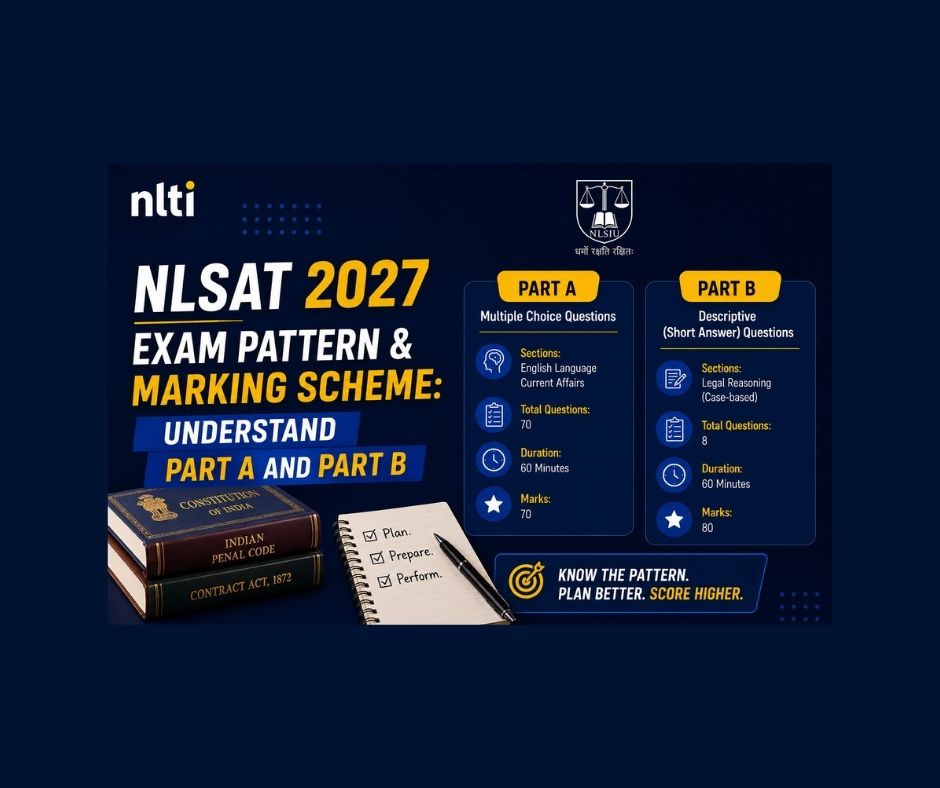
Step 4: Understand the Core Exam Pattern
CLAT is not a regular memorization test; it is an extensive, fast-paced assessment of your comprehension and logical faculties. The paper is traditionally held in an offline, pen-and-paper format utilizing OMR sheets.
Because time management is the real hurdle in this exam pattern, we provide our students with realistic mock exams that simulate the physical testing environment. Through the NLTI test series, we teach you how to read passages quickly, skip trap questions, and preserve accuracy under intense time pressure.
CLAT 2027 Complete Guide: Exam Date, Eligibility & Syllabus
Step 5: The Post-Exam Phase and the Counseling Portal
Once the exam concludes, the Consortium quickly publishes the provisional answer key. Candidates are given a brief window to raise online objections against any ambiguous questions. After checking valid claims, the final answer key and official merit list are published.
Shortly after the results, the Centralized Admission Process (CAP) begins.
The Consortium invites candidates who have met the baseline rank criteria to register for online counseling. To participate, you must pay a counseling registration fee, which is later adjusted against your university tuition. During these seat allotment rounds, you will be presented with three crucial tactical pathways:
Freeze: You accept the allotted seat, lock your choice, and drop out of subsequent allocation rounds to secure that specific university.
Float: You accept the currently allotted seat but wish to keep your options open for a higher-ranked university on your preference list if a vacancy opens up in the next round.
Exit: You choose to decline the allocated seat and completely withdraw from the remaining steps of the counseling process.
CLAT 2027 Quantitative Techniques Guide
How We Help You Win at NLTI
The path to an NLU requires more than just studying hard; it requires a highly organized roadmap. At the National Law Training Institute, we specialize in demystifying the entire curriculum. We offer customized prep materials, rigorous daily practice drills, and direct one-on-one mentorship from NLU alumni who have walked this exact path successfully.
We do not just teach you the law concepts; we continuously track your performance metrics, refine your test-taking style, and manage your administrative worries so that you can step into the examination hall with absolute clarity and conviction.
Frequently Asked Questions
1. Can I change my NLU preference list after the results are announced?
No, the preference list submitted during the initial application phase is treated as final and binding. The counseling software uses that exact sequence to allocate seats automatically based on merit rank, which is why we emphasize planning your list carefully during the application stage.
2. What happens if I choose the Float option but don't get a higher college?
If you choose the Float option and do not secure an upgrade in subsequent counseling rounds, your current seat remains safe and guaranteed. You will not lose your allocated place unless you manually select the Exit option or fail to pay the required institutional fees within the deadline.
3. Can I apply for CLAT 2027 if I am appearing for my Class 12 board exams?
Yes. Students appearing for their Class 12 board examinations are eligible to apply for CLAT 2027. However, they must meet the required qualifying marks at the time of admission.
4. How important is the NLU preference list during CLAT counseling?
The NLU preference list plays a crucial role in seat allocation. Your admission is based on your CLAT rank and the order of universities you select during the application process, so it should be filled carefully.
5. What is the CLAT 2027 exam pattern?
CLAT 2027 consists of 120 multiple-choice questions to be completed in 120 minutes. Each correct answer carries one mark, while every incorrect answer attracts a negative marking of 0.25 marks.
6. What happens after the CLAT 2027 results are announced?
After the results are declared, shortlisted candidates must participate in the centralized counseling process, where seats are allotted based on their rank, category, and NLU preferences.
7. What is the difference between Freeze, Float, and Exit in CLAT counseling?
Freeze means accepting the allotted seat and ending further participation in counseling. Float allows you to keep your current seat while waiting for a better preference in future rounds. Exit means withdrawing completely from the counseling process.
8. How can I improve my chances of getting admission to a top NLU through CLAT 2027?
Prepare consistently, perform well in mock tests, maintain high accuracy, create a strategic NLU preference list, complete all admission formalities on time, and actively participate in every counseling round to maximize your admission opportunities.
Get In Touch
Have questions? We'd love to hear from you. Send us a message and we'll respond as soon as possible.