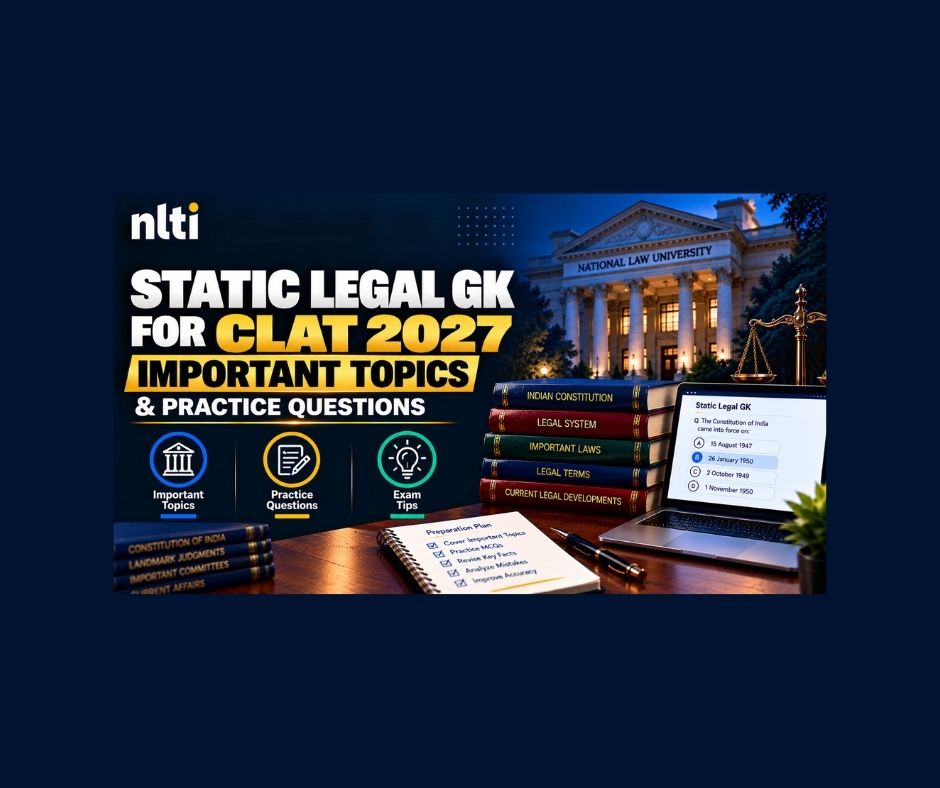
Static Legal GK for CLAT 2027: Key Topics & Practice
Share this article:
Preparing for CLAT 2027 and wondering whether you need to study static legal GK?
The short answer is: yes, but selectively.
Static legal knowledge is not a separate section in CLAT. Instead, basic knowledge of the Constitution, judiciary, legal principles and terminology can help you understand questions in Current Affairs including General Knowledge and Legal Reasoning.
The aim is not to memorise hundreds of legal facts. It is to understand the concepts that can help you read a legal or constitutional passage faster and apply information more accurately.
With CLAT 2027 scheduled for December 6, 2026, your preparation should now focus on high-value topics, regular revision and question practice. (Consortium of NLUs)
Best CLAT Coaching Online 2027–2028 by NLTI
Is Static Legal GK Important for CLAT 2027?
CLAT does not have a separate "Static Legal GK" section.
The UG paper includes Current Affairs including General Knowledge and Legal Reasoning. The Consortium's current CLAT 2027 information also does not prescribe a separate time limit for the Current Affairs including General Knowledge section. (Consortium of NLUs)
So why study static legal knowledge?
Because current events and legal passages often involve concepts from:
The Indian Constitution
Fundamental Rights
Judiciary
Legal principles
Important laws
Constitutional amendments
Legal terminology
For example, if a current-affairs passage discusses a Supreme Court judgment involving freedom of speech, knowing the basic constitutional framework can make the passage easier to understand.
Think of static legal GK as your foundation, not another section to memorise.
What Topics Should You Study for Static Legal GK?
You do not need to study the entire law syllabus before CLAT. Prioritise these areas:
1. Indian Constitution
Know the basics of:
Preamble
Fundamental Rights
Directive Principles of State Policy
Fundamental Duties
Constitutional amendments
Emergency provisions
Centre-State relations
Constitutional bodies
Focus on understanding the purpose and significance of these provisions rather than memorising every Article.
2. Indian Judiciary
Revise:
Supreme Court and High Courts
Judicial review
Judicial activism
Public Interest Litigation
Writs
Original and appellate jurisdiction
Judicial precedent
Basic structure doctrine
3. Legal Principles and Doctrines
Some principles that are useful to understand include:
Rule of Law
Separation of Powers
Basic Structure Doctrine
Doctrine of Precedent
Judicial Review
Pith and Substance
Colourable Legislation
Repugnancy
You should know what these principles mean and where they are generally applied.
CLAT 2027 Question Selection Strategy: Attempt or Skip
4. Legal Maxims
Some common legal maxims include:
Do not just memorise the Latin phrases. Understand the principle behind them.
5. Important Laws
You should have a basic understanding of what major laws deal with. For example:
Right to Information Act
Consumer Protection Act
Protection of Children from Sexual Offences Act
Environment Protection Act
Information Technology Act
Right to Education Act
Representation of the People Act
Protection of Women from Domestic Violence Act
For CLAT, knowing the purpose and broad scope of a law is generally more useful than memorising sections.
Static Legal GK Questions for CLAT 2027
The following questions are designed to test whether you can apply basic legal knowledge, rather than simply recall isolated facts.
Question 1
A government authority takes an adverse decision against a person without giving them a reasonable opportunity to present their case. Which principle of natural justice is most directly involved?
A. Stare decisis
B. Audi alteram partem
C. Res judicata
D. Nemo judex in causa sua
Answer: B. Audi alteram partem
Explanation: The principle means "hear the other side." It requires that a person generally be given an opportunity to be heard before an adverse decision is taken.
Question 2
A judge is assigned a case involving a company in which the judge has a personal financial interest. Which principle is most relevant?
A. Audi alteram partem
B. Rule of law
C. Nemo judex in causa sua
D. Judicial review
Answer: C. Nemo judex in causa sua
Explanation: This principle means that no person should be a judge in their own case. It is intended to prevent bias in decision-making.
Question 3
Parliament passes a law. A person challenges the law on the ground that it violates a Fundamental Right. Which power allows the court to examine the constitutional validity of the law?
A. Judicial review
B. Judicial restraint
C. Parliamentary privilege
D. Judicial appointment
Answer: A. Judicial review
Explanation: Judicial review allows courts to examine whether legislative and executive actions are consistent with the Constitution.
Question 4
A person is unlawfully detained and approaches the court seeking an order requiring that the detained person be brought before the court. Which writ is relevant?
A. Mandamus
B. Habeas Corpus
C. Certiorari
D. Quo Warranto
Answer: B. Habeas Corpus
Explanation: Habeas Corpus is used to challenge unlawful detention and requires the detained person to be produced before the court.
Question 5
A later court is required to follow an applicable legal principle established by a higher court. Which concept is involved?
A. Judicial precedent
B. Judicial activism
C. Natural justice
D. Separation of powers
Answer: A. Judicial precedent
Explanation: Judicial precedent refers to the principle that courts follow applicable decisions of higher courts. The doctrine of stare decisis is closely associated with this principle.
Question 6
A constitutional amendment attempts to completely remove a fundamental feature of the Constitution. Which doctrine is most relevant?
A. Doctrine of Severability
B. Basic Structure Doctrine
C. Doctrine of Eclipse
D. Doctrine of Waiver
Answer: B. Basic Structure Doctrine
Explanation: The Basic Structure Doctrine places limits on Parliament's power to amend the Constitution by protecting its basic features.
Question 7
Article 14 is being discussed in a passage about discriminatory treatment by the State. Which constitutional principle should you connect it with?
A. Freedom of religion
B. Equality before law and equal protection of laws
C. Protection against arrest
D. Freedom of trade
Answer: B. Equality before law and equal protection of laws
Explanation: Article 14 deals with equality before the law and equal protection of the laws.
Question 8
A passage discusses the freedom of citizens to express their opinions but also mentions restrictions imposed by law in certain circumstances. Which constitutional provision is most relevant?
A. Article 14
B. Article 19
C. Article 21
D. Article 32
Answer: B. Article 19
Explanation: Article 19 protects several freedoms of citizens, including freedom of speech and expression, subject to constitutionally permitted restrictions.
CLAT 2027: Questions to Attempt for 80, 90 & 100+ Marks
Question 9
A student argues that the Constitution requires the State to work towards equal pay for equal work. Which category does this principle fall under?
A. Fundamental Right
B. Directive Principle of State Policy
C. Fundamental Duty
D. Constitutional remedy
Answer: B. Directive Principle of State Policy
Explanation: Equal pay for equal work is reflected in Article 39(d), which forms part of the Directive Principles of State Policy.
Question 10
A legal question uses the expression ignorantia juris non excusat. Which meaning should you select?
A. The law helps those who are vigilant
B. Ignorance of law is no excuse
C. The thing speaks for itself
D. No one should judge their own case
Answer: B. Ignorance of law is no excuse
Question 11
A legal passage states that the existence of a right normally implies the availability of a legal remedy when that right is violated. Which maxim best represents this idea?
A. Ubi jus ibi remedium
B. Res ipsa loquitur
C. Audi alteram partem
D. Stare decisis
Answer: A. Ubi jus ibi remedium
Explanation: The maxim broadly means "where there is a right, there is a remedy."
Question 12
A court is asked to examine whether a particular executive action violates the Constitution. Which concept is most directly relevant?
A. Judicial review
B. Parliamentary privilege
C. Delegated legislation
D. Judicial appointment
Answer: A. Judicial review
Question 13
A passage discusses a situation where the government treats two similarly placed groups differently without sufficient justification. Which constitutional concept should a CLAT aspirant examine first?
A. Equality
B. Freedom of religion
C. Right to education
D. Preventive detention
Answer: A. Equality
Explanation: The issue may raise questions under the constitutional guarantee of equality, particularly Article 14.
Question 14
A court refuses to follow an earlier decision because that earlier legal principle has been declared incorrect by a competent higher court. Which concept is most closely associated with changing the legal position established by an earlier decision?
A. Overruling
B. Habeas Corpus
C. Mandamus
D. Estoppel
Answer: A. Overruling
Explanation: Overruling occurs when a court establishes that an earlier legal decision or principle should no longer be treated as good law.
Question 15
A CLAT passage discusses the division of governmental authority among the legislature, executive and judiciary. Which constitutional principle is being discussed?
A. Separation of Powers
B. Judicial Precedent
C. Natural Justice
D. Rule against Bias
Answer: A. Separation of Powers
Explanation: Separation of powers refers broadly to the distribution of governmental functions among different organs of the State.
CLAT 2027: How to Crack CLAT in 80 Days
How to Prepare Static Legal GK for CLAT 2027
Static legal GK should support your CLAT preparation, not consume the time you need for mocks, Legal Reasoning and Current Affairs. Use this approach:
1. Build Your Legal Foundation
Start with the Constitution, judiciary, important legal principles, maxims and major laws.
2. Connect Static GK With Current Affairs
This is where static knowledge becomes more useful. For example:
Current event: A Supreme Court judgment involving freedom of speech
↓
Static concept: Article 19
↓
Related concept: Reasonable restrictions
↓
Practice: Solve questions based on the judgment and constitutional principle
This approach helps you remember concepts instead of learning disconnected facts.
3. Practise Application-Based Questions
After studying a concept, ask yourself: "Can I identify this principle if it appears inside a passage?" That is more relevant to CLAT than simply recalling a definition.
4. Maintain a Short Revision List
Create one document containing:
Important Articles
Legal maxims
Key doctrines
Major constitutional concepts
Important laws
Frequently confused terms
Revise this list regularly rather than starting from scratch every time.
Static Legal GK vs Current Affairs: What Should You Study?
Don't treat them as interchangeable.
Static Legal GK covers relatively stable concepts such as constitutional provisions, legal principles, terminology and judicial structure.
Current Affairs covers recent judgments, legislation, appointments, international developments, government policies and other significant events.
However, the two can overlap. A current Supreme Court judgment may require you to understand a constitutional provision. Similarly, a new law may make more sense when you already understand the legal concept behind it. That is why static knowledge should be used to understand current affairs, not studied in isolation.
Common Mistakes in Static Legal GK Preparation
Studying everything: You do not need to become a law student before entering law school. Prioritise concepts relevant to CLAT.
Memorising without understanding: Knowing that Audi alteram partem means "hear the other side" is useful. Understanding when the principle applies is more useful.
Ignoring changes in law: Some legal information becomes outdated after amendments or new legislation. Always verify older material before treating it as current.
Treating static GK as a separate CLAT section: It isn't. Use it to strengthen your understanding of the actual sections tested in the exam.
Spending too much time on obscure facts: Your preparation time is limited. Focus first on concepts that repeatedly connect with constitutional, legal and current-affairs questions.
CLAT 2028 Exam Pattern: 3 Sections & Preparation Guide
Final Takeaway
Static legal GK for CLAT 2027 is not about memorising hundreds of legal facts. It is about building a basic legal foundation that helps you understand passages, recognise principles and connect current events with the law.
Learn the concept → Connect it with current affairs → Apply it to questions → Analyse mistakes → Revise
With CLAT 2027 scheduled for December 6, 2026, focus on high-value concepts and regular revision rather than trying to cover everything. (Consortium of NLUs)
Prepare for CLAT 2027 with NLTI
NLTI's CLAT preparation combines structured preparation, practice and mentorship to help aspirants work on their individual strengths and weak areas.
[Explore NLTI's CLAT 2027 preparation programmes →]
Frequently Asked Questions
1. Is static legal GK a separate section in CLAT?
No. CLAT does not have a separate static legal GK section. Static legal knowledge can support preparation for Current Affairs including General Knowledge and Legal Reasoning.
2. What should I study for static legal GK in CLAT 2027?
Focus on the Constitution, Fundamental Rights, DPSPs, judiciary, legal principles, important doctrines, legal maxims, major laws and basic legal terminology.
3. Are legal maxims important for CLAT?
They can be useful when a legal principle or terminology appears in a question or passage. Focus on understanding their meaning and application rather than memorising very long lists.
4. Should I study static legal GK separately from current affairs?
Not completely. Build the basic concepts, but connect them with current affairs wherever possible. This makes your preparation more relevant to CLAT.
5. How can I revise static legal GK before CLAT 2027?
Maintain short notes covering important constitutional provisions, legal principles, maxims, doctrines and laws. Revise them through questions and revisit concepts you frequently get wrong.
Get In Touch
Have questions? We'd love to hear from you. Send us a message and we'll respond as soon as possible.