CLAT 2028 Current Affairs & GK Preparation Guide
Share this article:
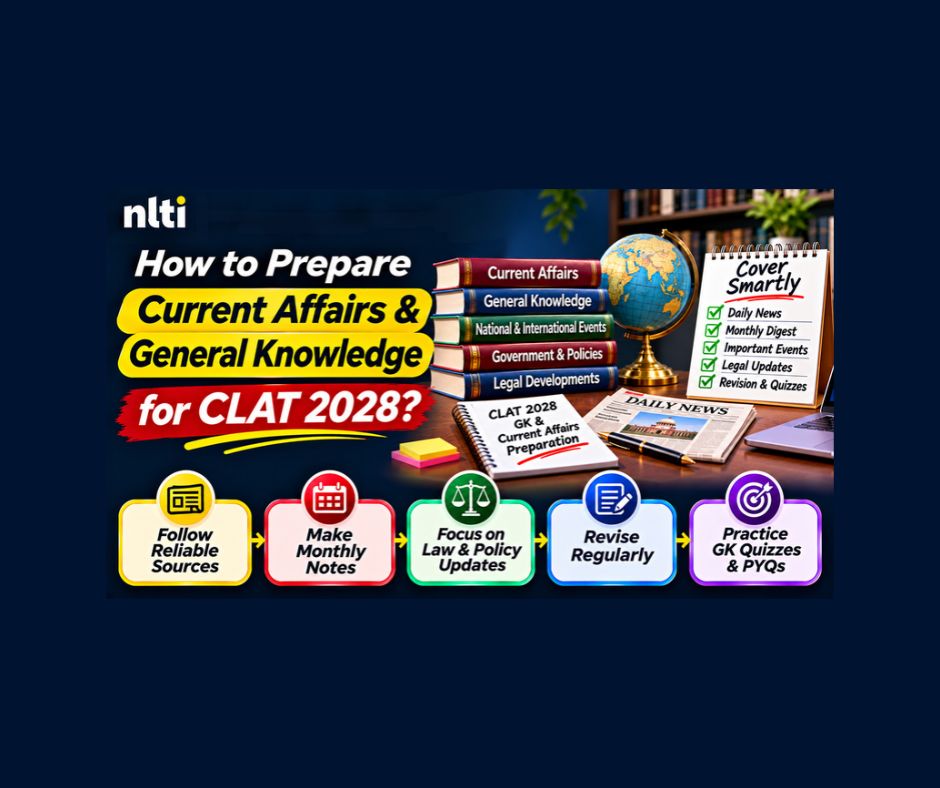
Few topics divide CLAT aspirants like current affairs. Some students spend hours memorising lists. Others skip the section because they have heard it may be removed. Both approaches carry risk.
This guide explains a smarter CLAT 2028 current affairs preparation plan: how much to study, what to read, how to make notes and how to protect yourself whichever pattern is announced.
Best CLAT Coaching Online 2027–2028 by NLTI
Will Current Affairs Stay in CLAT 2028?
Start with what is confirmed. The Consortium kept the CLAT 2027 pattern unchanged and said it would engage with the Expert Committee's recommendations and public feedback in preparation for CLAT 2028.
The committee proposed removing Current Affairs and GK as a separate section but that is a recommendation and a separate committee must review it.
So the sensible position for CLAT 2028 current affairs preparation is neither panic nor cramming.
Treat it as insurance: spend enough to protect a possible 25% of the paper and make the effort double as reading practice.
How Much CLAT 2028 Current Affairs Preparation Is Enough?
Preparation guides commonly advise covering roughly the last 12 months before the exam. For the expected 5 December 2027 exam, that window runs from about December 2026 to November 2027, which means anything you read from now onward counts. You are not late. You are on time.
Here is a suggested time budget for your CLAT 2028 current affairs preparation. It is our suggestion, not an official figure
What the Section Tests in CLAT 2028 Current Affairs Preparation
The Consortium's CLAT 2027 guide describes passages drawn from news and other journalistic writing. Topics include contemporary events of significance from India and the world, arts and culture, international affairs and historical events of continuing significance.
In the CLAT 2026 paper, reports described around 28 questions in this section and called it easy to moderate, though accounts differ on how passage-dependent the questions were. The takeaway for your CLAT 2028 current affairs preparation is to understand events, not collect trivia.
Group your reading into five buckets for CLAT 2028 current affairs preparation:
Legal and constitutional developments: court rulings, new laws and bills.
Government and policy: schemes, appointments and decisions.
International affairs: treaties, organisations and conflicts.
Economy and environment: major reports and agreements.
Arts, culture, sports and awards: notable events and people.
CLAT English Preparation 2027: Tips to Score Higher
A Minimal Source List for CLAT 2028 Current Affairs Preparation
Too many sources create anxiety, not knowledge. Keep your CLAT 2028 current affairs preparation to three:
One newspaper: read the main news and the editorial page daily.
One monthly compilation: use it to catch what you missed.
One legal news source: to track court and law developments.
Avoid collecting PDFs from five channels. The best CLAT 2028 current affairs preparation setup is one you can finish every week. Our current affairs strategy can help you stay on track.
Legal News: The Highest-Return Bucket in CLAT 2028 Current Affairs Preparation
If you must prioritise, start with legal news. It feeds three sections at once: Current Affairs, Legal Reasoning and often Logical Reasoning. Follow Supreme Court and High Court rulings, new legislation, constitutional questions and policy debates.
For each, ask what the court or government decided, on what reasoning and what remains open. This habit makes your CLAT 2028 current affairs preparation useful for Legal Reasoning too.
The Four-Line Note Method for CLAT 2028 Current Affairs Preparation
Notes should be short enough to revise. For every important story, write four lines:
What happened: one sentence.
Status: decided, referred, or pending.
Why it matters: the principle or policy behind it.
CLAT angle: how a passage could use it.
Take a court example. When the Supreme Court refers a question to a larger bench, as it did on the two-child norm issue in November 2026, the status line reads referred, not decided.
That one word saves you from a wrong option. The status line is the most valuable part of CLAT 2028 current affairs preparation because passages often test whether you know what actually happened.
A Sample Day of CLAT 2028 Current Affairs Preparation
A realistic day is shorter than most students expect. Read the front page and one editorial in the morning, about 30 minutes. Pick two stories that matter and write the four-line note on each.
In the evening, spend five minutes re-reading yesterday's notes. That is under 45 minutes and over a year it builds a solid base. Consistency beats intensity in every successful CLAT 2028 current affairs preparation plan.
A Weekly and Monthly Routine for CLAT 2028 Current Affairs Preparation
This rhythm keeps your CLAT 2028 current affairs preparation steady, so you never face a last-month mountain of unread news.
CLAT 2027: 30-Day Strategy Based on Mock Scores
Revising the Last 12 Months
Revision is where CLAT 2028 current affairs preparation turns into marks. Use a layered approach:
Because the status line is on every note, you can skim quickly and still recall what was decided, referred or left pending.
What About Static GK?
Static GK is background, not a separate subject to master. Since the 2020 revamp, the section has leaned on news and static facts mostly appear as context.
Learn static material only when a news story needs it: the capital of a country in a treaty story, or the history behind an anniversary. Do not buy a thick book of capitals and rivers. This keeps CLAT 2028 current affairs preparation lean and focused.
How to Test Your CLAT 2028 Current Affairs Preparation
Reading is not recalled. Test your CLAT 2028 current affairs preparation in three ways:
Close your notes and explain a story aloud in one minute.
Solve current affairs passages from previous papers and mocks.
Review wrong answers: was it a missed fact, a missed status or a misread passage?
Passage practice also feeds your English and Legal Reasoning scores, so CLAT 2028 current affairs preparation pays off even if the pattern changes.
Make Your Reading Count Twice
The smartest feature of CLAT 2028 current affairs preparation is that it overlaps with everything else. Editorials train English comprehension, court stories train legal reasoning and economic reports train data reading for quant.
Treat the newspaper as a free, daily mock section. If the pattern changes, this reading will still pay off in Language and Comprehension and in the reasoning section.
CLAT Exam Centers 2027: State & City-Wise List
Five Mistakes in CLAT 2028 Current Affairs Preparation
Dropping CLAT 2028 current affairs preparation because of the proposal.
Memorising dates and names without understanding the event, which wastes CLAT 2028 current affairs preparation time.
Following too many sources for CLAT 2028 current affairs preparation.
Noting everything instead of the few stories that matter.
Leaving revision to the last two months of your CLAT 2028 current affairs preparation.
Build Your Plan With NLTI
At NLTI, we help students turn CLAT 2028 current affairs preparation into a weekly habit, with monthly current affairs modules, passage practice and mentors who review your notes. Our CLAT 2028 exam pattern guide tracks every update on the proposed changes. Explore NLTI's CLAT coaching and start your plan today.
FAQs
1. Is current affairs removed from CLAT 2028?
Not officially. The committee proposed it but the final decision rests with the Consortium. Continue your CLAT 2028 current affairs preparation until it announces the pattern.
2. How many months of news should my CLAT 2028 current affairs preparation cover?
About the last 12 months before the exam is a common benchmark, with extra attention to the final six.
3. How many hours daily should CLAT 2028 current affairs preparation take?
Around 30 to 40 minutes for reading and notes is enough in the early months.
4. Do I need a separate GK book for CLAT 2028 current affairs preparation?
No. One newspaper and one monthly compilation cover most needs, with static facts learned only when a story requires them.
5. Can I start CLAT 2028 current affairs preparation in Class 11?
Yes. Starting now builds the reading habit and puts your notes inside the 12-month window.
6. Is legal news enough for CLAT 2028 current affairs preparation?
No, but it is the best starting point. Add national, international and economic news so you can handle any passage.
Read Next on NLTI
Get In Touch
Have questions? We'd love to hear from you. Send us a message and we'll respond as soon as possible.