CLAT 2028 Syllabus: Subject-Wise Topics & Guide
Share this article:
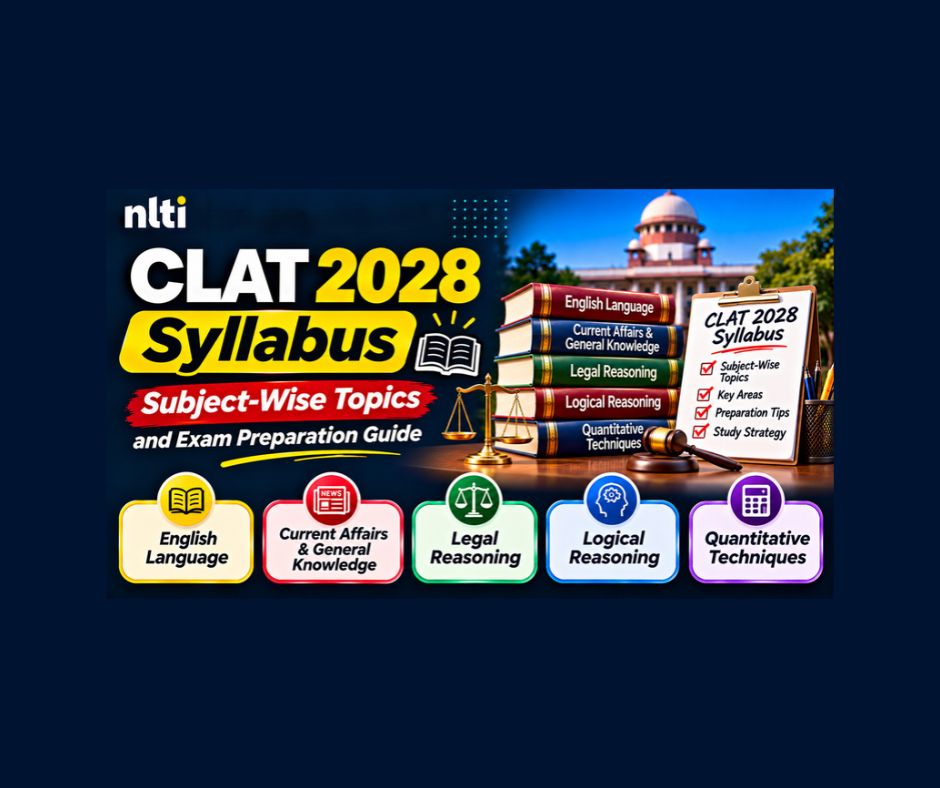
Search for the CLAT 2028 syllabus and you will find dozens of lists, many of them contradicting each other. This guide separates what is official from what is only expected, then walks through every section with the topics that matter and a practical way to prepare.
By the end, you will know what the CLAT 2028 syllabus covers, what may change and how to study without wasting a month.
Best CLAT Coaching Online 2027–2028 by NLTI
CLAT 2028 Syllabus: What Is Official and What Is Expected
The Consortium of NLUs has not yet published a separate CLAT 2028 syllabus. Until it does, the best guide is the published CLAT 2027 syllabus because the Consortium kept that pattern unchanged and said the Expert Committee's recommendations would be considered for CLAT 2028.
In short, the CLAT 2028 syllabus you can study today is the five-section one, held loosely.
CLAT 2028 Syllabus at a Glance: Section-Wise Weightage
CLAT is a passage-based paper. Each passage runs to about 450 words and is followed by questions. The usual distribution is below.
Legal Reasoning and Current Affairs together carry roughly half the paper. Even so, the weightage is a guide, not a prediction and a recent paper can shift a few questions either way, so no section of the CLAT 2028 syllabus can be ignored.
English Language in the CLAT 2028 Syllabus
This section tests reading, not grammar rules. You get passages of about 450 words from fiction and non-fiction, then questions on meaning and argument.
Main idea and theme: what the author is really saying.
Inference and conclusion: what follows from the passage.
Tone and purpose: why the author wrote it.
Vocabulary in context: word meaning from the sentence.
Comparing viewpoints: where two arguments agree or clash.
How to prepare: read two editorials a day and write a two-line summary. Flag unfamiliar words but guess their meaning from context first and write down their correct meaning there when analyzing the mock.
CLAT English Preparation 2027: Tips to Score Higher
Current Affairs and GK in the CLAT 2028 Syllabus
This section also uses passages, drawn from news and other journalistic writing. The official guide mentions contemporary events of significance from India and the world, arts and culture, international affairs and historical events of continuing significance.
National developments: court rulings, laws, policies and appointments.
International affairs: treaties, organisations and conflicts.
Arts, culture and awards: notable people and events.
Background: why an event matters, not only the date.
How to prepare: follow one newspaper daily (The Hindu or The Indian Express) and keep monthly notes. This is the part of the CLAT 2028 syllabus most affected by the proposal because a separate GK section may be removed. News reading still helps, since passages across the paper draw on it.
Legal Reasoning in the CLAT 2028 Syllabus
You do not need prior legal knowledge. Passages present legal matters, public policy questions or moral philosophical enquiry and the principle is usually given in the passage itself.
Applying a rule to facts: the classic principle-and-fact question.
Understanding a principle: what it allows and what it forbids.
Public policy issues: weighing competing interests.
Basic constitutional ideas: rights, equality and the rule of law.
How to prepare: solve principle-and-fact passages daily and note why each wrong option fails. Landmark cases help as background but they do not replace practice. Our legal reasoning strategy goes deeper.
Logical Reasoning in the CLAT 2028 Syllabus
Here the passages are short arguments and the questions ask you to analyse them. This section rewards careful reading more than tricks.
Arguments, premises and conclusions: spotting each part.
Assumptions: what the argument silently needs.
Strengthening and weakening: which fact helps or hurts a claim.
Analogies and contradictions: parallel cases and inconsistencies.
How to prepare: practise verbal and argument-based reasoning first. Skip puzzle-heavy chapters that look nothing like CLAT. This section of the CLAT 2028 syllabus may merge with Legal Reasoning if the proposal is adopted.
Quantitative Techniques in the CLAT 2028 Syllabus
This is the smallest section, yet often the most scoring for students who prepare it. Questions come from short sets of facts, tables or numerical information, at about Class 10 level.
Percentages and ratios.
Averages, profit and loss, time and work.
Reading tables and graphs.
Data Interpretation
How to prepare: revise Class 10 maths, then move to data interpretation sets. The proposed pattern leans towards data interpretation, so this approach fits both versions of the CLAT 2028 syllabus.
CLAT 2027: 30-Day Strategy Based on Mock Scores
Which Topics Matter Most in the CLAT 2028 Syllabus?
Not every topic deserves equal time. Use this priority view to decide where your first month goes.
This ranking is our reading of the CLAT 2028 syllabus, not an official list, so adjust it using your own mock results.
How the CLAT 2028 Syllabus Could Change
The Expert Committee proposed three sections instead of five. This is a recommendation only and a separate committee must review it before anything becomes official.
Notice that three of the four rows need the same preparation as today. That is why the safest plan for the CLAT 2028 syllabus is to build skills first. See our CLAT 2028 exam pattern guide for updates.
A Simple Checklist for the CLAT 2028 Syllabus
Before you buy a single book, tick these off:
Open the Consortium's UG syllabus guide and read each section once.
Write the five sections on one page with their question ranges.
Mark which parts of the CLAT 2028 syllabus you already find easy.
Take one diagnostic test to find your weakest section.
Set a weekly time split and review it every month.
This one-page map keeps the CLAT 2028 syllabus from feeling endless.
CLAT Exam Centers 2027: State & City-Wise List
How to Prepare Using the CLAT 2028 Syllabus
Turn the syllabus into a plan with a simple weekly split:
Reading (about 35% of time): editorials for English, news and legal passages.
Reasoning (about 30%): legal and logical practice.
Quant (about 15%): maths basics and data sets.
Tests and review (about 20%): sectional tests, mocks and your error log.
These percentages are a starting suggestion, not an official rule. Adjust them after your first few tests. NLTI suggests 35 to 50 full-length mocks across the cycle, which is how you check your command of the CLAT 2028 syllabus under time pressure.
Five Mistakes to Avoid With the CLAT 2028 Syllabus
Hunting for a perfect CLAT 2028 syllabus PDF instead of starting.
Treating the proposed pattern as the final CLAT 2028 syllabus.
Memorising GK lists instead of understanding news.
Learning legal rules by heart, though passages supply them.
Skipping quant because it has the fewest questions.
CLAT 2027 Mock Test: Dates, Attempt & Strategy
Study the CLAT 2028 Syllabus With NLTI
A syllabus tells you what to study; NLTI shows you how and when. Our classes, mocks and mentors turn each section into a weekly routine and NLTI tracks the CLAT 2028 syllabus so you do not have to.
Read our section-wise weightage guide, then explore NLTI's CLAT coaching and start your preparation today.
FAQs
1. Is the CLAT 2028 syllabus released?
Not yet. The Consortium has not published a separate CLAT 2028 syllabus, so students follow the current five-section syllabus.
2. Will the CLAT 2028 syllabus change?
Possibly. The Expert Committee proposed three sections but the final decision rests with the Consortium.
3. Is GK removed from the CLAT 2028 syllabus?
Only as a proposal. Until the Consortium announces a decision, keep reading the news daily.
4. Do I need legal knowledge for the CLAT 2028 syllabus?
No. Legal Reasoning passages give the principles you need, though basic awareness helps.
5. Which section of the CLAT 2028 syllabus is easiest to improve?
Quantitative Techniques often improve fastest, since it is small and based on Class 10 basic maths.
6. How should beginners start on the CLAT 2028 syllabus?
Begin with daily reading and basic maths for a month, then add legal and logical practice. Take a diagnostic test before committing to any schedule.
7. Where can I find the official syllabus?
On the Consortium's website, which publishes a UG syllabus guide for each cycle. Check it again when the CLAT 2028 notification arrives.
Read Next on NLTI
Get In Touch
Have questions? We'd love to hear from you. Send us a message and we'll respond as soon as possible.